Press play to start at .
Beyond the Pocket, Against the Network
From the film
- New sites and covalent bonds bypass competition, yet networks push back.
- Reversible drugs fail in Ras's GTP pocket because GTP sits near half a millimolar and binds picomolar-tight, an overwhelming concentration-to-Kd advantage.
- Sotorasib avoids competition by filling an induced pocket beside the nucleotide site in GDP-bound K-Ras G12C and bonding covalently to mutant cysteine 12.
- Signalling networks answer any block by reloading GTP onto Ras, relieving negative feedback, or amplifying a bypass receptor such as MET.
Read the transcript of “Beyond the Pocket, Against the Network”
Film transcript: Beyond the Pocket, Against the Network
Tap a sentence to play from there.
- 0:02 In the first film, imatinib won a kinase pocket and escape guided the next drug.
- 0:09 Why did that plan fail for decades against the cancer switch K-Ras?
- 0:14 And how do networks push back even when a drug lands?
- 0:18 The barrier is binding arithmetic.
- 0:21 A ligand's share of a pocket scales with its concentration divided by its dissociation constant, the concentration that fills half the sites.
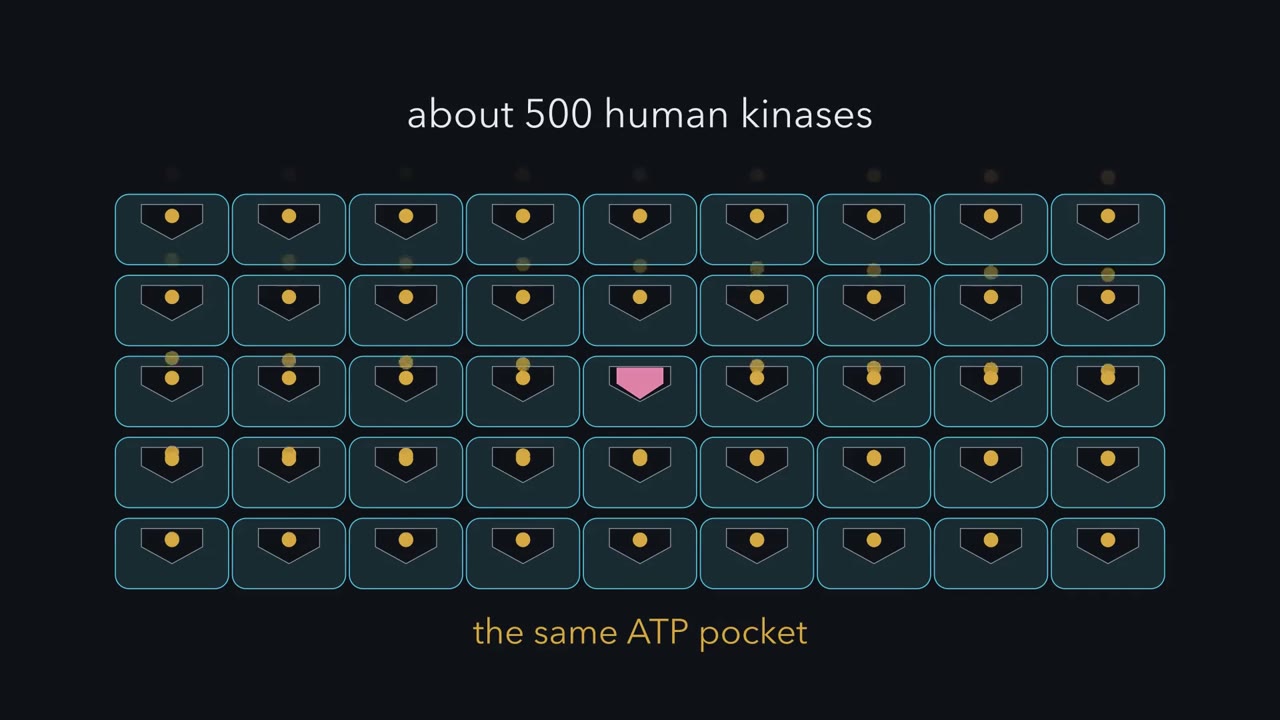
- 0:31 For a typical kinase, 1 mM ATP divided by 10 µM equals 100.
- 0:39 A drug with a 1 nM constant, reaching 1 µM, scores 1,000.
- 0:45 So the drug wins the pocket.
- 0:48 Now run that rule on K-Ras.
- 0:52 Cellular GTP sits near 0.5 mM, while Ras holds it at about 10 pM.
- 0:58 0.5 mM divided by 10 pM is 50,000,000.
- 1:04 A strong reversible drug at 5 µM, with a 1 nM constant, scores 5,000.
- 1:11 That leaves barely 1 Ras in 10,000 holding the drug.
- 1:16 Chemists stopped fighting GTP directly.
- 1:20 One cancer mutation, G12C, replaces glycine 12 with cysteine.
- 1:26 Cysteine exposes a reactive sulphur group called a thiol.
- 1:30 Even mutant K-Ras G12C still slowly cuts GTP to GDP, its off shape.
- 1:37 In that GDP shape, a hidden pocket opens beneath the switch II loop, beside the nucleotide site. Sotorasib enters and forms a permanent covalent bond to cysteine 12. Normal Ras lacks cysteine 12, so sotorasib spares it and never fights GTP.
- 1:58 Other drugs sidestep natural active pockets too.
- 2:02 Antibodies grab a receptor's outer face outside the cell.
- 2:07 Allosteric inhibitors sit in a side pocket beside an enzyme's active site.
- 2:13 They lock kinases such as MEK shut without displacing ATP.
- 2:18 Yet every drug lands inside a living network.
- 2:23 Remember: sotorasib traps K-Ras G12C only in its brief GDP state.
- 2:29 Pause and predict.
- 2:31 If upstream growth receptors wake up and reload Ras with GTP, what happens to sotorasib's grip?
- 2:44 Reloading GTP shrinks the GDP pool, so fewer Ras molecules get trapped.
- 2:51 Networks push back in other ways.
- 2:54 Block MEK, and ERK drops its braking signal, called negative feedback, so upstream steps push harder.
- 3:01 Or cells amplify another receptor, like MET, to bypass the block.
- 3:06 That completes the map of targeted drugs.
- 3:10 Side pockets, outer faces, and covalent bonds reach targets that beat reversible competition. Even then, blocking one part ripples through the whole circuit.
Cancer drug resistance: the same idea, other levels
A level is a place to start, not a rank. If this loses you, the rung below teaches the same idea, told more simply.
Graduate · the level you chose
Drugs Against a Part · this lesson
Imatinib fails when threonine 315 becomes isoleucine; the escape guides the next drug.
Cell Signaling · about 19 min · film 3:18 · 3 practice questions
Next door
- Antibiotic resistance: The Few That Survive · 3:12 · High school Survivors of a drug multiply and take over, whether the cells are bacteria in a patient or tumour cells.
- Mutation: Before the Phage Arrives · 3:37 · College: the core Resistance starts as a chance DNA change in the drug's target, which then spreads because the drug removes the others.
- Natural selection: Three Claims in One Drought · 3:20 · College: the core A tumour treated with a drug is a population where cells that survive the drug leave more descendants.
- Receptor kinases: Two Together: How Pairing Switches an RTK On · 3:35 Many cancer drugs block this receptor enzyme, and a change in its shape is a common way resistance appears.
More films from this lesson
Continue in the lesson: Drugs Against a Part →
Free, with captions and a transcript. The lesson has the full text, the questions and the sources.
How this film was made. Narration: an AI narrator voice (Kokoro, af_heart) reading narration written from this lesson's text. Animation: AI-generated in code (Manim) by Claude, a schematic with no drawn molecular structures. Captions come from the narration script. See something wrong? Report it.