The Few That Survive
Read the transcript of “The Few That Survive”
Film transcript: The Few That Survive
The first film raced microbes against the body's own defenses, but an antibiotic attacks the microbes directly. If it kills almost every bacterium, how can the infection come back? To answer that, start with what the drug needs. An antibiotic is a drug that kills bacteria or stops them growing and dividing. To work, it needs something to hit. Many antibiotics block the building of the bacterial cell wall. Others jam bacterial ribosomes, so the cell cannot make proteins. Now look at a virus. It has no cell wall and no ribosomes of its own. It works inside one of your cells and uses that cell's ribosomes. These drugs find no bacterial part there to hit.
So antibiotics do not treat colds or flu. Back to bacteria, now a large population of them in an infection. Most are sensitive, which means the drug kills or stops them. But a few may already carry a gene that lets them survive the drug. These are resistant. Antibiotic resistance is the ability of some bacteria to survive a drug that kills others of their kind.
Start the drug. Here it kills the sensitive cells. Round after round, the teal cells disappear. The orange ones survive, because they resist the drug. Now every teal cell is gone. Only the few orange cells remain, with empty space around them. When this population grows back, what will it be made of?
Resistant cells. With their competition gone, the orange cells divide and fill the space. The drug did not create them. In this example, they were there before the drug. It removed their competition. This is natural selection: individuals with a helpful trait survive and reproduce more. Here the trait is resistance, and the drug did the selecting. The bacteria did not choose to change. And the person did not become resistant. The bacteria did. There is one more route. A resistant bacterium can pass a resistance gene to another bacterium. That neighbour now survives the drug too. So resistance can spread to bacteria that never met the drug. Killing almost every bacterium is not a cure if resistant survivors grow back.
Using an antibiotic can favor any resistant bacteria present. An antibiotic spares resistant bacteria, and the survivors can take over.
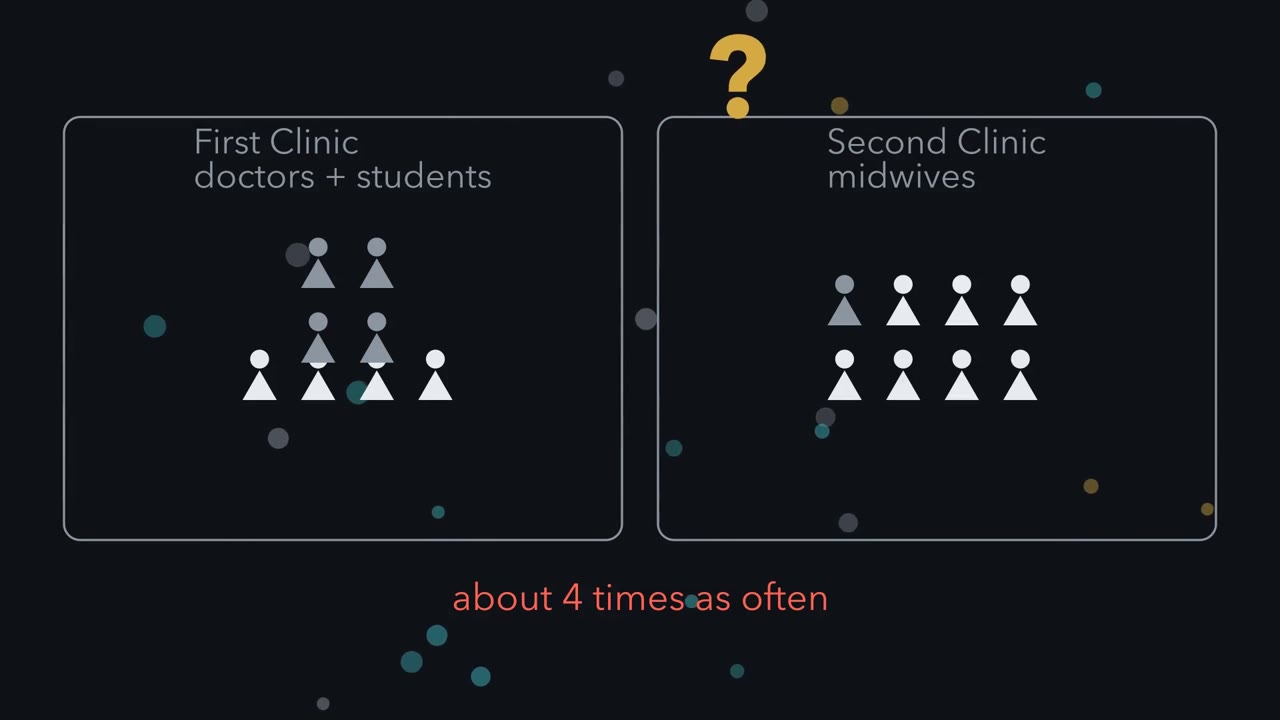
In 1846, mothers in one Vienna clinic died about four times as often as mothers in the clinic next door. What could the doctors have been carrying?
Continue in the lesson: Germs, Vaccines and Antibiotics →
3:12 · Free, with captions and a transcript. The lesson has the full text, the questions and the sources.
More films from this lesson
How this film was made. Narration: an AI narrator voice (Kokoro, af_heart) reading narration written from this lesson's text. Animation: AI-generated in code (Manim) by Claude, a schematic with no drawn molecular structures. Captions come from the narration script. See something wrong? Report it.