Three Claims in One Drought
Read the transcript of “Three Claims in One Drought”
Film transcript: Three Claims in One Drought
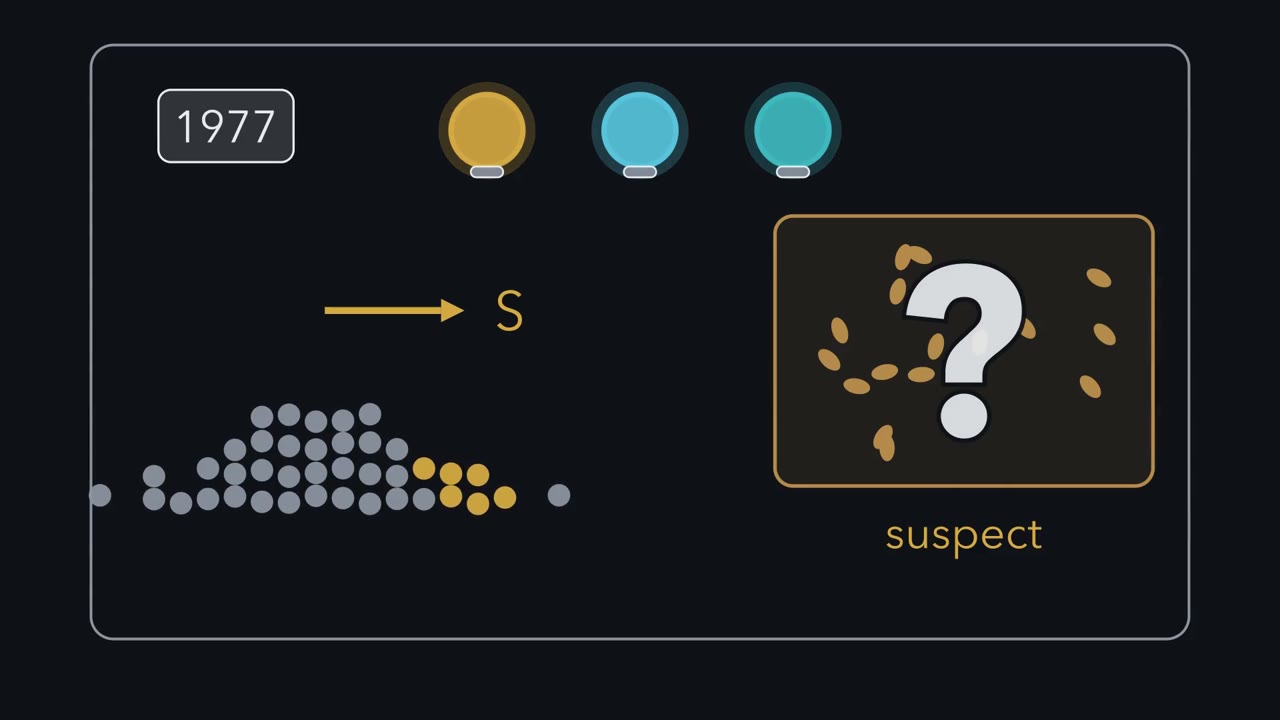
In 1977 a drought killed most of the finches on a small island, and the survivors had bigger beaks. Did the finches just evolve? The island is Daphne Major, in the Galápagos. Researchers had banded and measured nearly every medium ground finch living there. So they knew each bird's beak before the drought began. Picture each bird as a dot on a line of beak depth. Shallow beaks sit on the left, deep beaks on the right. Before the drought, the whole population makes this grey cloud. Then the drought comes. About 85 percent of the medium ground finches died. The survivors were not a random sample. Larger birds, especially males with larger beaks, survived best.
Why those birds? The food left on the island was mostly large, hard seeds. Something was sorting the birds, and the seeds that were left are the leading suspect. The survivors' average now sits to the right of the old average. That gap measures selection through survival. If the survivors breed about equally, it is the selection differential, called S. So is that evolution? Not yet shown. Survival tells you who lived. It cannot tell you what their chicks will look like. That depends on inheritance. Narrow-sense heritability, h², -squared, is the share of a trait's variation due to genes whose effects add up. That is the part that makes offspring resemble their parents.
It runs from 0 to 1, in one population and one environment. The survivors pair up and raise chicks. Suppose beak depth were not inherited at all. Where on the line would the survivors' chicks land? Right back under the old average, if the environment stays the same. However strong the selection, the chicks' average would not move at all. Turn the dial all the way to one, and the chicks' average lands on their parents' average. For most real traits the dial sits in between. The chicks' average moves only part of the way. That part is the response, called R. The breeder's equation says R = h² × S. It predicts how far the next generation's average moves.
So one sentence about a drought hides three claims. Selection happened. The trait is inherited. And the offspring changed. Each claim needs its own evidence. A survival record lights the first lamp. Comparing relatives lights the second. Only measuring the next generation lights the third. To show that selection changed a trait's average, you need all three.
A drought killed most of an island's finches, and the survivors had bigger beaks. Is that evolution yet?
Continue in the lesson: How to Test an Evolutionary Explanation →
3:20 · Free, with captions and a transcript. The lesson has the full text, the questions and the sources.
More films from this lesson
How this film was made. Narration: written from this lesson's text and read by an AI narrator voice (Kokoro, af_heart). Animation: AI-generated in code (Manim) by Claude, a schematic with no drawn molecular structures. Captions come from the narration script. See something wrong? Report it.