Read the Escape, Design the Next Drug
Read the transcript of “Read the Escape, Design the Next Drug”
Film transcript: Read the Escape, Design the Next Drug
In 2001 a capsule was approved for a leukaemia. It was aimed at one enzyme. But about five hundred human kinases hold ATP in nearly the same pocket. A protein kinase moves a phosphate onto a protein. Around 1990, a molecule shaped to jam one pocket was expected to jam dozens. So how do you drug just one? The molecule that worked is called imatinib. It hit a short list of kinases, not hundreds. One of them is BCR-ABL. This fused kinase is always on, and it drives chronic myeloid leukaemia. Imatinib sits in its ATP pocket and inhibits it. Most leukaemia cells do not get through a period without it. In early tests, normal colonies grew. Some patients in the early imatinib trials, mostly those with advanced disease, got well and then relapsed.
In one laboratory, a scientist read the BCR-ABL gene from their blood. In several patients, one DNA letter had changed. ACT had become ATT. That replaces threonine at position 315 with isoleucine. Threonine 315 is one of the contacts that hold imatinib in its pocket. Isoleucine is bulkier. It cannot make that contact. So the drug no longer binds. But the enzyme can still do its reaction. The change can even favour its active shape. A relapse looks like a failure of the idea. Read it as an experiment instead. The drug selected cells with a change at the one position it depended on. The rest of the enzyme was untouched. That is strong evidence that the drug had been working through BCR-ABL, and that the leukaemia still needed it.
The relapse also wrote the specification for the next drug: grip ABL without needing residue 315. Ponatinib was built with a slim carbon-carbon triple bond where the isoleucine side chain sticks out. It inhibits the mutant kinase. Keep this rule. A relapse writes the specification for the next drug.
About five hundred human kinases hold ATP in nearly the same pocket. How do you drug just one?
Continue in the lesson: Drugs Against a Part →
2:14 · Free, with captions and a transcript. The lesson has the full text, the questions and the sources.
More films from this lesson
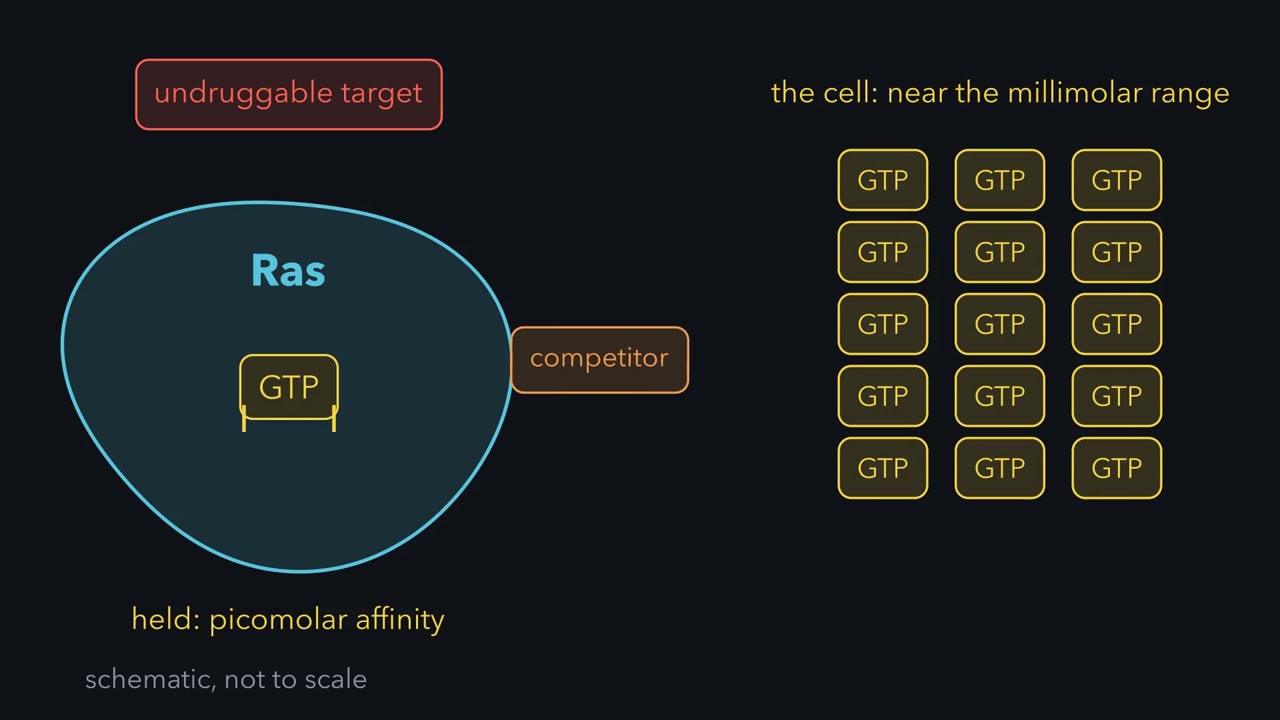
How this film was made. Narration: an AI narrator voice (Kokoro, af_heart) reading narration written from this lesson's text. Animation: AI-generated in code (Manim) by Claude, a schematic with no drawn molecular structures. Captions come from the narration script. See something wrong? Report it.