Films · Developmental Neuroscience
Cells Marked with an X
Read the transcript of “Cells Marked with an X”
Film transcript: Cells Marked with an X
How do you find the genes for a death, when you do not know which proteins are involved? The worm C. elegans is about a millimetre long, and it is transparent. With Nomarski optics, its nuclei are visible in the living animal, without any staining. Researchers followed its cells as they divided, and drew the full family tree. Some branches end in a death. On the chart, each death is marked with an X. The same identified cells die in every animal, at the same place in the tree. Counting both lineages, 131 of the hermaphrodite's 1,090 somatic cells die during development. A death that happens to a named cell, on schedule, is a phenotype. And a phenotype can be screened for.
Horvitz's laboratory started from a mutant called ced-1. In it, corpses are not engulfed, so they stay visible. They searched for new mutations in which the corpses never appeared. In 1986 they reported two genes, ced-3 and ced-4. In strong mutants, the cells that should have died lived. Some took on features of neurons. Then came a gene that works the other way. It is called ced-9. A gain-of-function mutation in ced-9 kept doomed cells alive. Loss of ced-9 killed cells that should have lived. With severe loss of ced-9, the worms die as embryos. Put the results in a table, one genotype per row. Losing ced-3 or ced-4 saves doomed cells. Losing ced-9 kills extra cells.
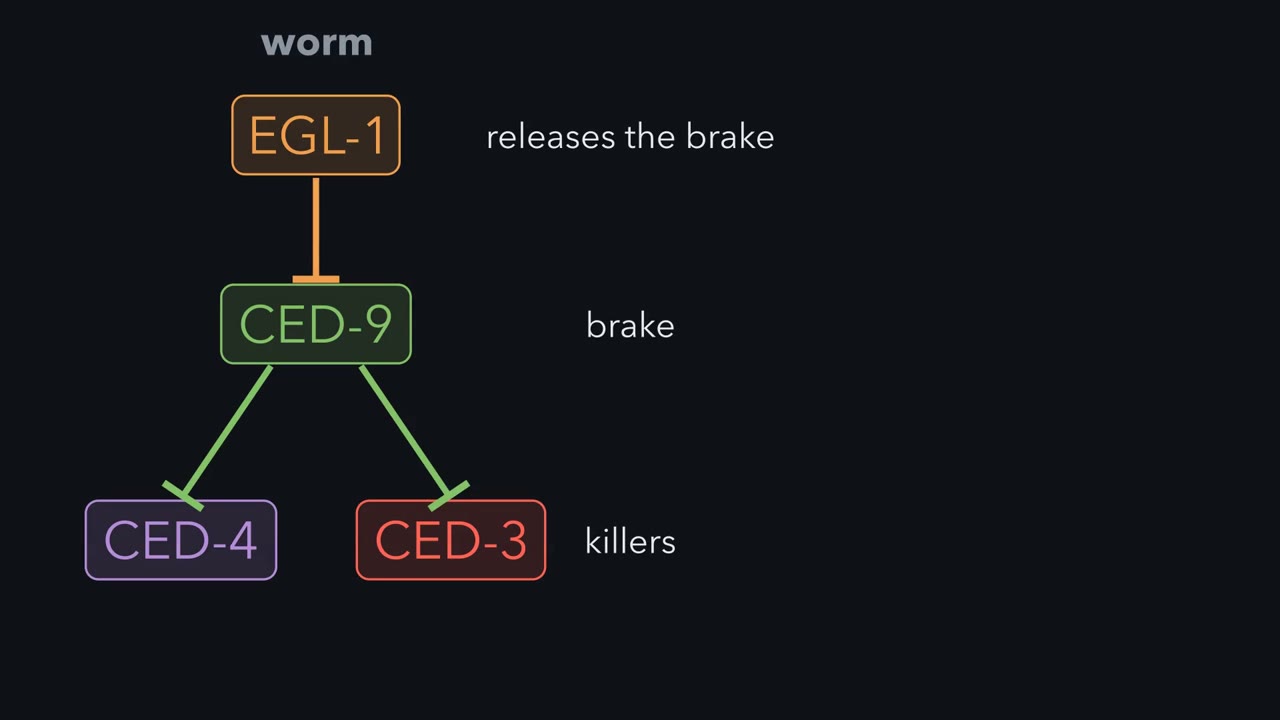
Now remove both ced-9 and ced-3. Do the extra deaths still happen? No. Few cells die, and the embryos survive. Removing ced-4 instead of ced-3 gives the same result. If removing the killer cancels the effect of removing the brake, the brake works through the killer. So, in genetic order, CED-9 acts upstream. It is a brake on the two killers. Genetic order does not, by itself, show which proteins touch. One more gene sits above the brake. It is called EGL-1. EGL-1 carries only a short stretch, called a BH3 domain. It binds CED-9 and releases the brake. It is needed for most somatic cell deaths in the worm. Without it, most doomed cells live. So the worm's core pathway has one brake.
CED-9 holds back the killers, and EGL-1 releases it.
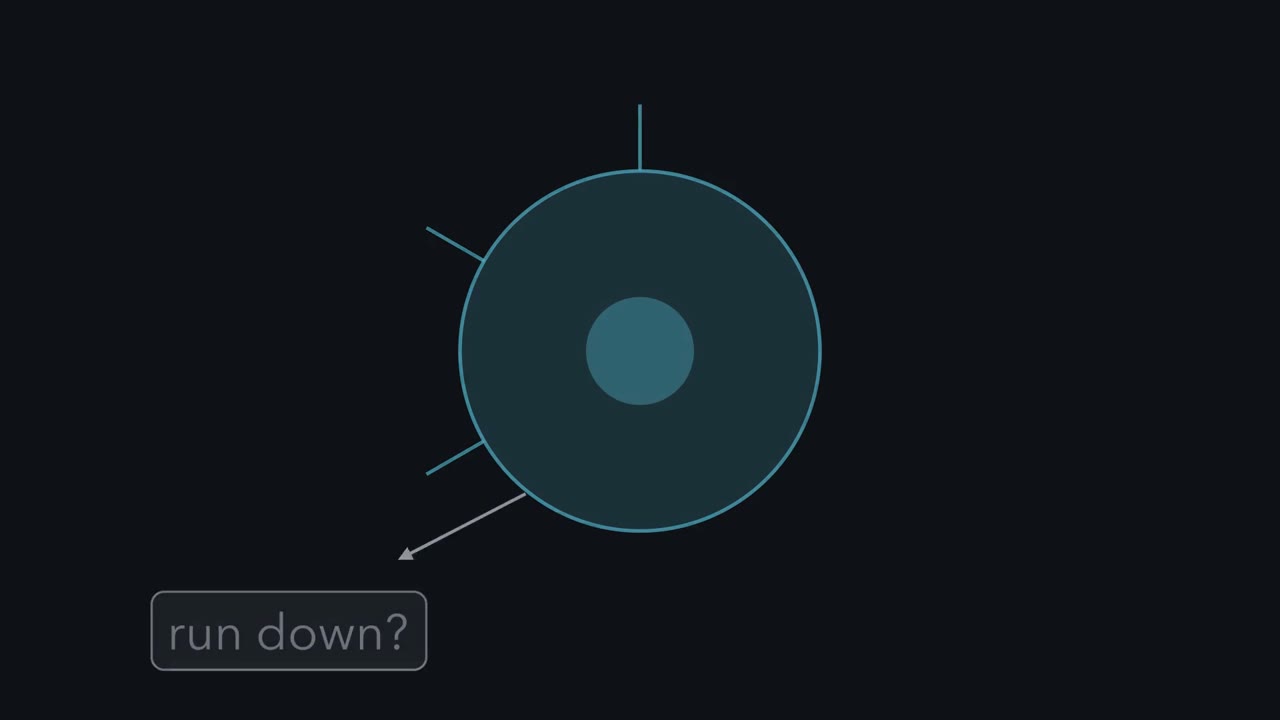
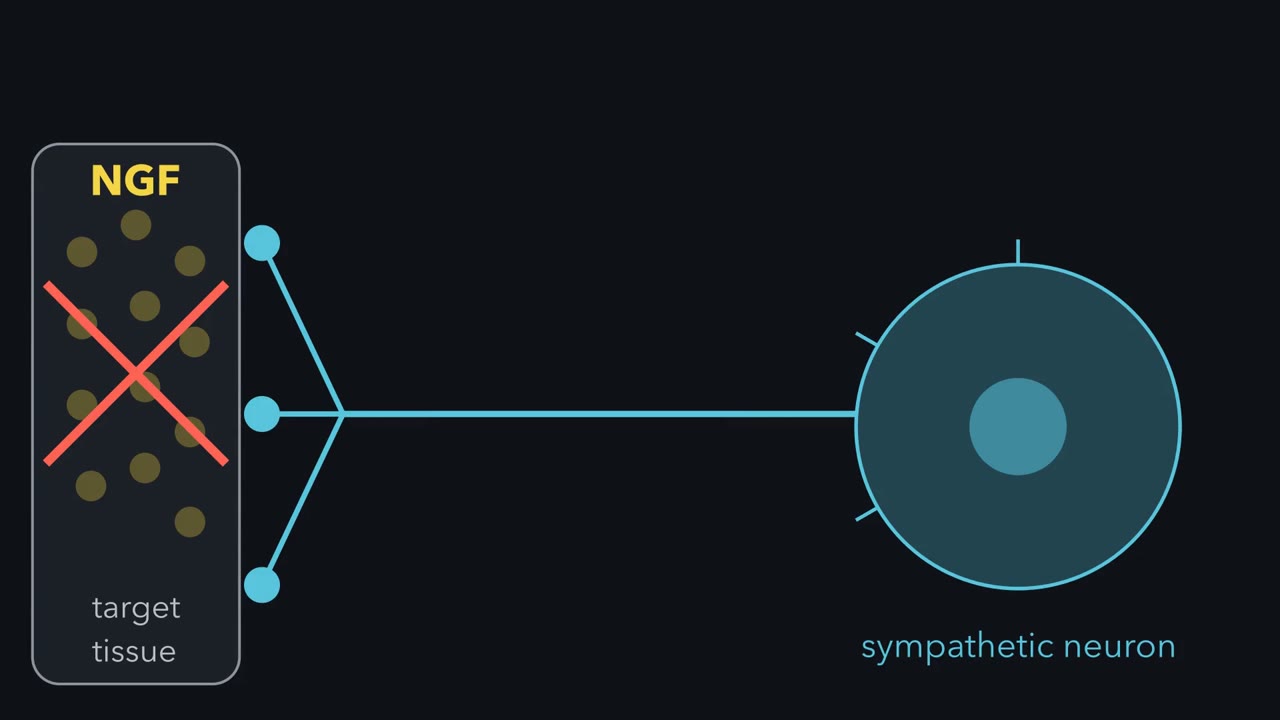
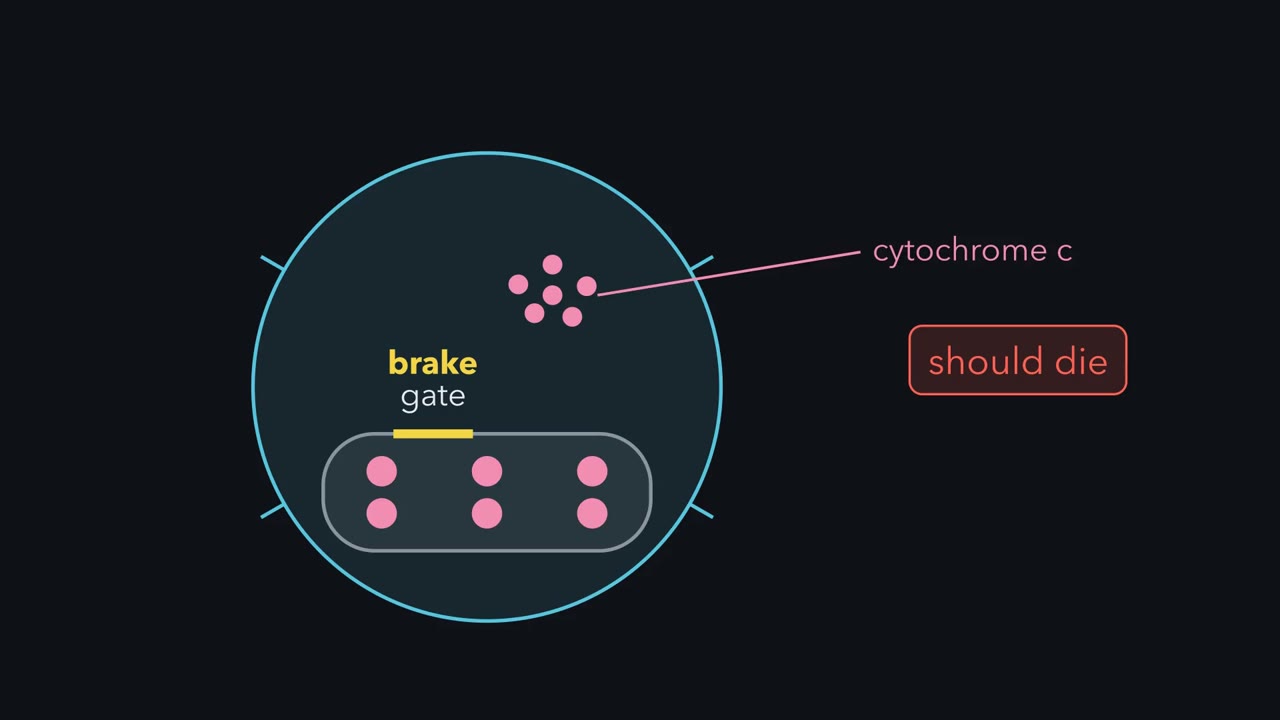
Stop a starving neuron from making new proteins, and it lives longer. Why?
Continue in the lesson: The Death Machinery in Neurons →
2:54 · Free, with captions and a transcript. The lesson has the full text, the questions and the sources.
More films from this lesson
How this film was made. Narration: an AI narrator voice (Kokoro, af_heart) reading narration written from this lesson's text. Animation: AI-generated in code (Manim) by Claude, a schematic with no drawn molecular structures. Captions come from the narration script. See something wrong? Report it.