Films · Developmental Neuroscience
Input Finishes the Drawing
Read the transcript of “Input Finishes the Drawing”
Film transcript: Input Finishes the Drawing
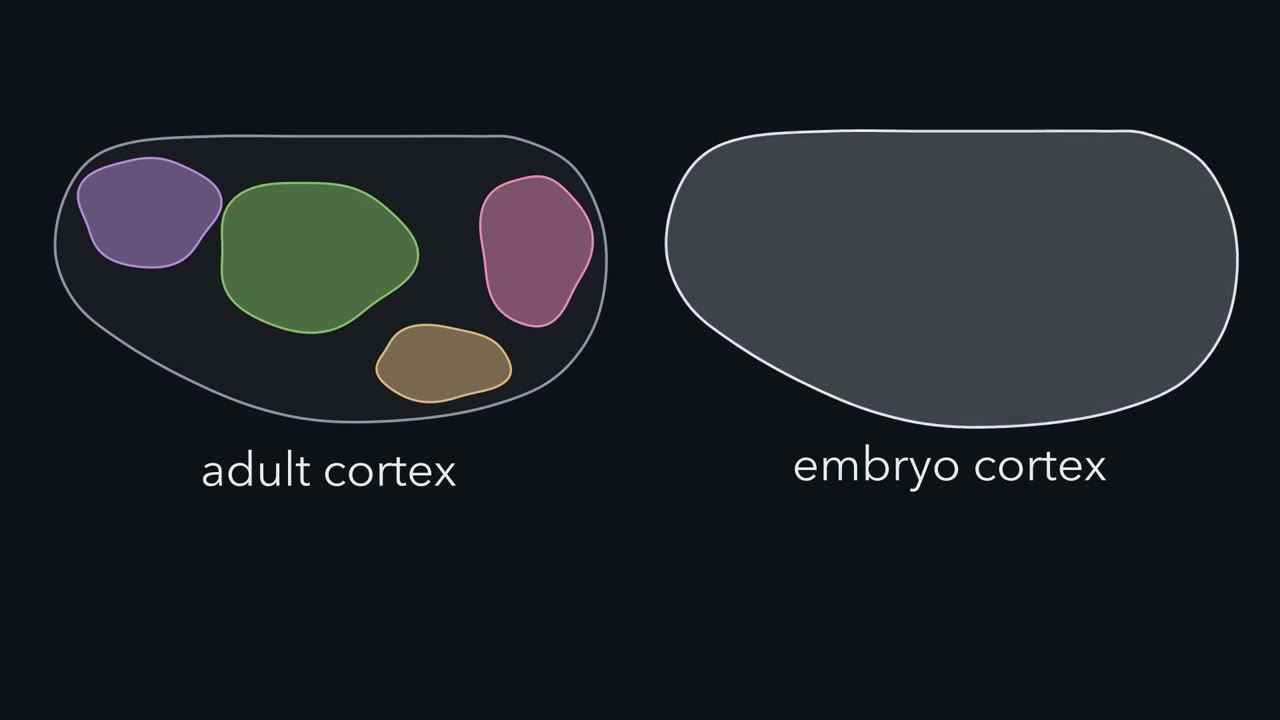
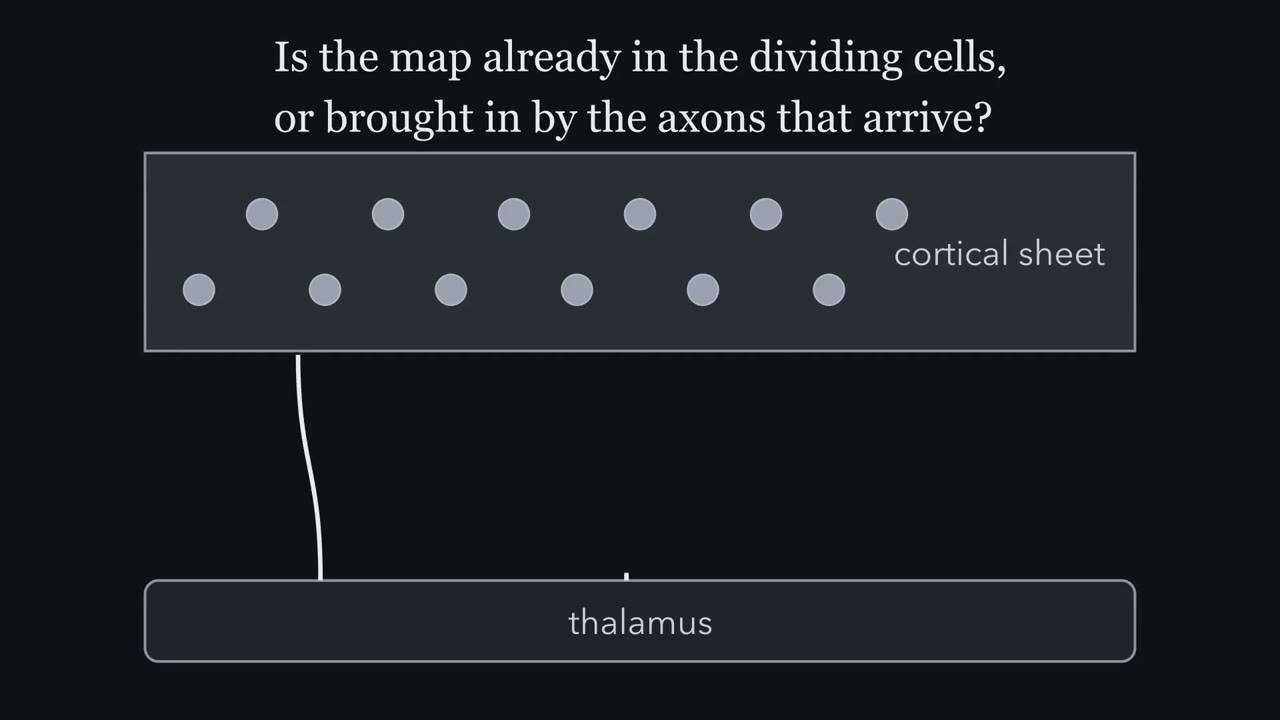
The sheet draws a sketch before thalamic axons arrive. Does the sketch need those axons at all? Start with a mouse that lacks the transcription factor Gbx2. In these mice, thalamic axons never reach the cortex. If areas came only from thalamic input, what should the marker borders look like at birth?
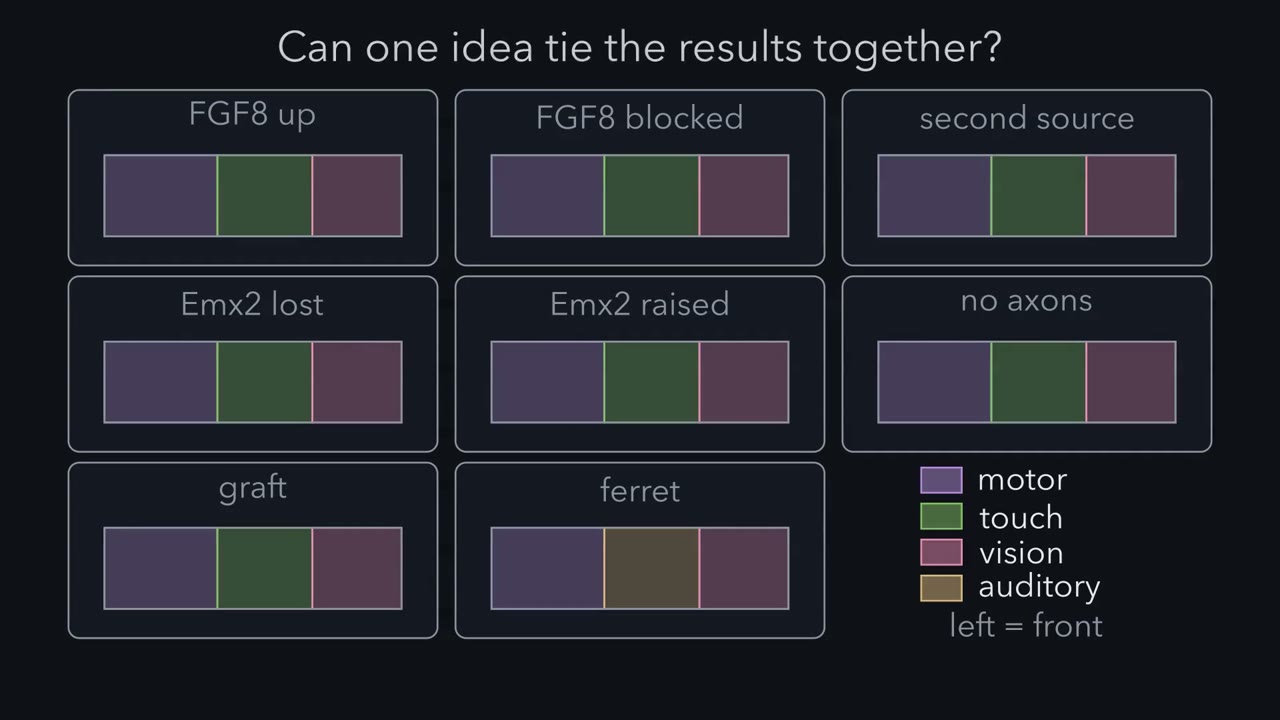
They should be missing or misplaced. They were not. In 1999, Emily Miyashita-Lin, John Rubenstein and colleagues found normal borders for several area markers at birth. The marker sketch forms without thalamic input. The limit is the readout. Markers at birth are a sketch, and adult borders could still need input. Now ask the other question. What does input add? In 1991, Bradley Schlaggar and O'Leary grafted visual cortex from fetal rats into newborn rat somatosensory cortex. Thalamic axons carrying whisker signals grew into the graft. What should the graft build?
It formed barrels. Tissue that would have become visual cortex built a feature of the area whose input it received. Mriganka Sur's laboratory went further, in ferrets, which are born with immature visual pathways. In newborns, the retina's normal targets were reduced. The normal inputs to the auditory thalamus were removed. Retinal axons then grew into the auditory thalamus. Auditory cortex received visual activity. Normal auditory cortex has no map of edge orientation. What did the rewired cortex build?
Neurons tuned to edge orientation, arranged in a map like visual cortex, though less regular. A companion paper reported that the animals responded to light through the rewired pathway as a visual stimulus. Input also sharpens the sketch. In 2013, Shen-Ju Chou and colleagues in O'Leary's laboratory removed the axons from the visual thalamus. The genetic distinction between primary visual cortex and the higher-order areas around it failed to develop. Spontaneous and sensory activity then refine the maps inside each area. Later lessons take that up. The takeaway: the marker sketch forms without input by birth. Input then sharpens it, and shapes what each area builds.
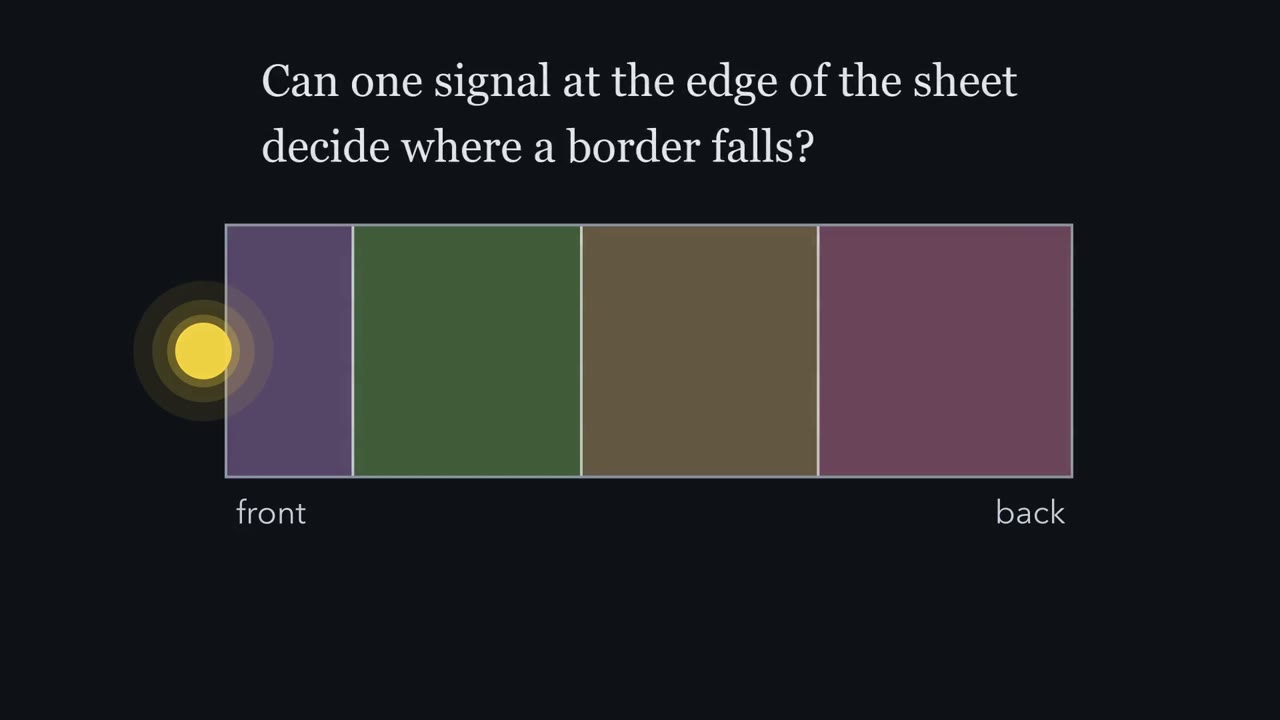
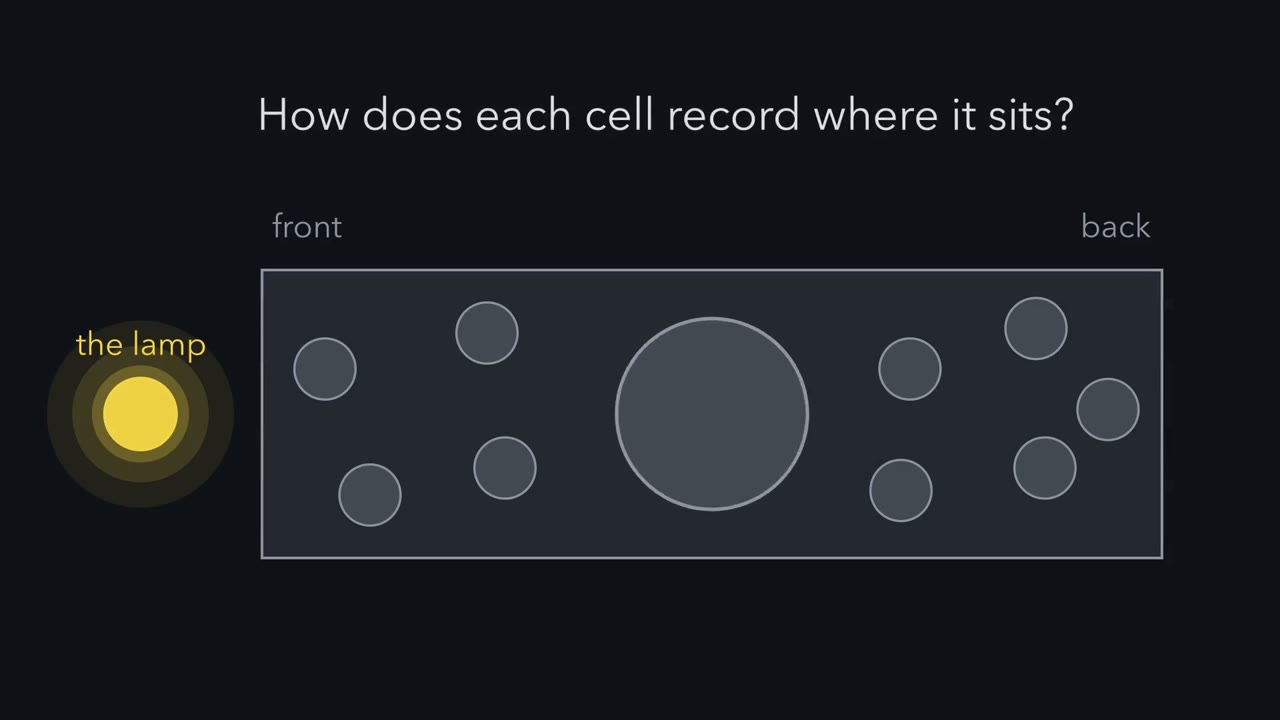
Add one secreted protein to the back of a mouse embryo's cortex and a second, partial whisker map can appear there.
Continue in the lesson: Mapping the Cortex: Areas and Arealization →
2:59 · Free, with captions and a transcript. The lesson has the full text, the questions and the sources.
More films from this lesson
How this film was made. Narration: an AI narrator voice (Kokoro, af_heart) reading narration written from this lesson's text. Animation: AI-generated in code (Manim) by Claude, a schematic with no drawn molecular structures. Captions come from the narration script. See something wrong? Report it.