Films · Developmental Neuroscience
The Cells' Own Record
Read the transcript of “The Cells' Own Record”
Film transcript: The Cells' Own Record
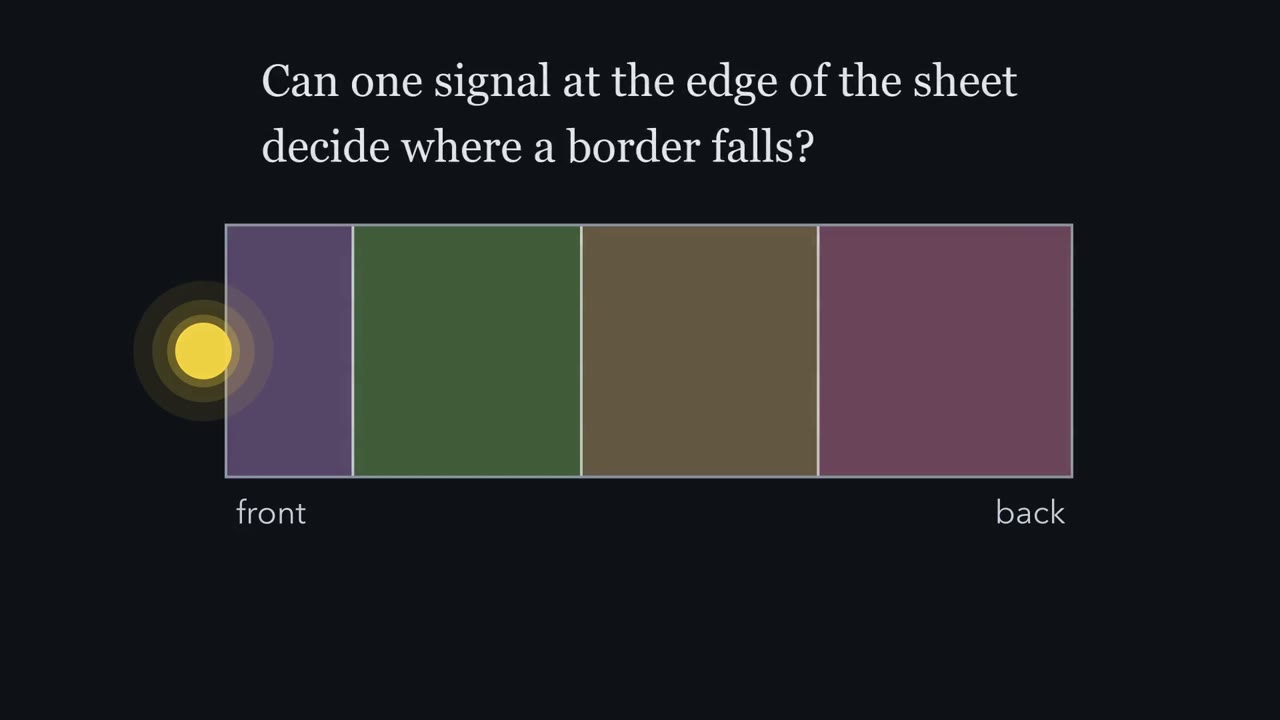
The lamp is outside the cells. How does each cell record where it sits? Inside the cells, position is recorded as levels of transcription factors, proteins that switch genes on or off. Two of them run in opposite directions along the front-to-back axis.
Emx2 is highest at the back. Pax6 is highest at the front. Each also varies from the midline outward, and two more factors join them. The levels of these proteins are each progenitor's record of where it sits. The record and the lamp are linked. Changing FGF8 shifts the gradients. Whether Emx2 acts back on it is still argued. A gradient alone is only a correlation. So run both tests: remove the factor, then add more.
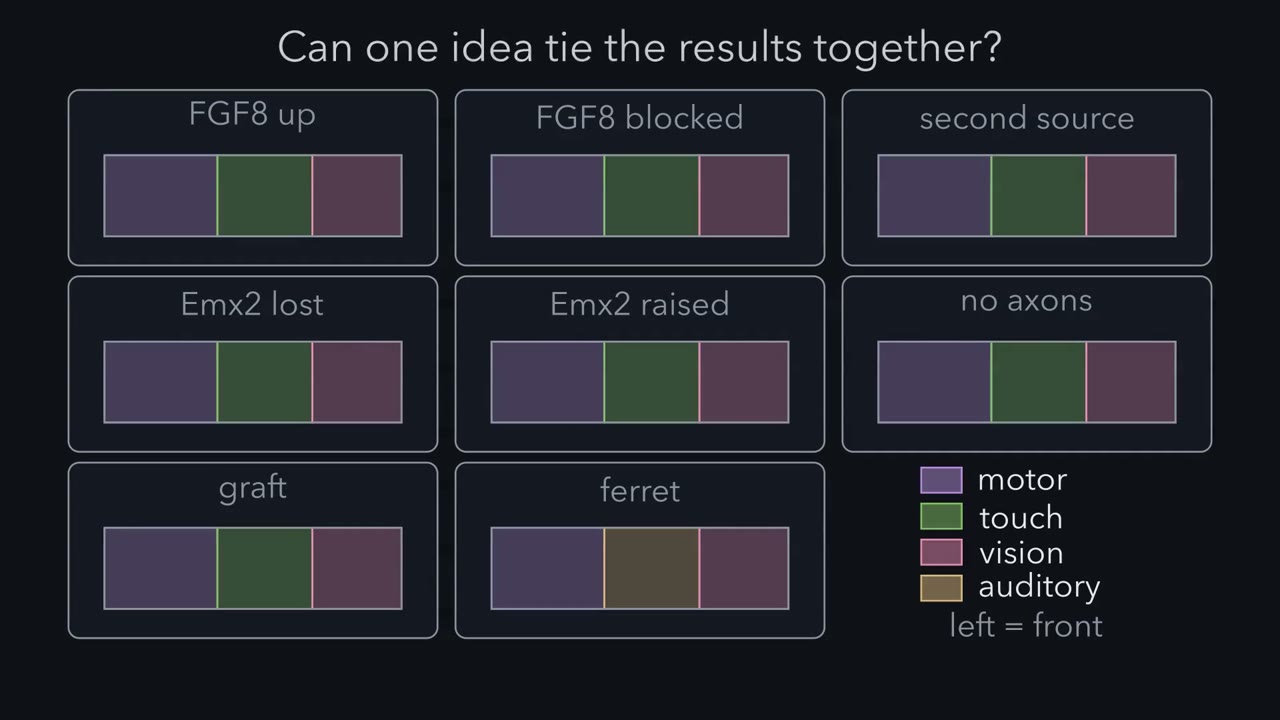
Emx2 is highest at the back. Delete it. Which way should the borders move, and which areas should grow? The borders move back. The front-and-middle areas grow, and the visual area shrinks. In 2000, Kathie Bishop, Guy Goudreau and Dennis O'Leary found this in mice lacking Emx2. Without working Pax6, the shift went the other way. Front areas shrank, and the visual area grew forward. Now raise Emx2 everywhere, keeping its slope. What would show that it allocates territory?
The map should move the opposite way, with the whole cortex about the same size. In 2004, Tadashi Hamasaki and colleagues in O'Leary's laboratory found this. The visual area grew and the front areas shrank. Total cortical area did not change significantly. Loss and gain move the borders in opposite directions. That is strong evidence for allocating territory, not simply permitting cortex to exist. COUP-TFI tells a similar story for loss. In 2007, Michèle Studer's laboratory removed it from cortex alone. Frontal motor areas spread across most of the sheet, and the sensory areas were squeezed toward the back. Pax6 is the cautionary case. In 2007, David Price's group raised it up to three times normal.
The map barely moved. A knockout limited to cortex shifted the markers. Yet the area-specific connections with the thalamus stayed normal. So Pax6 may bias how markers are expressed more than it decides where an area sits. But in 2013, a cortex-only knockout shrank the touch area. Its role is still unsettled. The takeaway: when losing a factor and adding it move borders in opposite directions, that is the strongest evidence the factor helps allocate territory. A missing converse result does not rule a factor out.
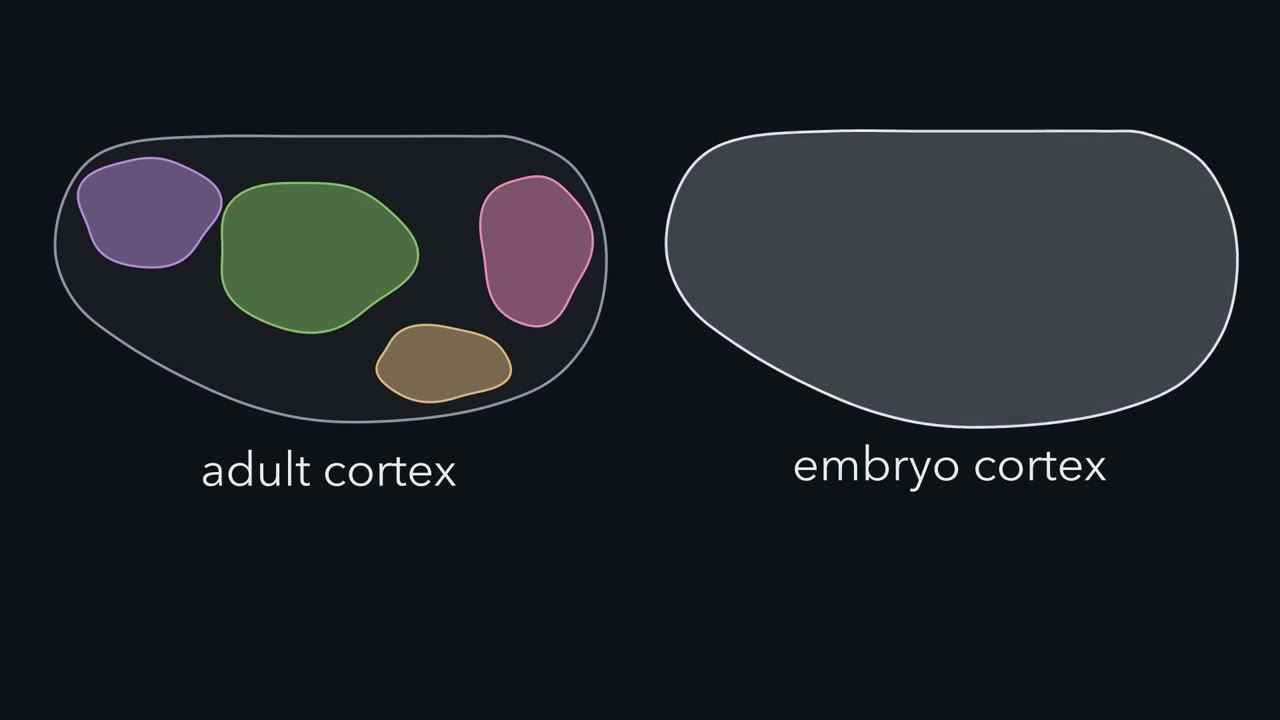
Add one secreted protein to the back of a mouse embryo's cortex and a second, partial whisker map can appear there.
Continue in the lesson: Mapping the Cortex: Areas and Arealization →
3:17 · Free, with captions and a transcript. The lesson has the full text, the questions and the sources.
More films from this lesson
How this film was made. Narration: an AI narrator voice (Kokoro, af_heart) reading narration written from this lesson's text. Animation: AI-generated in code (Manim) by Claude, a schematic with no drawn molecular structures. Captions come from the narration script. See something wrong? Report it.