Holding the Voltage Still
Read the transcript of “Holding the Voltage Still”
Film transcript: Holding the Voltage Still
How do you watch a conductance change, when the voltage keeps running away? In a free axon there is a loop. Depolarization opens sodium channels, and their current depolarizes the membrane further. During a free spike, voltage and channel opening change together. To see how a conductance changes with time, hold the voltage still. Picture a leaky bathtub you must keep at one exact level, by adjusting the tap. If the drain opens wider, you run the tap faster. The tap's flow tells you how fast the drain leaks. If water pours in through a crack instead, the tap must run backwards, like a pump, and remove it. The voltage clamp works the same way. A feedback amplifier holds your chosen voltage and supplies whatever current that takes.
Why does that current equal the channel current? The membrane is a capacitor, and it takes current only while the voltage changes. Hold the voltage fixed, and the capacitor takes none. So the amplifier's current matches the channel current. When channel current flows out, the amplifier supplies charge. When it flows in, the amplifier withdraws it. Now step the voltage up and hold it. If the conductances stayed fixed, what would the current do?
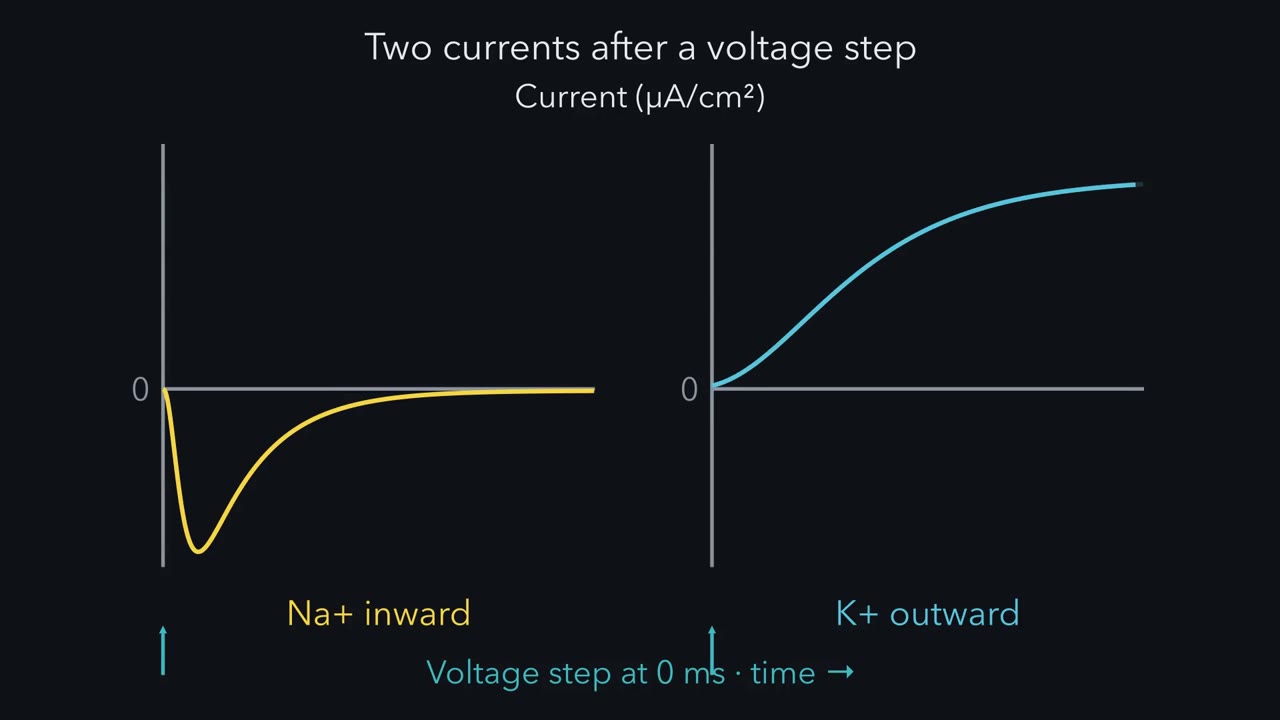
It would jump to a new level and stay flat. Here is what Hodgkin and Huxley saw, with inward current drawn downward. First, a brief blip at the step. That is the membrane charging. It stops once the voltage is steady, so set it aside. Next, an early inward current. It grows fast, then dies away, though the voltage is still held. Last, a delayed outward current. It rises slowly and lasts as long as the step. Here is the key step. With the voltage fixed, the driving force is fixed. Only the conductance can change. So the conductance itself is opening and closing with time. Which ions carry these currents? Hodgkin and Huxley replaced most outside sodium with choline, which the membrane passes poorly.
If sodium carries the early current, what happens when most sodium is gone? It reversed. The early current turned outward. The delayed outward current was little affected. Why? Less sodium outside lowers sodium's equilibrium potential. In the cold squid axon, a tenfold drop moves it from plus +50 to about minus −5 mV. A step to zero now sits above sodium's equilibrium potential. So sodium flows out, and the early current reverses. Plot the early current against step voltage. It crosses zero near sodium's equilibrium potential. Low sodium moved the crossing more negative. That is just what a sodium current should do. So the early current was assigned to sodium.
The delayed current was assigned to potassium on other evidence, including tracer measurements of potassium leaving stimulated axons. Early inward current: sodium. Delayed outward current: potassium. Both change with time at a fixed voltage.
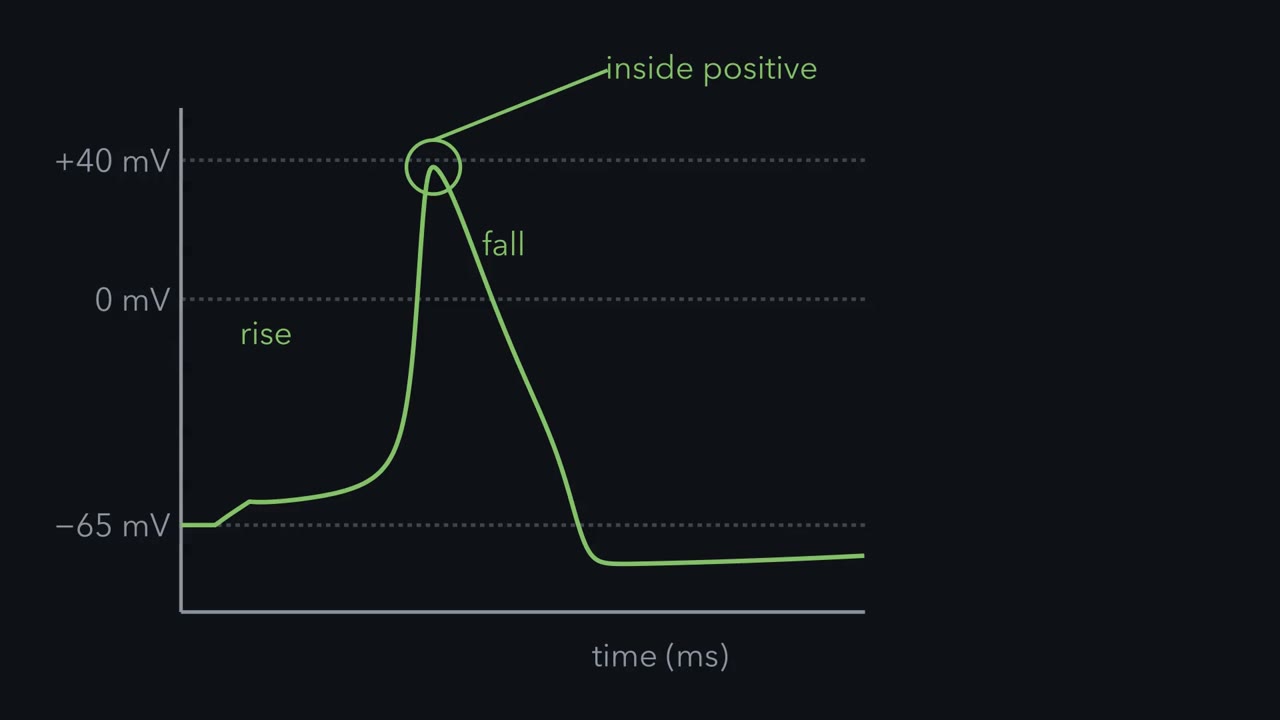
At the peak of a squid axon's impulse the inside turns positive. What lets charge in faster than it leaks out?
Continue in the lesson: The Action Potential and Conduction →
3:36 · Free, with captions and a transcript. The lesson has the full text, the questions and the sources.
More films from this lesson

How this film was made. Narration: an AI narrator voice (Kokoro, af_heart) reading narration written from this lesson's text. Animation: AI-generated in code (Manim) by Claude, a schematic with no drawn molecular structures. Captions come from the narration script. See something wrong? Report it.