Moving Down the Axon
Read the transcript of “Moving Down the Axon”
Film transcript: Moving Down the Axon
A spike fires at one spot. How does it reach the far end, and why doesn't it come back? Inward current at the active patch spreads along the core of the axon. It brings the next stretch of membrane to threshold. That stretch fires, and its current spreads on to the next. The spike moves along, patch by patch. Here is a question. Current spreads both ways from the active patch. So why doesn't the spike turn back?
The membrane just behind has just fired. Its sodium channels are inactivated. It is refractory, so it cannot be excited again. The axon itself has no preferred direction. Stimulate the middle, and spikes travel both ways. A spike travels away from wherever it started. Speed depends first on diameter. A wider axon has lower internal resistance, so current spreads farther before leaking away. Think of a wide pipe against a narrow, leaky one. Farther spread means a faster spike, which is why the squid giant axon is so wide. The other way to speed up is myelin, glial membrane wrapped around the axon. Picture a leaky garden hose wrapped in tape. Less current leaks out.
Myelin also lowers capacitance. Think of a narrow water tank: the same pour raises its level more. With less capacitance, the same charge raises the voltage more. The voltage climbs as the charge arrives. So current from one gap reaches the next fast and strong. The gaps are nodes of Ranvier, where sodium channels regenerate the spike. This is saltatory conduction, from the Latin for leap. Excitation skips the wrapped stretch. Current does not. It flows through the axon from node to node. Speeds vary widely. In mammalian nerve, unmyelinated C fibres conduct at about walking pace. The largest myelinated fibres are roughly a hundred times faster.
Now strip the myelin from one stretch. What happens to the spike? The bare stretch leaks current and has more membrane to charge. The next node is reached late, or not at all. Conduction slows or blocks. It does not always block. In some fibres the bare stretch develops sodium and potassium currents of its own. Then it conducts slowly and continuously. Back to the puzzles. Overshoot: sodium briefly pulls the balance point above zero. Threshold: sodium feedback sustains itself. All-or-none: brief pushes from rest give spikes of about the same size. Refractoriness: inactivated sodium channels need time to recover. Travel: current spreads ahead, and refractory membrane behind blocks the way back.
Spread ahead, refractory behind. Wider and myelinated means faster.
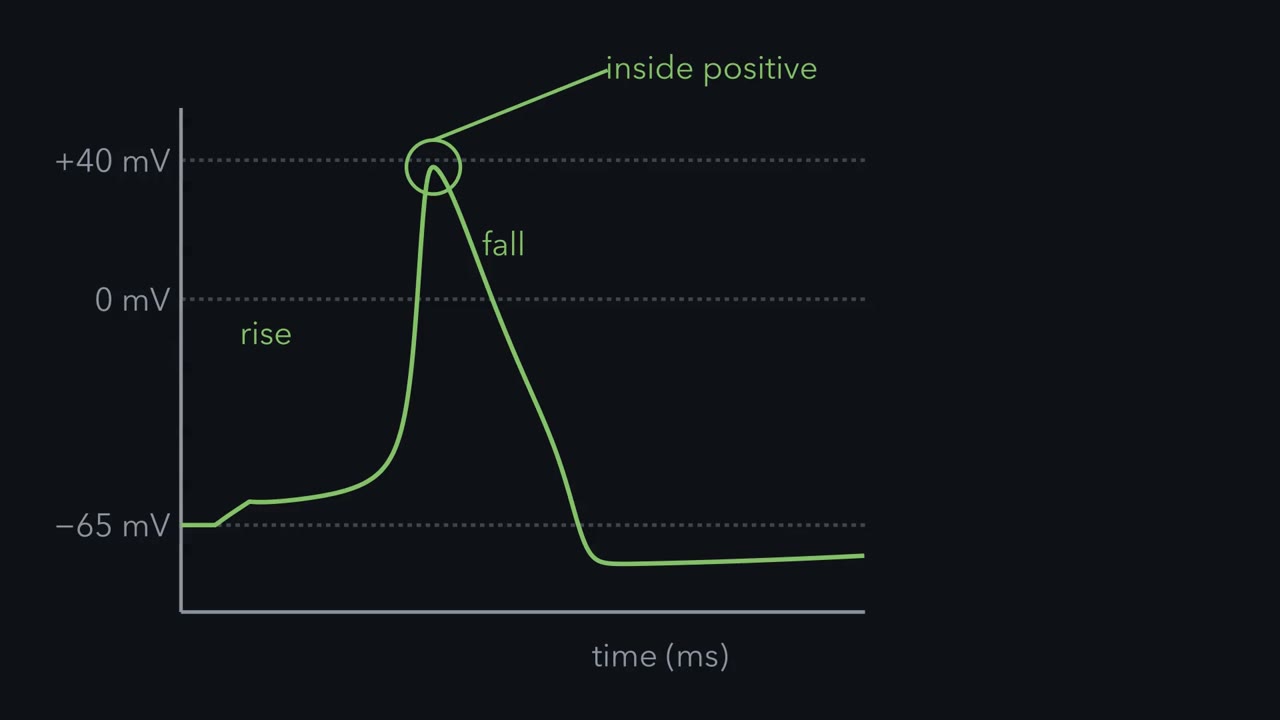
At the peak of a squid axon's impulse the inside turns positive. What lets charge in faster than it leaks out?
Continue in the lesson: The Action Potential and Conduction →
3:16 · Free, with captions and a transcript. The lesson has the full text, the questions and the sources.
More films from this lesson

How this film was made. Narration: an AI narrator voice (Kokoro, af_heart) reading narration written from this lesson's text. Animation: AI-generated in code (Manim) by Claude, a schematic with no drawn molecular structures. Captions come from the narration script. See something wrong? Report it.