Biochemistry · Water and Weak Interactions
Water, Weak Bonds, and the Generation of Order
Rewritten on : new film. Your notes and highlights stay, but the text around them may have moved.
A protein folds itself, and no instructions are needed. Water and many weak, reversible bonds make the folded state the favorable one, and burying oily groups away from water is widely considered the largest single contribution.
The main idea, the figures and what the films show. Under each heading, "Read this part" opens it.
Both films in order, 7 minutes. Each one ends with what to take from it.
The whole lesson: about 27 minutes of reading and 7 of film.
Pause when the reading reaches a film, and offer to play it. Saved on this device.
Watch the film now, or keep listening
That is the end of the reading
This idea at other levels
This lesson teaches weak bonds in Biochemistry, an upper-level college course. Simpler: Water and Life (high school), or read a short high school version here.
The high school version · about 1 minute to read
Water is a polar molecule: oxygen hogs the electrons, so it has a slightly negative end and slightly positive ends. That makes it stick to itself, dissolve charged things, and reject greasy (nonpolar) things. That last one matters most. When oily molecules sit alone in water, the water has to form an ordered cage around them, which lowers its disorder (entropy). Water doesn't stay in that state willingly, so it shoves the oily molecules together to free itself. This "hydrophobic effect" is what makes proteins fold and cell membranes form. Inside the cell, the parts that actually do work are held by weak bonds — hydrogen bonds, ionic attractions, van der Waals forces — strong enough to hold, weak enough to let go. And pH controls everything: it decides whether each part is positive, negative, or neutral, which decides how everything sticks together.
See every levelHide the levels
This lesson also teaches two more ideas; their ladders are below.
Weak bonds (noncovalent interactions)
Hydrogen bonds, ionic attractions and van der Waals contacts are weak enough to break and re-form, and cells run on them.
Two levels here: high school and upper-level college. The lesson at high school was picked by hand for this lesson.
College, upper level · the level you chose
Water, Weak Bonds, and the Generation of Order · this lesson
Bonds worth one or two RT: why water evens out ionic and hydrogen bonds.
Biochemistry · about 27 min · 4 practice questions
High school · the level you chose
Water and Life · also at this level, picked for this lesson
Biology · about 40 min · Virginia BIO.2a
Next door to weak bonds
- Binding strength (affinity and Kd)Weak bonds let a protein grip a partner and let go again, and Kd measures how tightly it holds.Nearest lesson: Protein Binding and Allostery: How Hemoglobin Loads and Delivers Oxygen (upper-level college)
- DNA, the molecule of heredityHydrogen bonds between base pairs hold the two DNA strands together yet let them come apart for copying.Nearest lesson: DNA Is the Genetic Material (college core)
pH and buffers
pH tells how acidic a solution is; it decides which groups carry charge, and buffers keep it steady.
Taught at one level so far: upper-level college.
College, upper level · the level you chose
Water, Weak Bonds, and the Generation of Order · this lesson
Predict charge from pH minus pKa; bicarbonate holds blood at 7.35 to 7.45.
Biochemistry · about 27 min · 4 practice questions
Next door to pH and buffers
- Acid-base balance (blood pH)Blood stays near pH 7.4 because buffers work together with the lungs and the kidneys.Nearest lesson: Acid-Base Balance (upper-level college)
- Amino acids and their side chainsAmino acid side chains pick up or lose charge with pH, which changes how a protein acts.Nearest lesson: Amino Acids: How One Side Chain Decides Everything (upper-level college)
The hydrophobic effect
Water pushes oily groups together because that frees the water, which helps fold proteins and build membranes.
Taught at one level so far: upper-level college.
College, upper level · the level you chose
Water, Weak Bonds, and the Generation of Order · this lesson
Count the water: folding a 100-residue protein wins about 40 kJ/mol, paid by water.
Biochemistry · about 27 min · film 3:19 · 4 practice questions
Next door to the hydrophobic effect
- Protein foldingOily parts of the chain are pushed to the middle, which is a main force that folds a protein.Nearest lesson: Protein Three-Dimensional Structure: The Sequence Sets the Shape (upper-level college)
- The cell membraneThe same push of water holds the fatty tails of a membrane together, away from water on both sides.Nearest lesson: Lipids: The Building Blocks That Refuse to Polymerize (upper-level college)
Short versions inside this lesson
The graduate version · about 1 minute to read
The chapter's organizing claim is thermodynamic: for many proteins, native structure behaves as the minimum of Gibbs free energy for the polypeptide-plus-solvent system (Anfinsen's thermodynamic hypothesis), though some native states are kinetically trapped or metastable relative to amyloid. A major stabilizing term is the hydrophobic effect, together with tight van der Waals packing of the buried core. Near room temperature, burial of apolar area is entropy-driven, releasing ordered solvation water, and it grows more enthalpic as temperature rises; the effect strengthens with temperature over the physiological range. The large positive heat-capacity change of unfolding, from hydrating exposed nonpolar groups, bends ΔG_unfold(T) into the two-armed stability curve: heat denaturation is driven by the chain's conformational entropy, and cold denaturation by the weakening of the hydrophobic effect at low temperature. Electrostatics are context-dependent: Coulombic energy scales as q₁q₂/(Dr), so a salt bridge worth a few kJ/mol on a protein surface (D ≈ 80) is markedly stronger in the low-dielectric interior (D ≈ 2–4) — but burial also carries a large desolvation penalty, so a buried salt bridge's net effect ranges from destabilizing to several kcal/mol, which matters when interpreting buried-charge mutations. Hydrogen bonds contribute specificity (Watson–Crick pairing) while base stacking (dispersion, electrostatic and solvent terms together) supplies most of the thermodynamic stability of duplex DNA. The acid–base layer is the Henderson–Hasselbalch relation derived from Ka; buffering capacity is maximal at the pKa and effective within ±1 unit. The bicarbonate system's effective pKa (6.1, not the 3.77 of carbonic acid alone) folds in the CO₂ hydration equilibrium; open-system CO₂ ventilation is why a pKa more than a full unit from physiological pH still buffers blood effectively.
The plainest version · about 1 minute to read
Water is sticky and likes to hold hands with other water. Oily things don't want to hold hands, so the water pushes them all into one corner to get them out of the way. That pushing is what folds the tiny machines in your body into the right shapes. The pieces that make those machines work are held by little "weak grips" — strong enough to hold on, weak enough to let go again, like magnets you can pull apart. And a special number called pH tells all the parts whether to grab on or let go.
Find an idea: every idea, searchable
Which lessons teach an idea, and the notes on each level, were written by AI models from the lessons and checked by a second model. A person has not yet read every one. How we use AI
About this lesson goals, parts
What you'll learn
- Explain water's polarity and its three jobs in the cell: cohesion, dissolving charged things, and rejecting nonpolar things.
- Rank the weak interactions (ionic, hydrogen, van der Waals) by strength in vacuum and in water, explain why water evens them out, and explain why hydrogen bonds and van der Waals contacts work only within a few Ångströms.
- Explain the hydrophobic effect as water pushing nonpolar groups together, mainly an entropy story about water that is clearest for small groups near room temperature, and connect it, with packing and weak bonds, to protein folding and membrane assembly.
- Use pH = pKa + log([A⁻]/[HA]) to predict whether a group is protonated, and explain how the bicarbonate buffer keeps blood between 7.35 and 7.45 although its pKa is 6.1.
Builds on:Water and Life (read)What Am I Made Of? (read)Why these?
Rewritten on : new film. Notes and highlights stay, but the text around them may have moved.
The main idea. The second law seems to say everything should fall apart.
The films
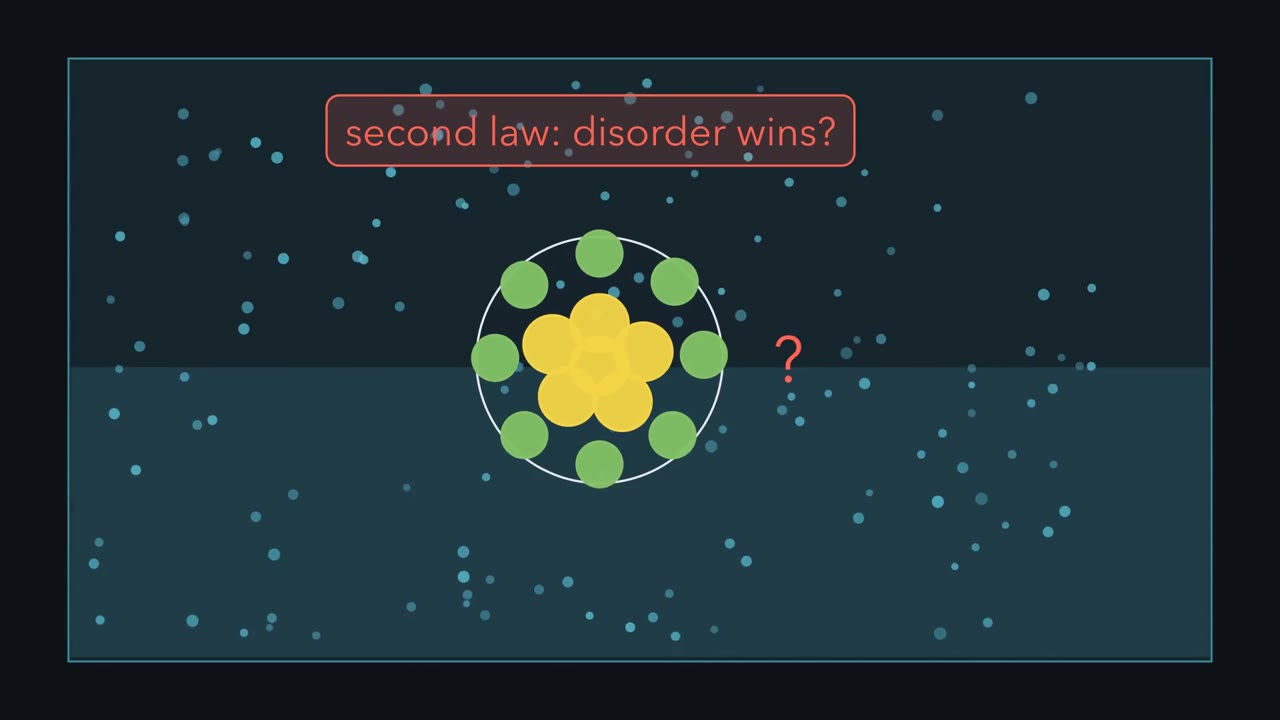 ▶ Watch Count the Water · 3:19
Read the transcript of “Count the Water”
Film transcript: Count the Water
A chain of amino acids folds itself into one precise shape. Doesn't the second law say disorder always wins? Watch the water around it. The second law counts total entropy. That means the protein, the water around it, and the heat they trade with their surroundings. So here is the rule. Count the water, not just the molecule. Start with one oily group, a methyl on an alanine side chain. Water cannot hydrogen bond to it. So the water touching it points its bonds along the surface. That layer has fewer ways to arrange itself: lower entropy. Pictures often draw this layer as an ice cage. That overstates it. The layer is only slightly stiffer than bulk water.
But a protein has many oily groups. Around all of them, it adds up. Now gather the scattered oily groups into one cluster. What happens to the water's entropy? Up, or down? Decide before the picture moves. It goes up. One cluster has less surface than six scattered groups. So less water must line it. The freed water rejoins the bulk. The groups gather mainly because the water gains freedom, not because they attract. That release is the hydrophobic effect. Near room temperature, its gain is almost all entropy. At higher temperatures, enthalpy takes a bigger share. It does at large, flat surfaces too. Fold a small protein—about a hundred residues—using round numbers near room temperature. The chain's lost freedom costs about plus +550 kJ/mol.
Freed water gives back minus −500. Bonds and packing inside the fold add about minus −90. The total is about minus −40. Folding is favored, by a small difference between big numbers. Shift the burial term by ten percent. The total moves by more than its own size. That is why one bad mutation can unfold a protein. And the second law? The water's entropy gain covers most of the chain's loss, but not quite all. The bonds inside release heat. That heat raises the entropy of the surroundings.
Count everything, and total entropy rises. So the second law is not broken. And order is not free. In this ledger, water pays most of the bill. It wins back its freedom when oily surfaces hide.
From the film: five take-homes
- The second law counts total entropy: the protein, its water, and the heat they trade with their surroundings.
- Water lining an oily group forms a layer only slightly stiffer than bulk water, with lower entropy.
- Gathering small oily groups frees that water; near room temperature, this hydrophobic effect is almost all entropy.
- In the film's round-number ledger for a roughly 100-residue protein, folding wins by about −40 kJ/mol.
- In this ledger, water's regained freedom pays most of the bill for folding.
A protein folds itself into its working shape, often in milliseconds, with no instructions but its own sequence — and at first glance the second law of thermodynamics seems to forbid it. Disorder is supposed to win: a sandcastle never builds itself. Yet inside every cell, polypeptide chains snap into precise structures, membranes seal themselves shut, and DNA strands find their exact partners.
The film above gives the resolution, the idea most students get backwards: entropy can build structure, with water’s help, once you count whose entropy. At constant temperature and pressure, the total entropy (protein, water and surroundings) rises exactly when ΔG = ΔH − TΔS for protein-plus-water is negative (ΔH is the change in enthalpy, or heat content; T the absolute temperature; ΔS the change in entropy, the number of ways a system can be arranged, which this lesson calls freedom). Why the same thing? Heat given off warms the surroundings and raises their entropy by −ΔH/T, so the entropy of everything changes by ΔS − ΔH/T, which is −ΔG/T.
The one idea to carry through this lesson. Count the water, not just the molecule. A change goes forward when the free energy of the molecule plus its water falls (ΔG < 0). In water, each weak interaction is worth only about one to a few RT net (RT, the gas constant times the absolute temperature, ≈ 2.6 kJ/mol at 37 °C), so no single contact decides anything. The sum decides. That sum includes the freedom water gains when nonpolar surface is buried, and the charges that pH allows: one pH unit changes the free energy of a group’s protonation by 2.303 RT, about 5.9 kJ/mol, the size of one weak bond.
The rule is for dilute watery solution near 25–37 °C. It says which state is favored, not how fast a chain gets there, or whether it gets there without help.
Water is the engine, not the stage
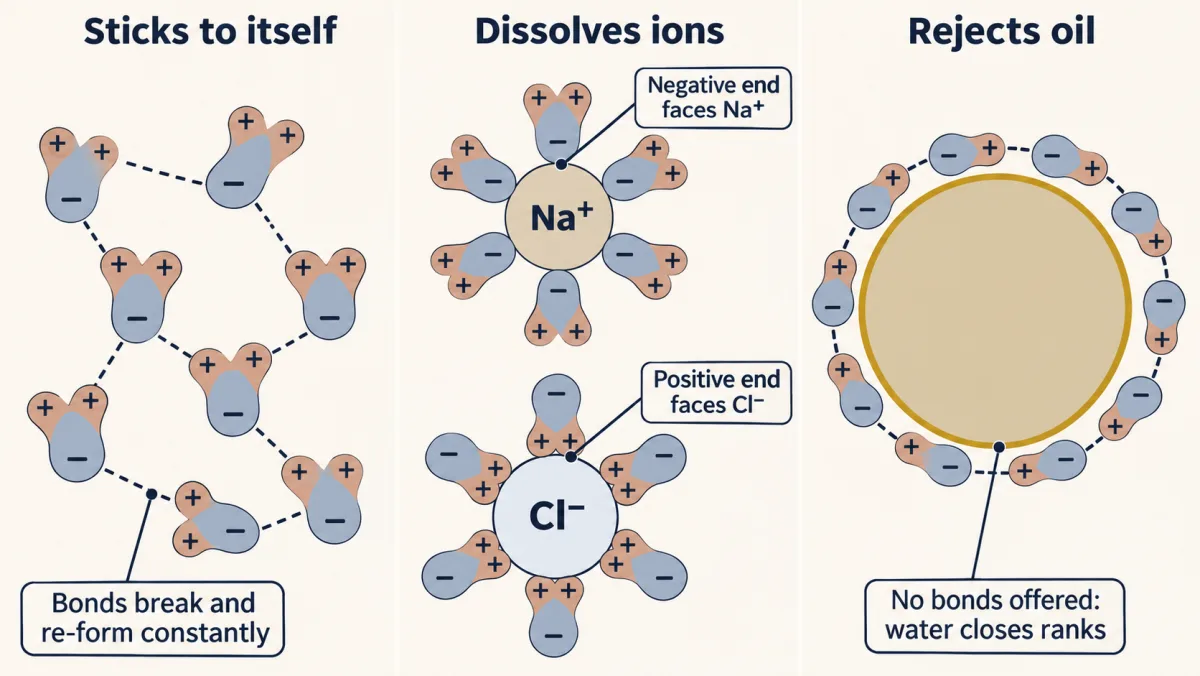
Water is polar. The oxygen pulls electrons far harder than the hydrogens do, so the oxygen carries a partial negative charge and each hydrogen a partial positive. The molecule bends at about 104.5 degrees, so those charges don’t cancel: water is an electric dipole, with a minus end and a plus end.
That polarity gives water three jobs. It sticks to itself, hydrogen end to oxygen end, in a flickering network where each bond forms and breaks in a few trillionths of a second. It dissolves many charged things, wrapping a sodium ion in a shell of oxygens and a chloride in a shell of hydrogens. And it rejects anything nonpolar, refusing to make room for an oil droplet the way a crowded room refuses to absorb someone who won’t talk to anyone. Hold onto that third job.
Weak on purpose, measured in RT
Covalent bonds build the cell — the backbone of a protein, the sugar-phosphate rails of DNA — and at 100 to 1,000 kilojoules per mole they are made to last. But the cell’s work is done by bonds you can break: hydrogen bonds, ionic attractions, van der Waals contacts. When you smell a cat, odorant molecules bind your receptors, trigger a signal, and fall off. If that binding were covalent, you would smell that cat for the rest of your life. Reversibility is the point.
What breaks a weak bond is heat. A particle in water jitters as water molecules hit it, the random walk that, summed over billions of molecules, we call diffusion. Warm the water or shrink the tracer and watch it speed up.
- Diffusion speed, D ∝ T/r (vs. default)
- —
- Path traveled
- —
- Net distance from start
- —
- RT, the size of the kicks
- 2.58 kJ/mol
The big particle is never pushed by a hand — only by lopsided volleys of water molecules (each hit flashes dark). It travels a long, wandering path yet ends up only a short way from the start (the + mark): that is a random walk. Warm it up or shrink it and the walk speeds up.
Einstein's 1905 insight: the jitter you can see in a microscope is direct evidence of molecules you cannot. Diffusion is just this random walk, summed over billions of particles. RT, about 2.6 kJ/mol at 37 °C, is the size of these kicks; a bond worth one or two RT is broken and re-formed by them all the time.
RT is the yardstick for that jostling: covalent bonds are about 40 to 400 RT, so heat almost never breaks them, while a bond worth one or two RT breaks and re-forms all the time.
Hydrogen bonds: who can donate
A hydrogen bond forms when a hydrogen on a strongly electronegative atom, O or N (the donor), is drawn to a lone pair on another O or N (the acceptor).
Predict. Which can donate a hydrogen bond: serine’s –OH, lysine’s –NH₃⁺, or alanine’s –CH₃?
Check your prediction
The –OH and –NH₃⁺ can. The –CH₃ cannot, in any useful way: carbon’s electronegativity (2.55) is too close to hydrogen’s (2.20) to leave the hydrogen much positive charge, and the methyl carbon has no lone pair to accept one. That is why methyl groups are nonpolar.
In a vacuum a hydrogen bond is worth about 10 to 40 kJ/mol. In water the donor and acceptor were already hydrogen-bonded to water, so pairing them mostly trades one bond for another, and the net gain is a few kJ/mol, one to a few RT.
Charges: why water evens things out
Coulomb’s law gives the energy between two charges q₁ and q₂ a distance r apart: E = kq₁q₂/(Dr). Here k is a constant and D, the dielectric constant, measures how well the medium screens charge: 1 for a vacuum, about 80 for water, about 2 to 4 inside a protein. Two opposite charges 4 Å apart attract with about 350 kJ/mol in a vacuum, about 90 inside a protein (D ≈ 4), and about 4 in water. So in a vacuum, ionic beats hydrogen bond beats van der Waals, but in water an exposed salt bridge (an ion pair between side chains) gets at most about 4 to 6 kJ/mol from Coulomb’s law alone, measured values are usually smaller, and it is no stronger than a hydrogen bond’s net share.
Predict. Move a glutamate–lysine salt bridge from the surface (D ≈ 80) into the core (D ≈ 3) at the same distance. How much stronger is the attraction, and does the protein gain that much stability?
Check your prediction
By Coulomb’s law alone, about 27-fold stronger (80 / 3). But to reach the core both charges had to leave their water, and that desolvation penalty can cost as much as the attraction gains. The net effect ranges from destabilizing to several kcal/mol.
Ethanol precipitation of DNA runs the same law the other way: change the water instead. Ethanol lowers D, the attraction between the negative phosphates and counterions such as sodium strengthens, and the DNA clumps into a white thread.
The four-Ångström window
Hydrogen bonds and van der Waals contacts work at the same length scale: roughly three to four Ångströms (a few ten-billionths of a meter) between atoms. Closer, atoms repel; a little farther, the attraction fades fast. Ionic attraction reaches farther, though water and dissolved salt damp it down. Life happens in that narrow window. On the ruler below, slide the distance past 5 Å and watch the energy all but vanish.
One hydrogen bond, at its ideal 2.8 Å.
Simplified model. In water, values are net of the bonds each group already made with water.
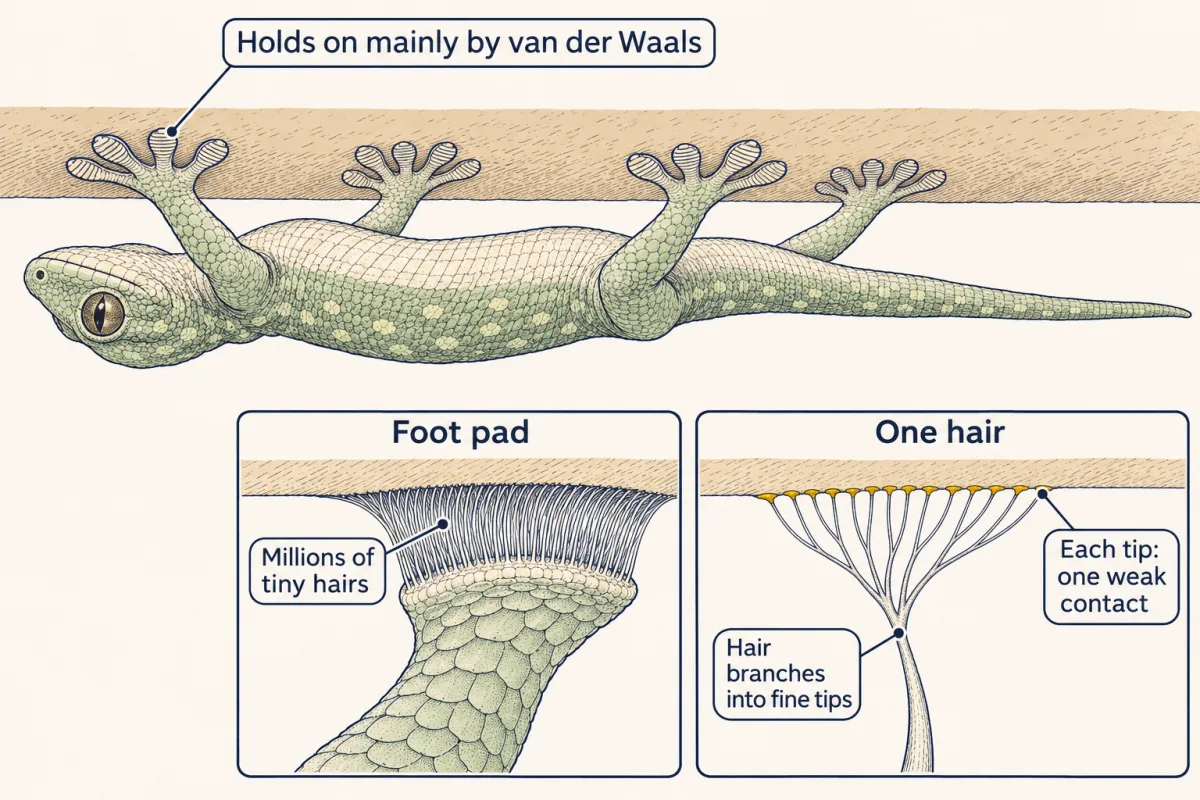
One van der Waals contact is worth under about 4 kJ/mol (1 kcal/mol), about 1.5 RT. But weak bonds add, and since an equilibrium constant grows exponentially with energy, their effects multiply: one 4 kJ/mol contact gives a constant of about 5, ten acting together about 5 million (an upper bound: in water the net gain per contact is smaller, because water was touching those atoms too, and a real interface pays some entropy back). A gecko hangs from a ceiling mainly on van der Waals forces, made over and over by the branching hairs on its feet (figure). Drag the “How many bonds” slider above and watch the total grow.
What pays for order: the hydrophobic effect
The film above animates this section: the stiffer layer of water around one methyl group, the release when oily groups gather, and the folding ledger. Here are the details it skips. The water next to a –CH₃ keeps its hydrogen bonds by pointing them toward other water.
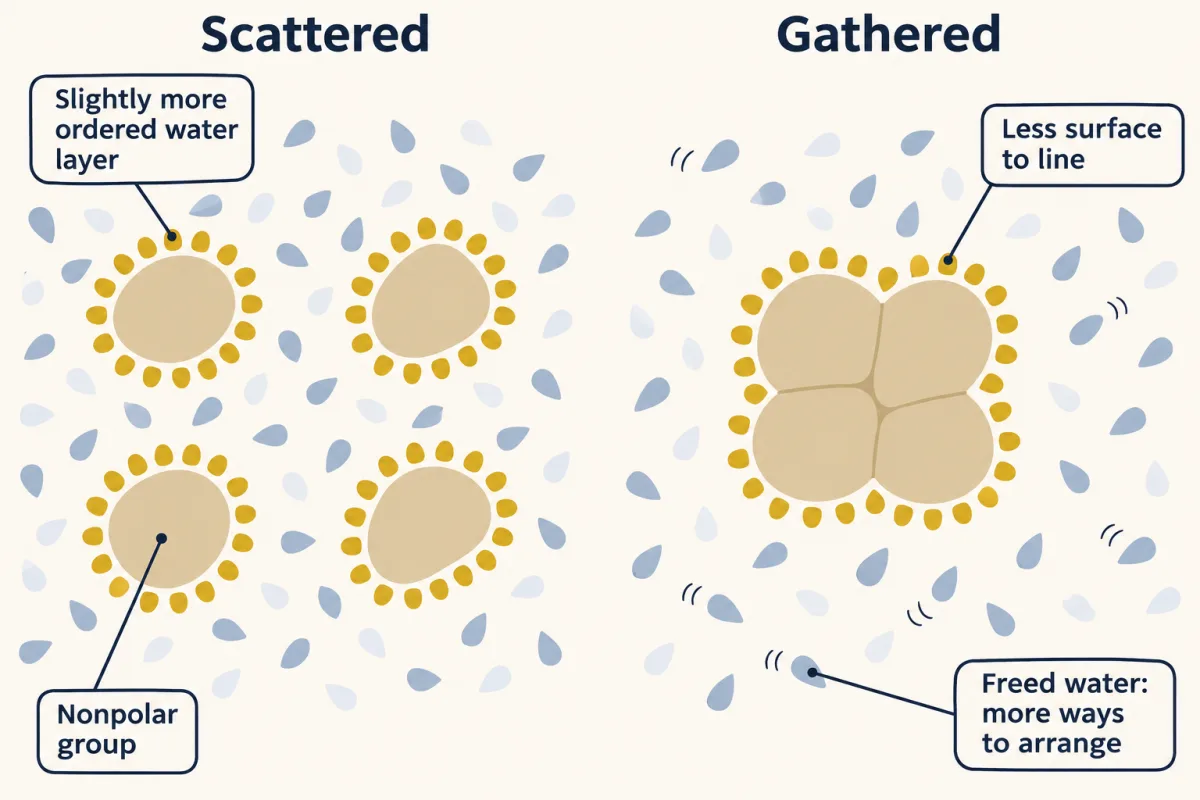
Predict. When a protein chain folds and buries its nonpolar side chains, what is the sign of ΔS for the chain? For the water?
Check your prediction
The chain’s entropy falls: a floppy chain that could take an astronomical number of shapes is held in roughly one. The water’s entropy rises: water that lined the buried surface is released into the bulk. Which is bigger? The ledger below answers it.
That release is the hydrophobic effect. The groups’ own van der Waals attraction is weak. At a large, flat surface such as an oil droplet’s, enthalpy’s larger share comes from water simply losing hydrogen bonds it cannot replace.
Here is the film’s ledger for a protein of about 100 residues near 25 °C, in round numbers (positive opposes folding, negative favors it):
| Term | Rough size (kJ/mol) |
|---|---|
| The chain loses its freedom of shape | about +550 |
| Water freed from about 4,800 Ų of nonpolar surface buried in the core | about −500 |
| Hydrogen bonds, ion pairs and tight van der Waals packing inside the fold, counted net of the bonds those groups used to make with water | about −90 |
| ΔG of folding | about −40 |
The first two rows come from standard rules of thumb: about 25 cal/mol for each Ų of nonpolar surface buried (4,800 × 25 cal is about 500 kJ), and 4 to 7 kJ/mol of lost freedom per residue. The total is what is measured: small proteins typically fold with ΔG between about −20 and −60 kJ/mol. So the third row is simply what is left over (Going deeper).
The film reads the ledger for the second law and for the small difference between big numbers. Two numbers it leaves out. Near 25 °C nearly all of the −500 is the water’s entropy, about −480: a little less than the chain’s +550. And a 10% change in the burial row is 50 kJ/mol. The same thin margin keeps folded proteins only modestly stable, which also leaves room for the flexing many proteins need to work.
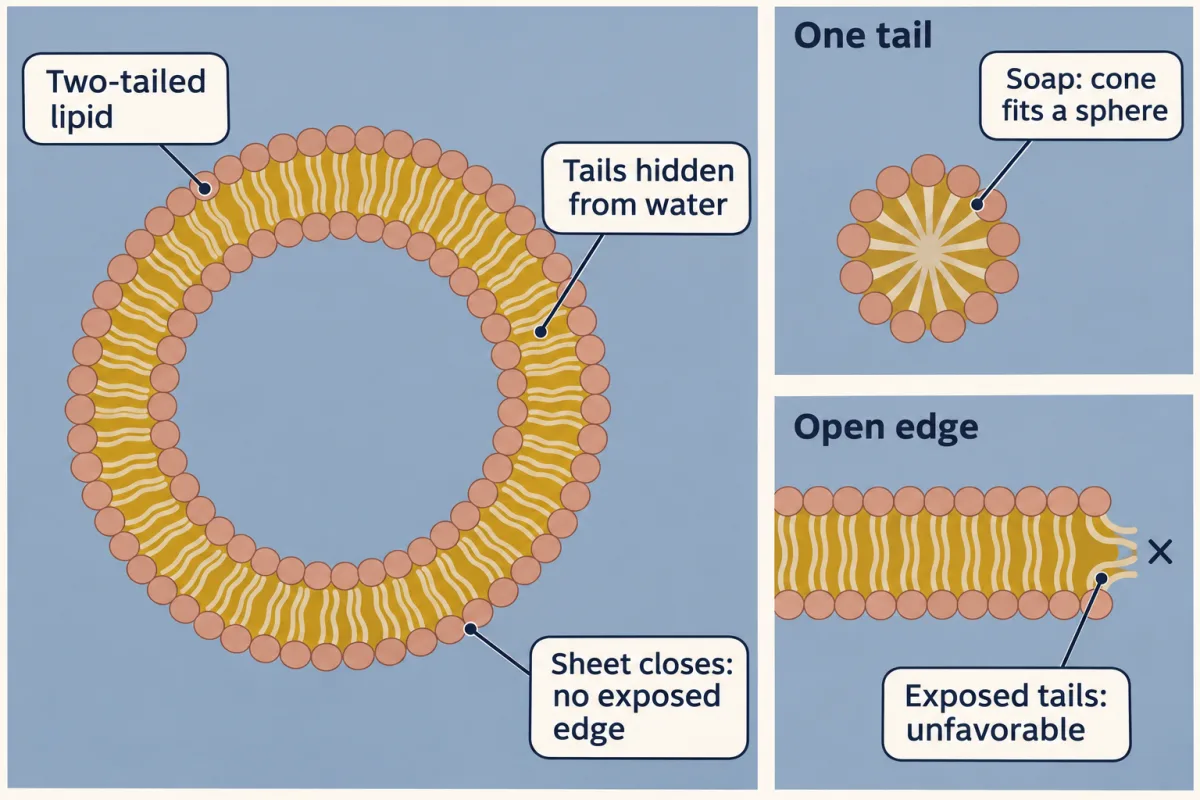
The same logic builds membranes. A phospholipid with two greasy tails can’t dissolve, and it is too bulky to pack into the small sphere, a micelle, that single-tailed soaps form. So it lines up tail-to-tail into a two-layer sheet, a bilayer, that closes on itself so no tails are left exposed at an edge. Enzymes make the lipids and proteins insert them into existing membranes, but no enzyme holds a bilayer together. Water does: the lipids lose freedom when they line up, and the water freed from their tails pays for it.
Read the transcript of “A Buffer That Breathes”
Film transcript: A Buffer That Breathes
Water lets weak bonds add up to a fold. But ionic attractions need charges, and pH decides which groups carry them. Blood holds its pH in a window a tenth of a unit wide. By the usual rule, its buffer is poor. How does it hold?
Take a group that can hold a proton. Below its pKa, it mostly keeps it. Above, it mostly lets go. At the pKa, a half and half. Each pH unit past the pKa shifts the ratio tenfold. One unit above, about 91% % have let go. Two units, about 99. One pH unit is worth about one weak bond. Near the pKa, both forms are plentiful, ready to absorb acid or base. Far away, one form has nearly run out. So a sealed flask buffers best within about one unit. Blood's buffer is bicarbonate, with CO₂ as the acid side. Its effective pKa is 6.1. Blood sits at 7.4, 1.3 off. About 20 bicarbonates per CO₂. Take 24 mM bicarbonate and 1.2 mM CO₂. Seal the flask and add 10 mM strong acid.
Each mM turns one bicarbonate into CO₂. Bicarbonate falls to 14. CO₂ piles up to 11.2. The ratio collapses to barely above one. The pH drops to about 6.2. Now open the flask. Breathing carries the extra CO₂ away, holding it at 1.2.
Same acid. Where does the pH land now? About 7.17. Bicarbonate falls to 14. CO₂ stays put, so the ratio stays near twelve to one. The acid side never builds up. That is the trick. Blood's buffer works far from its pKa because blood is not sealed. Breathing carries the extra CO₂ away. Real blood does even better. Hemoglobin and other buffers take up part of the acid. Later, the kidneys restore the bicarbonate. Cross much past the window, and proteins change their charges and work less well. The heart rhythm can falter. Less than one pH unit separates ordinary chemistry from emergency. A buffer's pKa is not the whole story. Blood's works because each breath throws out the acid side.
That helps steady the charges weak bonds need.
From the film
- Below a group's pKa it mostly holds its proton, above it mostly lets go, and at the pKa it is half and half.
- Each pH unit away from the pKa shifts the ratio tenfold, and one pH unit is worth about one weak bond.
- In a sealed flask a buffer works best within about one unit of its pKa, where both forms are plentiful.
- Blood's bicarbonate buffer has an effective pKa of 6.1, about 1.3 units from blood's 7.4, yet it works because breathing carries the extra CO₂ away.
- In a simple model, adding 10 mM of strong acid drops a sealed flask to about pH 6.2, but only to about 7.17 when breathing holds CO₂ steady.
pH: the ledger for charge
Ionic attractions, and many hydrogen bonds, depend on whether a group is charged, which depends on pH. Back to the one idea: a proton coming on or off is one more term in the ledger, worth about one weak bond per pH unit.
Below a group’s pKa, the group mostly holds its proton; above it, it mostly lets go; at the pKa, half and half. Call the protonated form HA and the form that has lost its proton A⁻. The Henderson-Hasselbalch equation writes the rule out: pH = pKa + log([A⁻]/[HA]).
| pH − pKa | [A⁻] : [HA] | Share deprotonated |
|---|---|---|
| −2 | 1 : 100 | about 1% |
| −1 | 1 : 10 | about 9% |
| 0 | 1 : 1 | 50% |
| +1 | 10 : 1 | about 91% |
| +2 | 100 : 1 | about 99% |
Predict. Glycine has a carboxyl group (pKa 2.3) and an amino group (pKa 9.6). At pH 7.4, what form does each take, and what is the net charge?
Check your prediction
The carboxyl’s pKa is 5.1 units below the pH, far beyond the table’s last row: it is –COO⁻, more than 99.99%. The amino group’s pKa is 2.2 units above the pH, so it stays –NH₃⁺, about 99.4%. One negative, one positive: a zwitterion, net charge 0.
The table also explains buffers. Far from the pKa, one form has nearly run out, leaving little to absorb added acid or base, so a simple buffer in a sealed flask works best within about one unit of its pKa.
Blood pH lives between 7.35 and 7.45, a window one tenth of a pH unit wide, guarded by the bicarbonate buffer (CO₂ + H₂O ⇌ H₂CO₃ ⇌ H⁺ + HCO₃⁻), effective pKa 6.1. At 7.4 that is 1.3 units off, about 20 bicarbonate ions per dissolved CO₂ (101.3 ≈ 20): a poor buffer by the sealed-flask rule. It works because blood is not sealed: breathing carries the extra CO₂ away. Model it with bicarbonate alone, 24 mM HCO₃⁻ and 1.2 mM dissolved CO₂, and add 10 mM of strong acid; each mM of acid turns one mM of bicarbonate into CO₂. In a sealed flask the pH falls to about 6.2 (14 mM HCO₃⁻ against 11.2 mM CO₂). If breathing keeps CO₂ at 1.2 mM, it falls only to about 7.17. Real blood does better still: the lungs lower CO₂ in response, and hemoglobin and other buffers take up part of the acid. The kidneys then restore the bicarbonate.
Predict. A patient hyperventilates until blood CO₂ halves, bicarbonate unchanged. Which way does blood pH move?
Check your prediction
Up, to about 7.7: a respiratory alkalosis. Removing CO₂ pulls the equilibrium left, so [H⁺] falls (in this bicarbonate-only model, the bicarbonate used up is negligible against 24 mM). CO₂ is the acid side of the ratio, so halving it doubles [HCO₃⁻]/[CO₂], and pH rises by log 2, about 0.3.
Cross much past the window and proteins change their charges and work less well, the heart rhythm can falter, and a patient can slide toward coma. Less than one pH unit separates ordinary chemistry from a medical emergency. Life is organized chaos, held together by bonds weak enough to let go, paid for by water’s demand for its own freedom, and tuned by a single number, pH.
Going deeper
How temperature changes the hydrophobic effect
The hydrophobic contribution to stability tends to strengthen with temperature over the physiological range, so some proteins are less stable in the cold and can even cold-denature. The cause is a positive heat-capacity change, ΔCp, on exposing nonpolar surface: as temperature rises the entropy term shrinks and the enthalpy term grows. In a standard (convergence) model, entropy’s share of the cost is about 96% at 25 °C, 82% at 37 °C and 56% at 60 °C, while the total grows only about 4% from 25 to 37 °C. The same ΔCp bends protein stability into a two-armed curve: heat unfolds a protein because the chain’s entropy wins, and cold because the hydrophobic effect weakens.
Which favorable terms matter most
The ledger’s third row is a remainder, not a measurement, so how the favorable side splits is still argued. Burying oily groups is widely considered the largest single contribution to folding, but some calorimetric and mutational analyses argue that hydrogen bonds contribute comparably.
Favored is not the same as fast
Anfinsen proposed that the native shape is the chain’s lowest-free-energy state in its environment. Many proteins fit, but some need help to fold, and amyloid can be even more stable than the native form. Folding avoids a random search of every shape (Levinthal’s paradox) by running downhill on a funnel-shaped energy landscape.
Your notes
Select any text in the lesson to highlight it or add a note to it. Your highlights and notes are saved in this browser and collected in your notebook.
This browser is not letting the site save anything (a private window or strict privacy settings), so highlights and notes will be lost when you leave the page.
Try the Predict questions again
Five Predict questions from this lesson, on their own. Answer each one first, then open its check.
Which can donate a hydrogen bond: serine’s –OH, lysine’s –NH₃⁺, or alanine’s –CH₃?
From: Weak on purpose, measured in RT
Check your prediction
The –OH and –NH₃⁺ can. The –CH₃ cannot, in any useful way: carbon’s electronegativity (2.55) is too close to hydrogen’s (2.20) to leave the hydrogen much positive charge, and the methyl carbon has no lone pair to accept one. That is why methyl groups are nonpolar.
Move a glutamate–lysine salt bridge from the surface (D ≈ 80) into the core (D ≈ 3) at the same distance. How much stronger is the attraction, and does the protein gain that much stability?
From: Weak on purpose, measured in RT
Check your prediction
By Coulomb’s law alone, about 27-fold stronger (80 / 3). But to reach the core both charges had to leave their water, and that desolvation penalty can cost as much as the attraction gains. The net effect ranges from destabilizing to several kcal/mol.
When a protein chain folds and buries its nonpolar side chains, what is the sign of ΔS for the chain? For the water?
From: What pays for order: the hydrophobic effect
Check your prediction
The chain’s entropy falls: a floppy chain that could take an astronomical number of shapes is held in roughly one. The water’s entropy rises: water that lined the buried surface is released into the bulk. Which is bigger? The ledger below answers it.
Glycine has a carboxyl group (pKa 2.3) and an amino group (pKa 9.6). At pH 7.4, what form does each take, and what is the net charge?
From: pH: the ledger for charge
Check your prediction
The carboxyl’s pKa is 5.1 units below the pH, far beyond the table’s last row: it is –COO⁻, more than 99.99%. The amino group’s pKa is 2.2 units above the pH, so it stays –NH₃⁺, about 99.4%. One negative, one positive: a zwitterion, net charge 0.
A patient hyperventilates until blood CO₂ halves, bicarbonate unchanged. Which way does blood pH move?
From: pH: the ledger for charge
Check your prediction
Up, to about 7.7: a respiratory alkalosis. Removing CO₂ pulls the equilibrium left, so [H⁺] falls (in this bicarbonate-only model, the bicarbonate used up is negligible against 24 mM). CO₂ is the acid side of the ratio, so halving it doubles [HCO₃⁻]/[CO₂], and pH rises by log 2, about 0.3.
How we measure it
Reading bond strength off distance
Every weak interaction is a function of how far apart two atoms sit. Hydrogen bonds peak around 2.8 Ångströms, van der Waals around 3–4, and both fall off steeply past 5. Plot energy against distance and the "sweet spot" of biology draws itself.
Ethanol precipitation of DNA
Add ethanol to a salty DNA solution and the strands fall out as a white thread. Lowering the dielectric constant strengthens the ionic interactions holding sodium to the phosphate backbone, so the DNA stops dissolving. The abstract dielectric becomes a thing you can spool on a glass rod.
Henderson-Hasselbalch as a dial
pH = pKa + log([A⁻]/[HA]). One pH unit above the pKa means a 10:1 ratio of base to acid; at the pKa they are equal. Run the equation backward to find the protonation state of any group, and forward to design a buffer that holds a pH within one unit of its pKa.
Practice questions on this lesson (4) → MCAT-style, original, each with an explanation
Where this lesson fits
Before thisReview first
- Water and LifeBiology · High school
It teaches water's polarity and hydrogen bonding, which this lesson uses to explain cohesion, dissolving and rejecting oily groups.
- What Am I Made Of?Biology · High school
You need to know what proteins and lipids are made of before asking how they fold and assemble.
After thisStudy next
- Amino Acids: How One Side Chain Decides EverythingThis course · Lesson 4
Side-chain charge, pKa and oily versus polar groups here decide which amino acids bury, bind or ionize.
- Protein Three-Dimensional Structure: The Sequence Sets the ShapeThis course · Lesson 5
It applies hydrophobic burial, weak bonds and the folding ledger to explain how a sequence sets a protein's shape.
- Membranes: The Impermeable Sheet That Builds ItselfThis course · Lesson 12
It uses the hydrophobic effect to explain why lipids assemble themselves into a sealed bilayer.
Suggested by an AI model from the lessons themselves, then checked. How we use AI
That is the skim: you have the shape of it.
That is both films: the lesson in pictures.
The rest of the lesson is here when you want it.
Finish line
Test yourself
8 questions
Practice and MCAT-style, with explained answers.
Next · Lesson 4
Amino Acids: How One Side Chain Decides Everything
The R group sets what makes each amino acid different — its charge, its pKa, and the Glu→Val swap behind sickle cell.
Continue →← Lesson 2 · Introduction to Biochemistry and Cell Biology: Compartments Create Control
Rewritten on : new film. Notes and highlights stay, but the text around them may have moved.