Biochemistry · Skim version
Water, Weak Bonds, and the Generation of Order
Read the full lesson → Skim the whole course →
The guiding idea
A protein folds itself, and no instructions are needed. Water and many weak, reversible bonds make the folded state the favorable one, and burying oily groups away from water is widely considered the largest single contribution.
The second law seems to say everything should fall apart.
From the film
- The second law counts total entropy: the protein, its water, and the heat they trade with their surroundings.
- Water lining an oily group forms a layer only slightly stiffer than bulk water, with lower entropy.
- Gathering small oily groups frees that water; near room temperature, this hydrophobic effect is almost all entropy.
- In the film's round-number ledger for a roughly 100-residue protein, folding wins by about −40 kJ/mol.
- In this ledger, water's regained freedom pays most of the bill for folding.
-
Water is the engine, not the stage
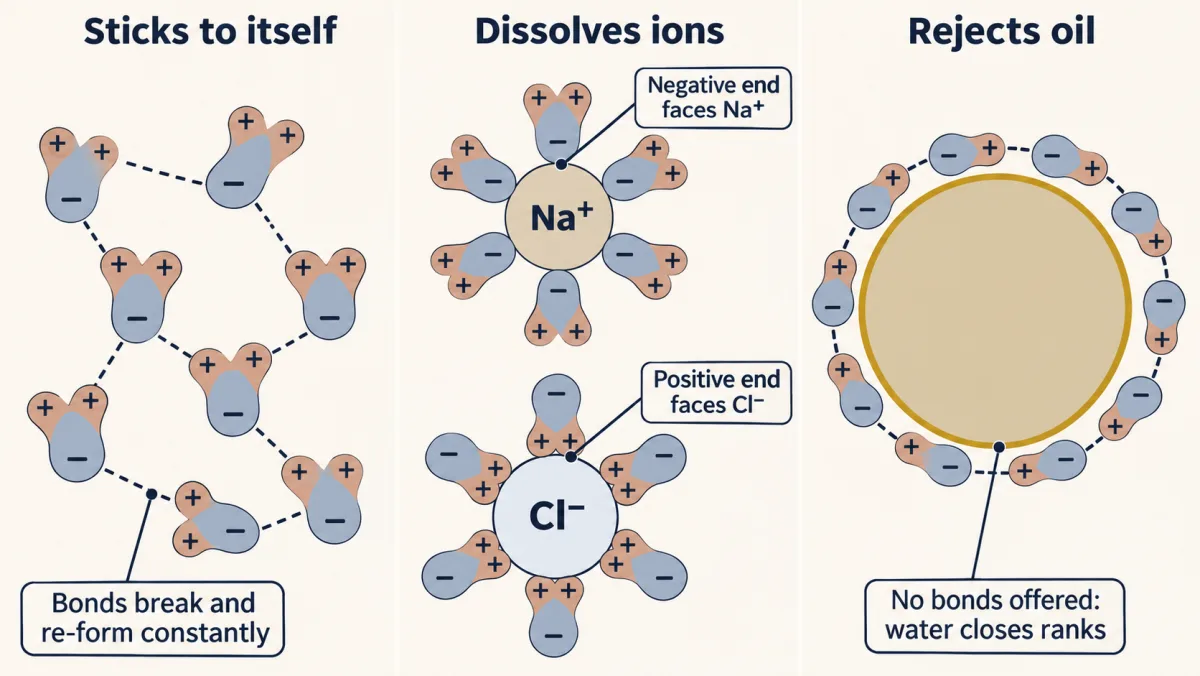
One polar molecule, three jobs. Water sticks to itself in a network whose bonds flicker on and off in trillionths of a second; it wraps ions in shells, negative end toward a cation and positive end toward an anion; and it offers nothing to a nonpolar surface. That third job is the one that builds proteins and membranes. AI-generated illustration -
Weak on purpose, measured in RT
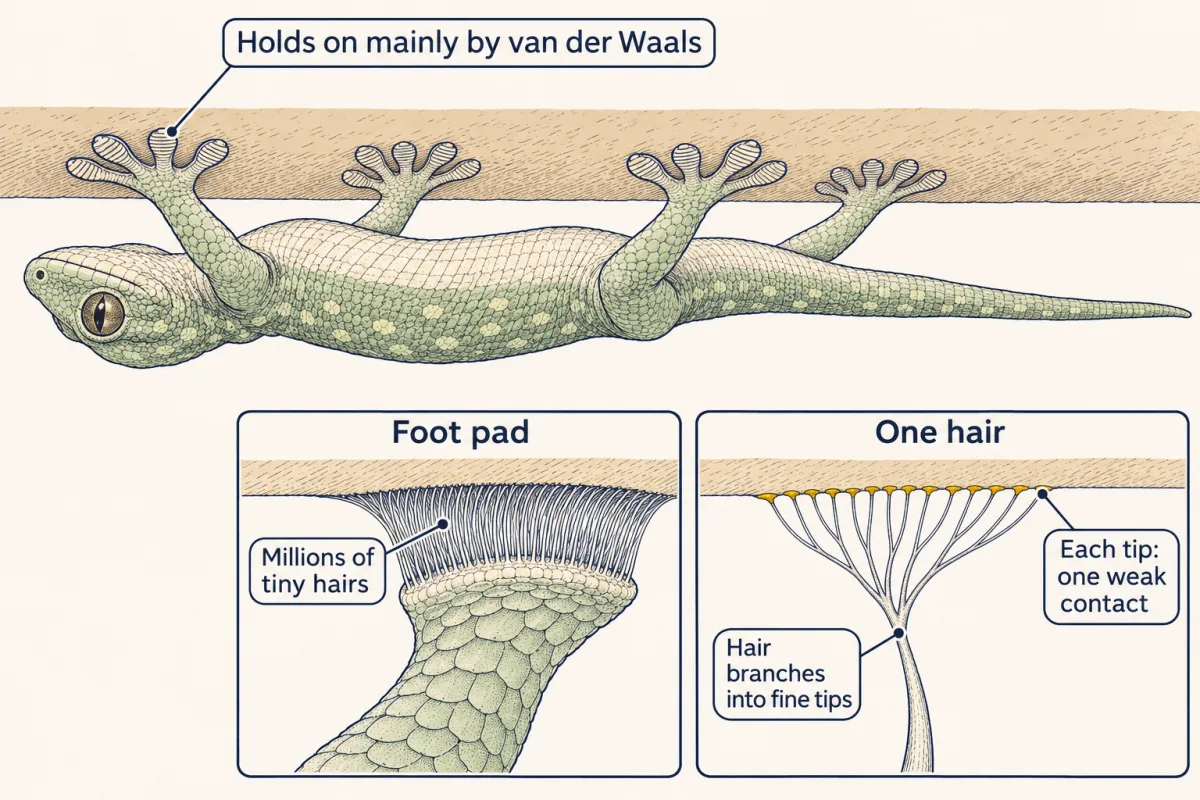
One weak bond is almost nothing, but weak bonds add. A gecko hangs from a ceiling mainly on van der Waals forces: millions of tiny hairs on its feet each branch into many finer tips, making countless trivial contacts, and the sum can hold many times its body weight. AI-generated illustration -
What pays for order: the hydrophobic effect
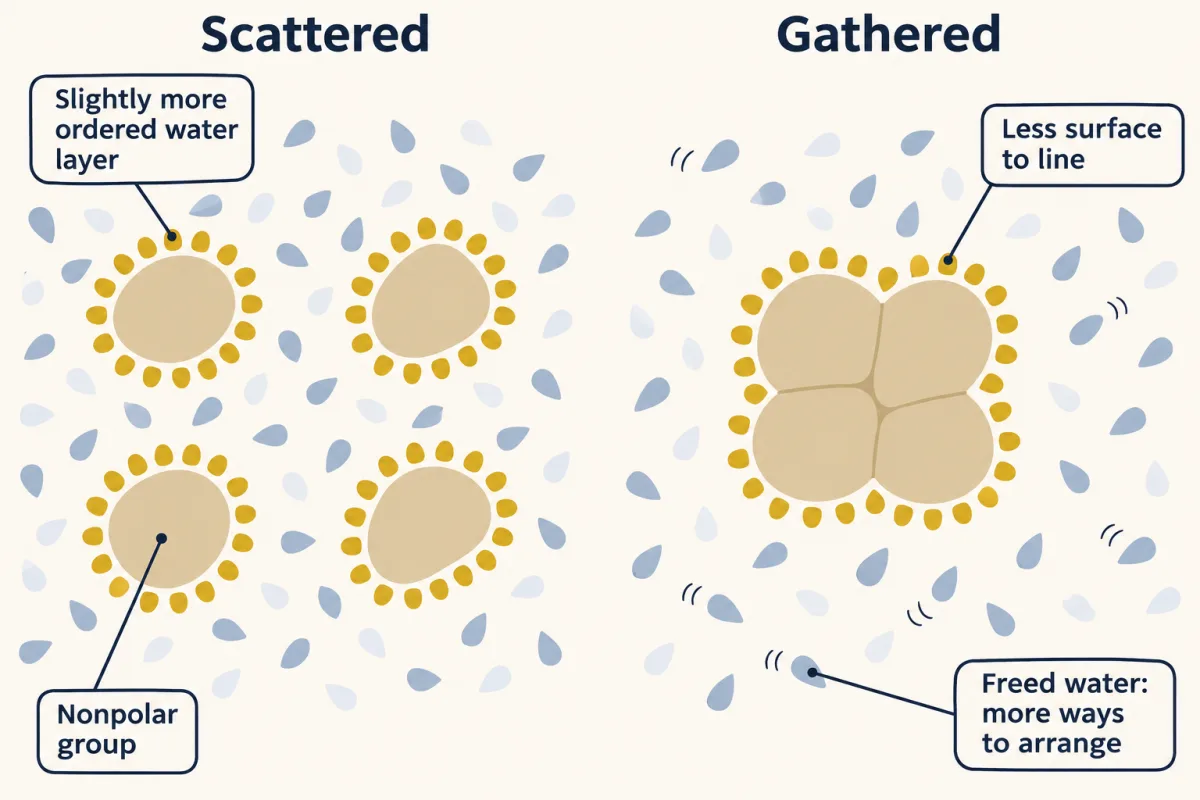
Nonpolar groups end up together mainly because water gains freedom, not because they attract each other. Each exposed group is lined by a layer of water only modestly more ordered than the bulk (not an ice cage); gathering the groups shrinks that surface and frees the water. Near room temperature this gain is almost all entropy. AI-generated illustration 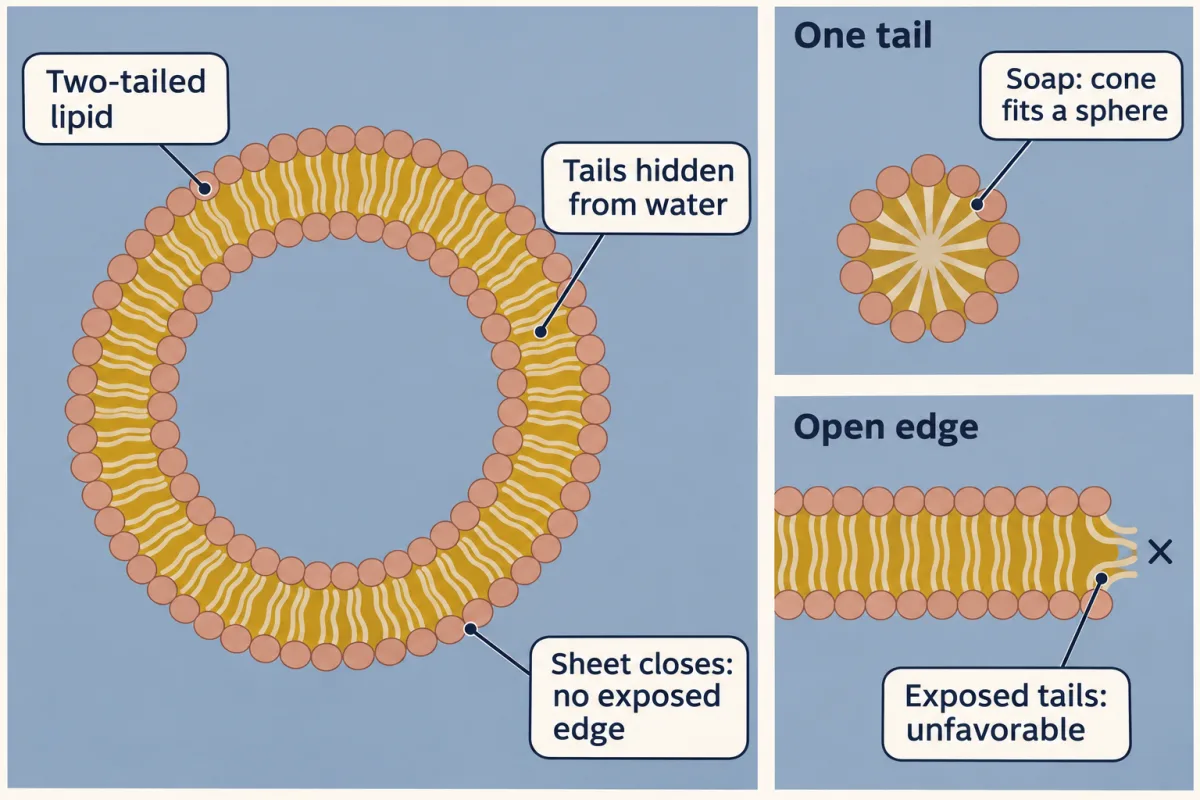
Single-tailed soaps pack into a small sphere, a micelle. Two-tailed phospholipids are too bulky for that, so they line up tail to tail in a bilayer, and the sheet closes on itself because an open edge would leave tails touching water. No enzyme holds the bilayer together; the water freed from the tails pays for the lipids' lost freedom. AI-generated illustration -
pH: the ledger for charge
-
Going deeper
Where this lesson fits
Before thisReview first
- Water and LifeBiology · High school
It teaches water's polarity and hydrogen bonding, which this lesson uses to explain cohesion, dissolving and rejecting oily groups.
- What Am I Made Of?Biology · High school
You need to know what proteins and lipids are made of before asking how they fold and assemble.
After thisStudy next
- Amino Acids: How One Side Chain Decides EverythingThis course · Lesson 4
Side-chain charge, pKa and oily versus polar groups here decide which amino acids bury, bind or ionize.
- Protein Three-Dimensional Structure: The Sequence Sets the ShapeThis course · Lesson 5
It applies hydrophobic burial, weak bonds and the folding ledger to explain how a sequence sets a protein's shape.
- Membranes: The Impermeable Sheet That Builds ItselfThis course · Lesson 12
It uses the hydrophobic effect to explain why lipids assemble themselves into a sealed bilayer.
Suggested by an AI model from the lessons themselves, then checked. How we use AI