Cell Signaling · Skim version
Turning the Signal Off: Arrestins, RGS Proteins and Phosphodiesterases
Read the full lesson → Skim the whole course →
The guiding idea
The hormone is still bound and the response has faded. What switched the receptor off?
During a GPCR response, each active layer fades when removal outruns production.
From the film: The Mark and the Reader
- A GRK mark does little until arrestin reads it.
- A GRK marks the active receptor; arrestin reads the mark and covers the surface the G protein needs.
- Controls ruled out look-alikes: an unrelated protein, heat-denatured arrestin and an unmarked receptor all failed.
- The agonist can stay bound while the receptor is silenced.
From the film: Where the Signal Runs Out
- Each downstream layer fades when removal outruns production.
- RGS proteins speed GTP hydrolysis, phosphodiesterases destroy cyclic nucleotides, and phosphatases remove target phosphates.
- A breakdown inhibitor makes no new messenger; it slows the decay of messenger already present and, with continuing input, raises and prolongs the pool.
- Pulses leave time for adaptation to reverse; a steady GnRH signal does not.
-
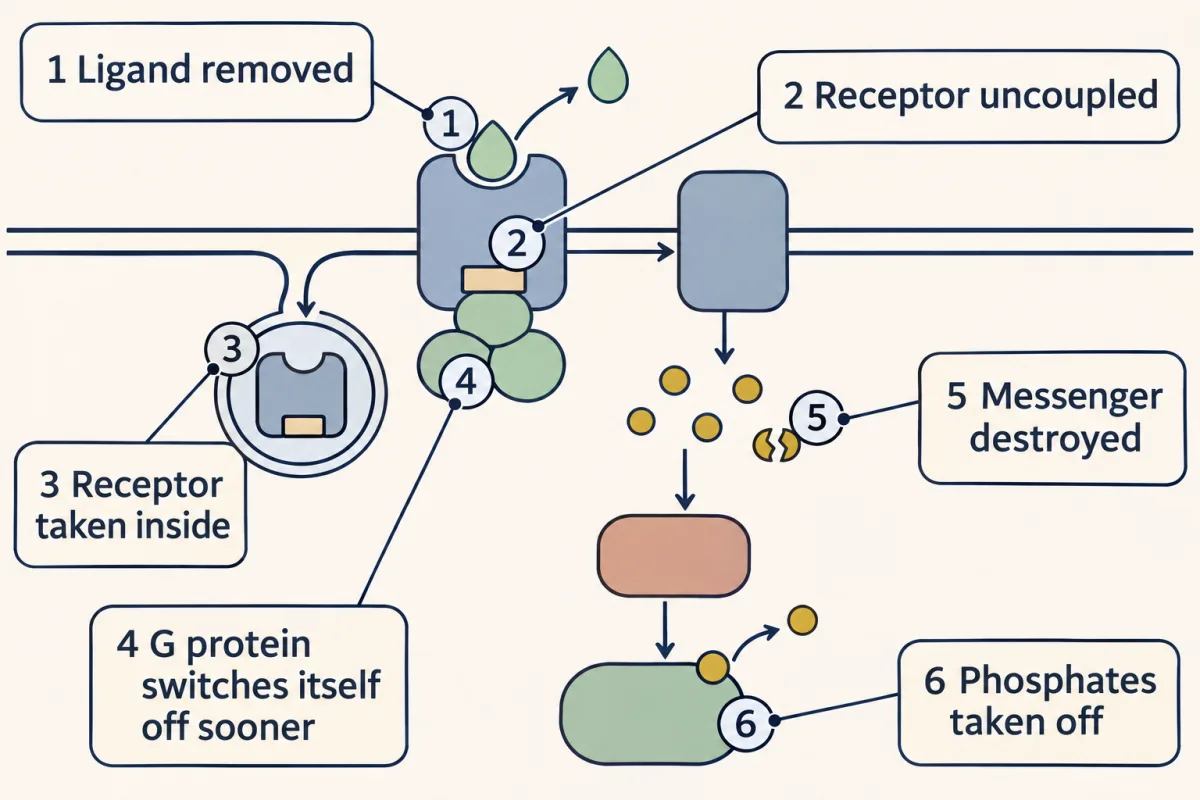
From the outside in, a GPCR response can be shortened at the ligand, receptor, G protein, messenger or phosphorylated target. AI-generated illustration -
The experiment: the mark is necessary but not sufficient
-
Arrestin carries the receptor into the cell
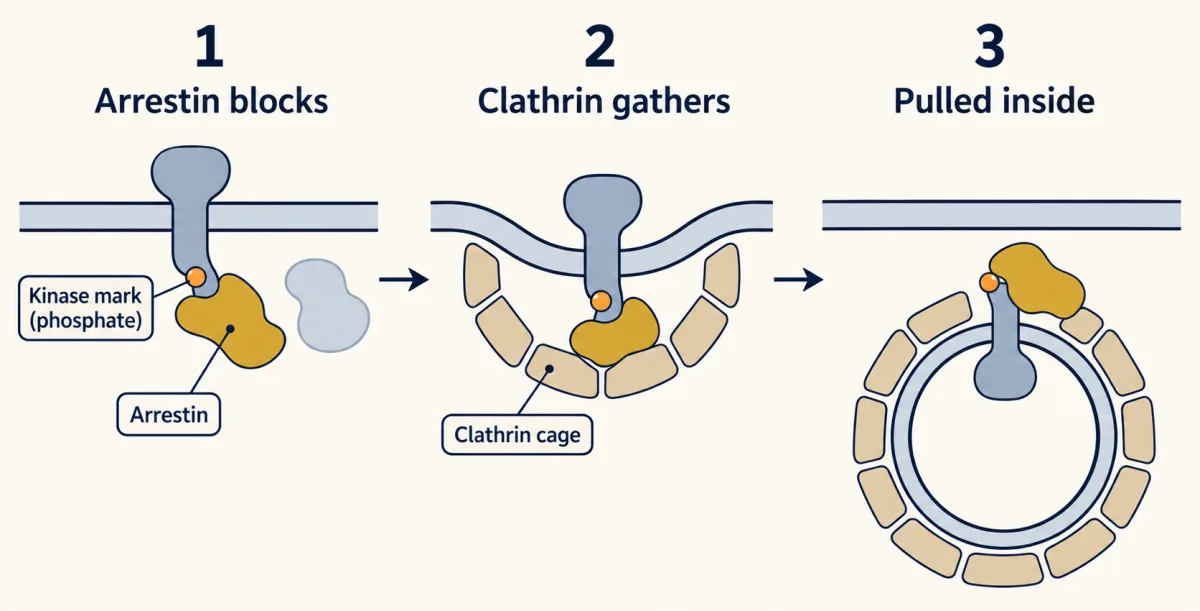
Core-bound arrestin can block G-protein coupling and recruit clathrin, but tail-bound or internalized receptors need not be silent. AI-generated illustration -
Three downstream removal processes
-
Constant GnRH shuts the pituitary down
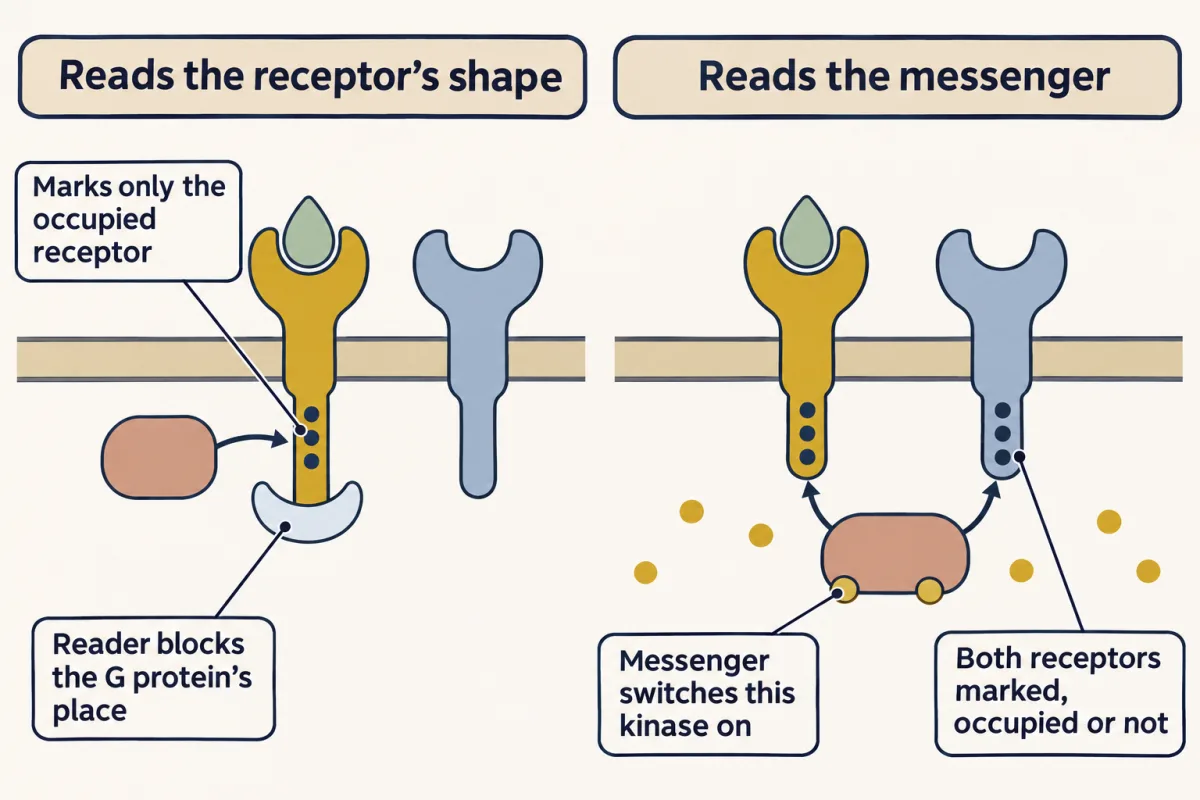
A GRK reads receptor shape for homologous desensitization, whereas messenger-activated kinases can mark occupied or empty receptors for heterologous desensitization. AI-generated illustration -
Going deeper
Where this lesson fits
Before thisReview first
- GTPase Switches: The TimerThis course · Lesson 7
RGS proteins here speed up the G-alpha GTP cut, which that lesson explains as the GTPase timer.
- GPCRs and Trimeric G ProteinsThis course · Lesson 12
You need the receptor, G protein and adenylyl cyclase on-pathway to see what each off switch removes.
- Phosphorylation: Kinases and PhosphatasesThis course · Lesson 6
The kinase mark on the receptor and the phosphatase reset both rest on how kinases and phosphatases act as switches.
After thisStudy next
- Endocytosis and Signaling EndosomesThis course · Lesson 36
It takes further the arrestin-clathrin trip into the cell and asks whether the receptor keeps signaling from endosomes.
- Sensing the World: Vision, Smell, Nitric Oxide and cGMPThis course · Lesson 17
It uses phosphodiesterase breakdown of cGMP and rhodopsin kinase with arrestin to shape the rod's response.
- The Shape of a Signal: Size, Duration, Frequency and PlaceThis course · Lesson 35
It builds on how pulses versus steady signals are read, as in the GnRH case.
Suggested by an AI model from the lessons themselves, then checked. How we use AI