Neuroscience · Skim version
Transmitter Systems and Drugs
Read the full lesson → Skim the whole course →
The guiding idea
Four drugs that act on GABA push inhibition in opposite directions. What decides which way a drug pushes?
A small set of transmitters, above all glutamate and GABA, carries most fast synaptic signaling in the brain, and every transmitter goes through three steps: it is released, read by receptors, and removed.
From the film: Three Steps, One Drug
- Every transmitter is released, read by receptors and removed, and a drug mainly changes one of these steps.
- Agonists imitate the transmitter, competitive antagonists block it, modulators change its effect and reuptake blockers or enzyme inhibitors make it last.
- Four drugs on one transmitter, GABA, can push inhibition in opposite directions depending on which step they change and in which direction.
From the film: How Much a Drug Changes a Step
- The share of targets a drug fills depends on its concentration relative to its dissociation constant, and the last few percent cost far more drug.
- In a simple model where a transporter is the only way out, blocking it stretches the signal by the factor 1 plus L over K.
- A competitive antagonist shifts a dose-response curve right without lowering the top, while a modulator at a separate site has a ceiling.
From the film: A Mechanism Is Not a Cause
- In a blinded tryptophan-depletion study, 14 of 21 patients in remission on antidepressants relapsed, which suggests some treated patients need serotonin to stay well.
- A treatment can depend on a transmitter that was never low.
- A drug's mechanism is evidence about the drug, not proof of what causes the disease.
-
A chemical message and three puzzles
-
The idea: three steps, and a drug changes mainly one
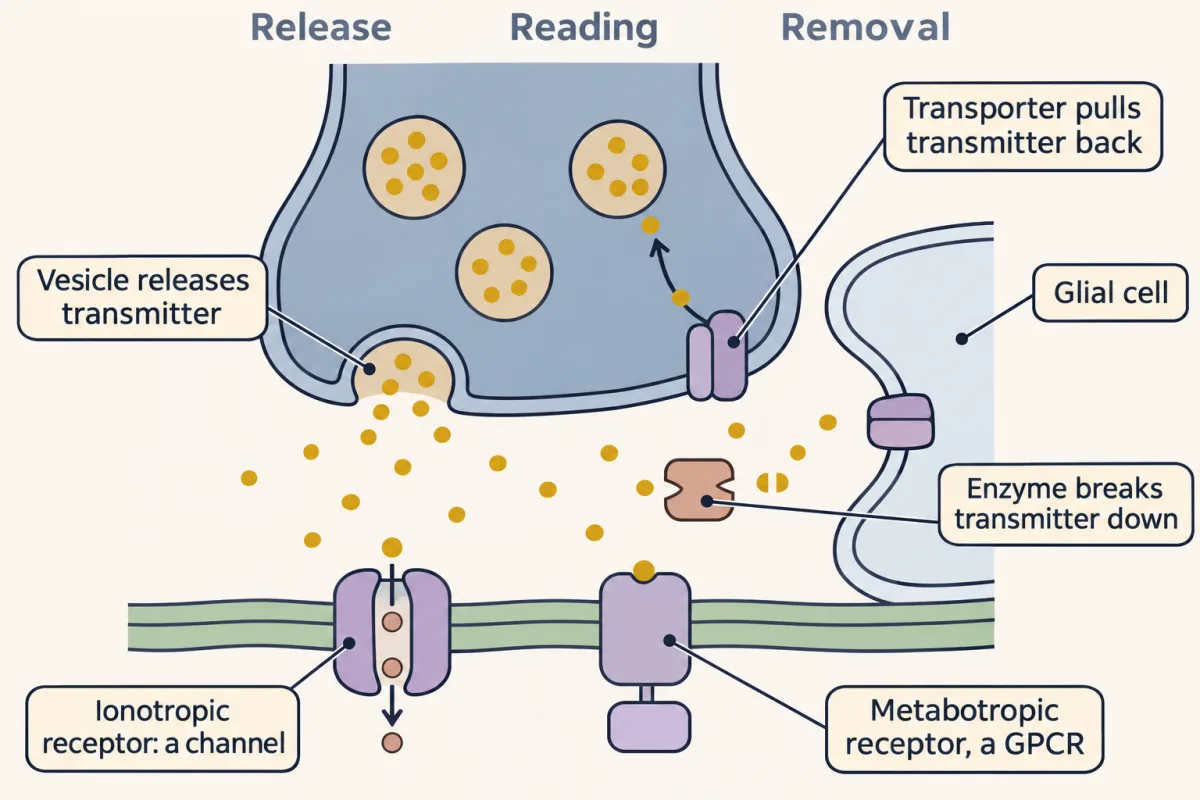
Every transmitter system has the same three steps, release, reading by ionotropic or metabotropic receptors, and removal by a transporter or an enzyme, and a drug changes mainly one of them. AI-generated illustration -
The reader decides the sign
-
Walking the systems
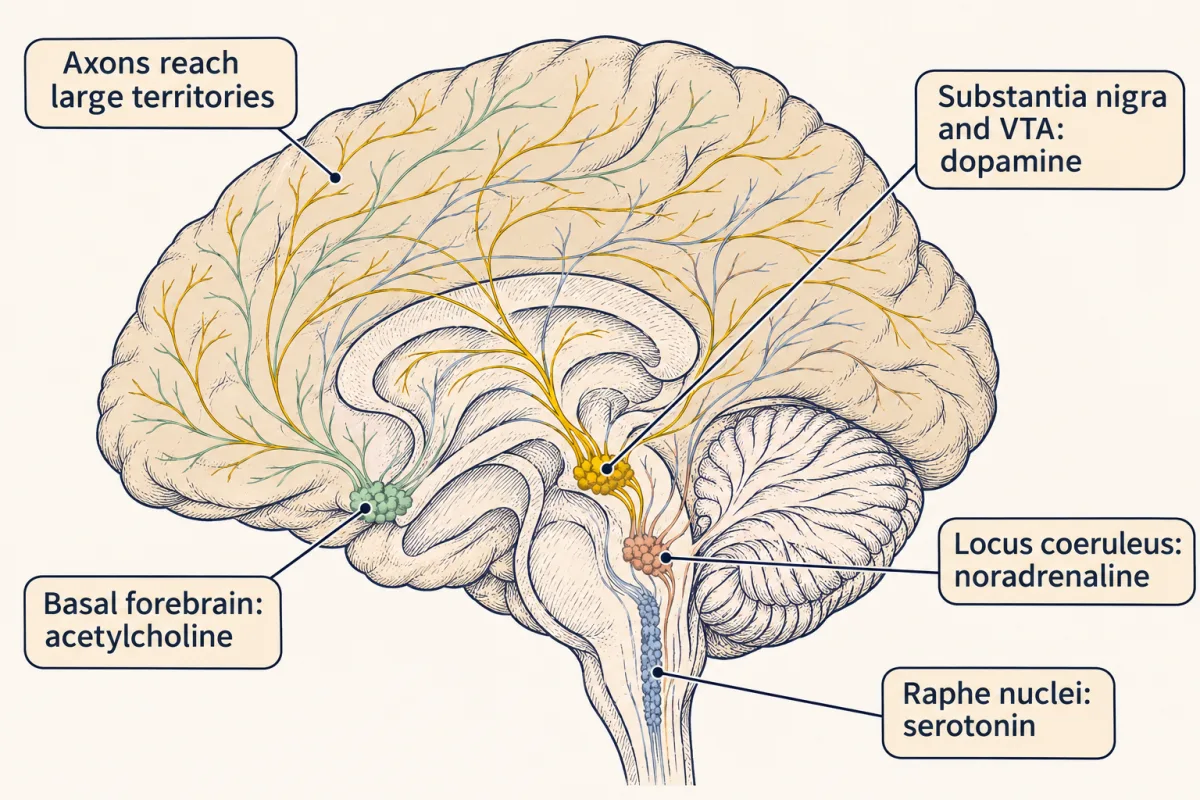
Acetylcholine and the amines come mainly from a few small nuclei whose axons reach large territories; positions are approximate and these are not the only sources. AI-generated illustration -
How much: occupancy and the factor 1 + L/K
-
A mechanism is not a cause
-
Going deeper
Where this lesson fits
Before thisReview first
- The Action Potential and ConductionThis course · Lesson 4
You need equilibrium potentials and channels pulling Vm toward them to see why GABA's sign depends on E_Cl.
- The Resting Membrane and Passive SignalsThis course · Lesson 3
Resting potential and conductance explain the balance-point calculation for chloride channels opening near rest.
- Synaptic Transmission and Quantal ReleaseThis course · Lesson 5
The lesson uses vesicular release and the cleft as the starting point and does not re-teach them.
After thisStudy next
- Integration, Inhibition and NeuromodulationThis course · Lesson 7
It takes the chloride shunting and inhibition-by-conductance idea from here and shows how inhibitory inputs shape firing.
- Feeding, Motivation and RewardThis course · Lesson 19
It builds on dopamine's source, receptors and uptake here to test what dopamine signals actually do.
- Descending Control and the Basal GangliaThis course · Lesson 16
Dopamine and GABA projection neurons introduced here are placed into movement circuits there.
Elsewhere on the siteFilms, simulations and method films in other courses
- Spectrophotometry and enzyme kineticsMethod film
Competitive inhibition raising the apparent Km by 1 + I/Ki is the same factor used here.
- Dose–response explorerSimulation · Cell Signaling
Occupancy from a dissociation constant and shifted dose-response curves under a competitive antagonist are worked through there.
- The type of receptor sets the speed of the responseFilm · Cell Signaling
It shows how the receptor type, not the transmitter, sets the response, as with ionotropic and metabotropic readers here.
- The Mark and the ReaderFilm · Cell Signaling
It shows how a signal is ended at the receptor and by degradation, the removal step here.
Suggested by an AI model from the lessons themselves, then checked. How we use AI