The Mark and the Reader
Read the transcript of “The Mark and the Reader”
Film transcript: The Mark and the Reader
Adrenaline still fills this receptor, but the cell's response has faded. How can an occupied receptor lose its voice? Start with the receptor while it is active. Its inner face can meet a G protein and start another round of signaling. A dedicated receptor kinase then approaches that active shape. The kinase is called a G-protein-coupled receptor kinase, or GRK. The kinase adds phosphate marks to the receptor's cytoplasmic side. But a mark is not the same as an off switch. That distinction emerged when researchers purified the kinase and rebuilt signaling from isolated parts. Rebuilding the pathway made each requirement testable. The receptor sat in a lipid vesicle beside purified G protein.
Researchers added candidate proteins one at a time. Receptor coupling became the readout, not phosphate alone. A partly purified preparation added phosphate and strongly reduced receptor coupling. A highly purified kinase added phosphate too, yet coupling fell only a little. The phosphate signal remained. Most of the functional effect vanished. The writer survived purification, but switching off did not. What missing part would make the phosphate mark matter?
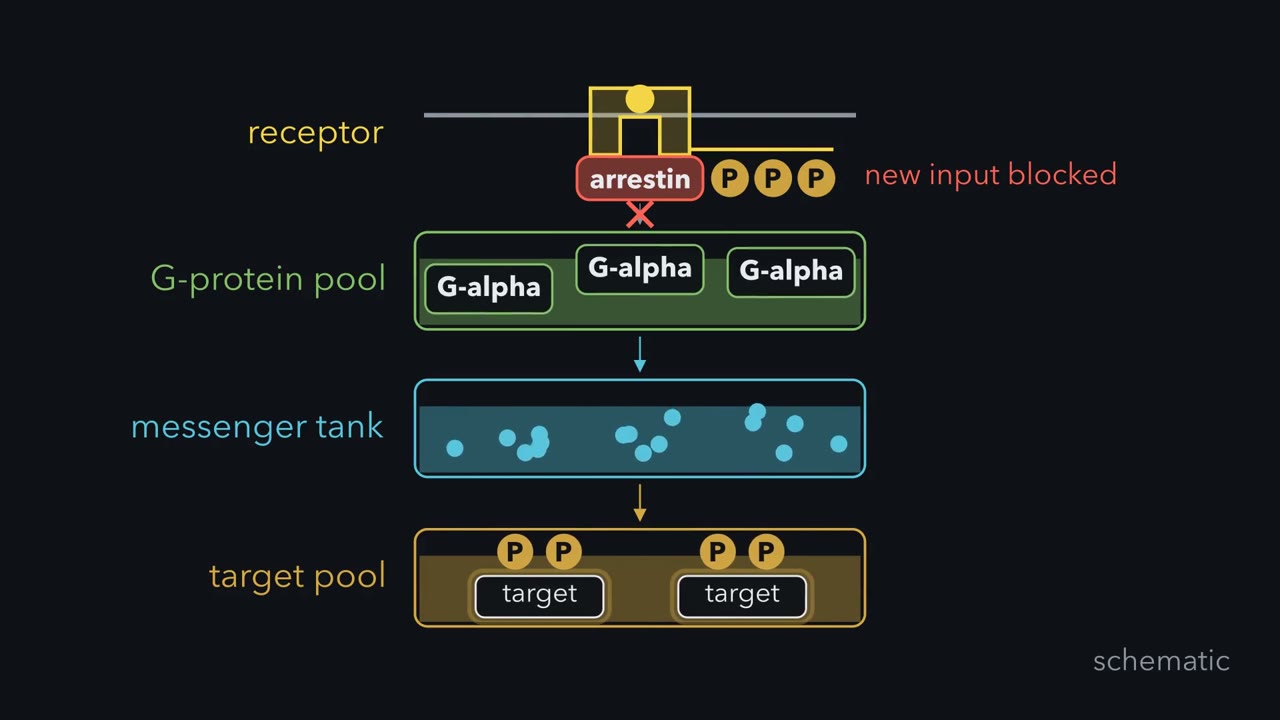
A clue came from the retina. Its light receptor used a second protein, later called arrestin. Adding retinal arrestin to the rebuilt system brought back part of the lost effect. Arrestin alone could not act on an unmarked receptor. The controls narrowed the claim. An unrelated protein could not replace arrestin. Heat-damaged arrestin could not replace it either. The effect required an intact reader and a receptor carrying the kinase's mark. Now the two jobs separate cleanly. GRK writes the mark on the active receptor. Arrestin reads that mark and covers the surface needed by the G protein. The writer identifies the target. The reader produces the block.
This is one layer of a larger rule. During a GPCR response, each active layer fades when removal outruns production. Here, new receptor signaling stops because the mark and reader together prevent new G-protein activation. Notice what the mechanism does not require. The agonist need not leave first. The receptor can remain occupied while its access changes.
Desensitization therefore records regulation inside the cell, not simply disappearance of the outside signal. The receptor is not the whole pathway. Active G proteins, second messengers, and phosphorylated targets can persist after receptor coupling falls. Their removal processes decide how long the rest of the response lasts.
The hormone is still bound and the response has faded. What switched the receptor off?
Continue in the lesson: Turning the Signal Off: Arrestins, RGS Proteins and Phosphodiesterases →
3:36 · Free, with captions and a transcript. The lesson has the full text, the questions and the sources.
More films from this lesson
How this film was made. Narration: written from this lesson's text and read by an AI narrator voice (Kokoro, af_heart). Animation: AI-generated in code (Manim) by Claude, a schematic with no drawn molecular structures. Captions come from the narration script. See something wrong? Report it.