Developmental Neuroscience · Skim version
Tools for Following Cells and Genes
Read the full lesson → Skim the whole course →
The guiding idea
A neuron has no label saying when it was born or where it came from. So how do you find out?
Developmental neuroscience is a methods field: almost every idea in it rests on a way of marking a cell, dating it, following its descendants, or removing a gene from it.
From the film: What Can a Label Prove?
- A method can reveal only what its mark records.
- Transport reveals a projection, not every synapse.
- DNA synthesis approximately dates a cohort.
- An inherited DNA change can reveal ancestry.
From the film: Build a Conditional Test
- Cre changes a floxed allele only where recombination occurs.
- An inducible driver adds control over timing.
- Read each locus separately before interpreting a cross.
- Reporter light does not prove target-gene deletion.
-
What is this cell, and where does it connect?
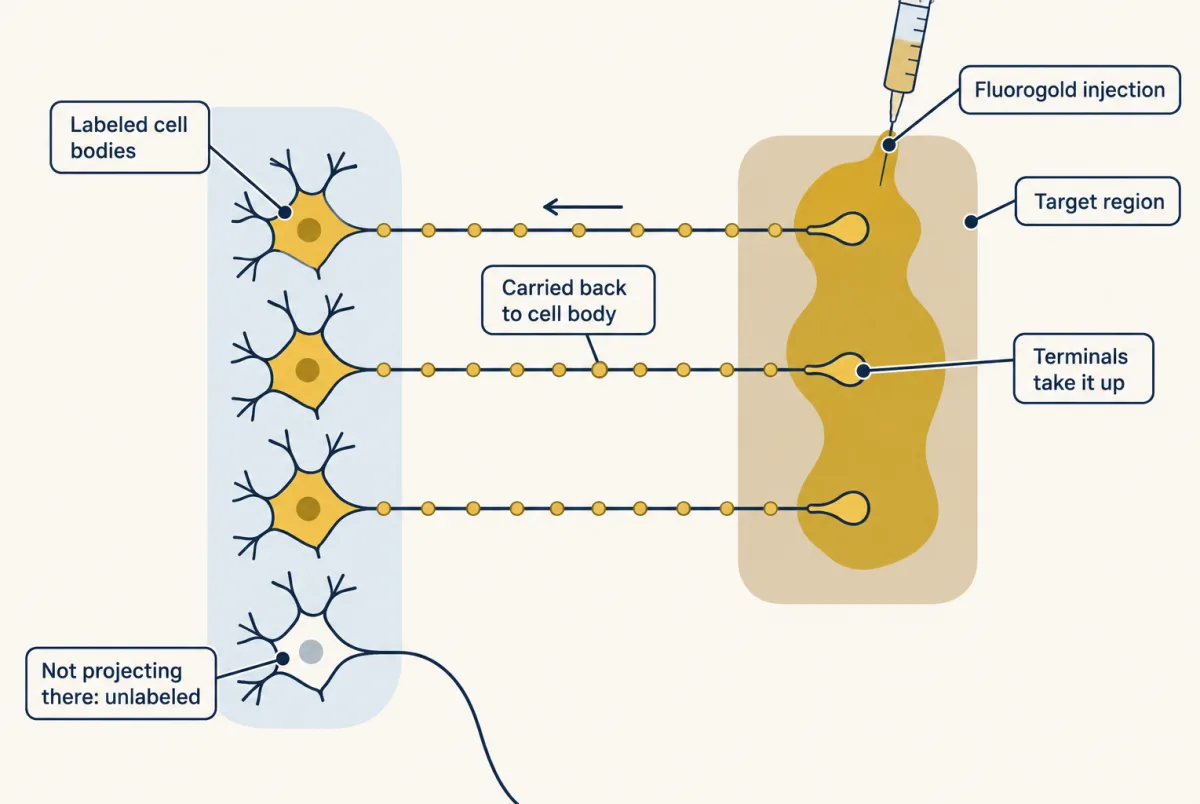
Fluorogold injected into a target region is taken up by axon terminals and transported back to cell bodies, labeling neurons whose terminals take up enough tracer there. Not every projecting neuron is necessarily labeled. This dye injection maps population projections, not individual synapses. AI-generated illustration -
When was this cell born?
-
Whose descendant is this cell?
-
How to make a mouse
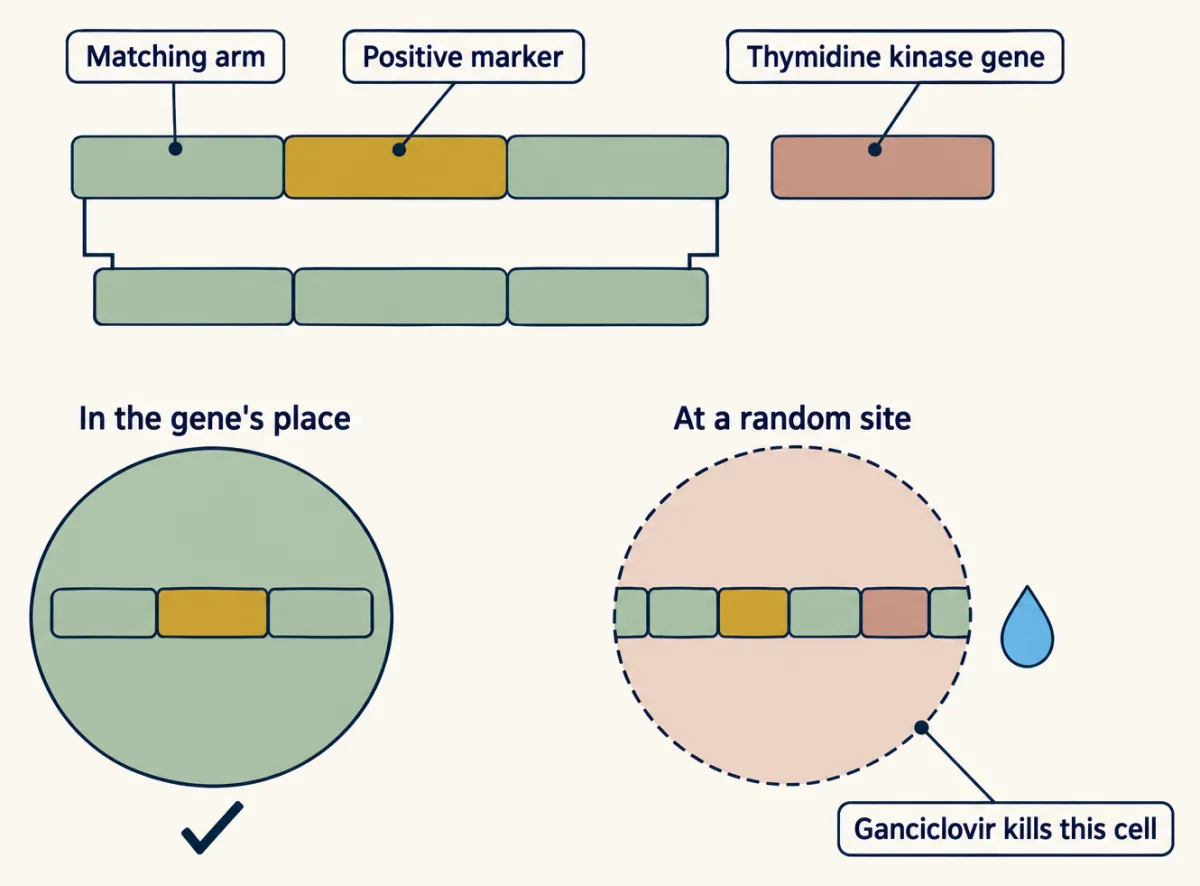
Positive selection retains mouse embryonic stem cells expressing the positive marker. Correct homologous replacement places that marker at the target locus while excluding the thymidine kinase gene, which lies outside the homology arms on the targeting construct. Ganciclovir kills most random integrants that retain functional thymidine kinase. Some random integrants escape negative selection, so surviving clones must still be genotyped. AI-generated illustration -
Necessary, sufficient, reporter, actuator
-
Going deeper
Where this lesson fits
Before thisReview first
- The Wiring Problem: How a Brain Gets BuiltThis course · Lesson 1
It sets out why the genome cannot list the wiring, which is the question these tools exist to answer.
- Seeing Neurons: Golgi, Cajal and the Neuron DoctrineThis course · Lesson 2
Dye-filling and Golgi-style staining here build on the way single neurons were first seen and counted as separate cells.
After thisStudy next
- The Organizer: Spemann and MangoldThis course · Lesson 5
Graft experiments are the classic use of transplanted tissue to follow cells and test what a signal does.
- The Ventricular Zone: Radial Glia as Stem CellsThis course · Lesson 13
Lineage tracing and birth-dating are the tools that showed radial glia make most cortical neurons.
- Birth Order and Fate: Temporal Identity and the Inside-Out CortexThis course · Lesson 16
It uses birth-dating labels to show that the first-born cortical neurons sit deepest.
Elsewhere on the siteFilms, simulations and method films in other courses
- Engineered mutants: site-directed, dominant-negative and constitutively activeMethod film
Making a protein constitutively active or dominant-negative is the same sort of tool as the conditional gene changes covered here.
- Targeted cell ablationMethod film
Removing chosen cells is one of the necessity tests this lesson sorts, using genetically targeted toxins.
Suggested by an AI model from the lessons themselves, then checked. How we use AI