Cell Signaling · Skim version
Innate Immunity: Toll-like Receptors and NF-κB
Read the full lesson → Skim the whole course →
The guiding idea
How does a cell recognize an enemy it has never met, and answer within minutes?
Toll-like receptors let a cell detect a microbe it has never met and switch on inflammatory genes within minutes, a defense that also injures the host when it runs too long or too hard.
-
The idea: detect what a microbe cannot give up
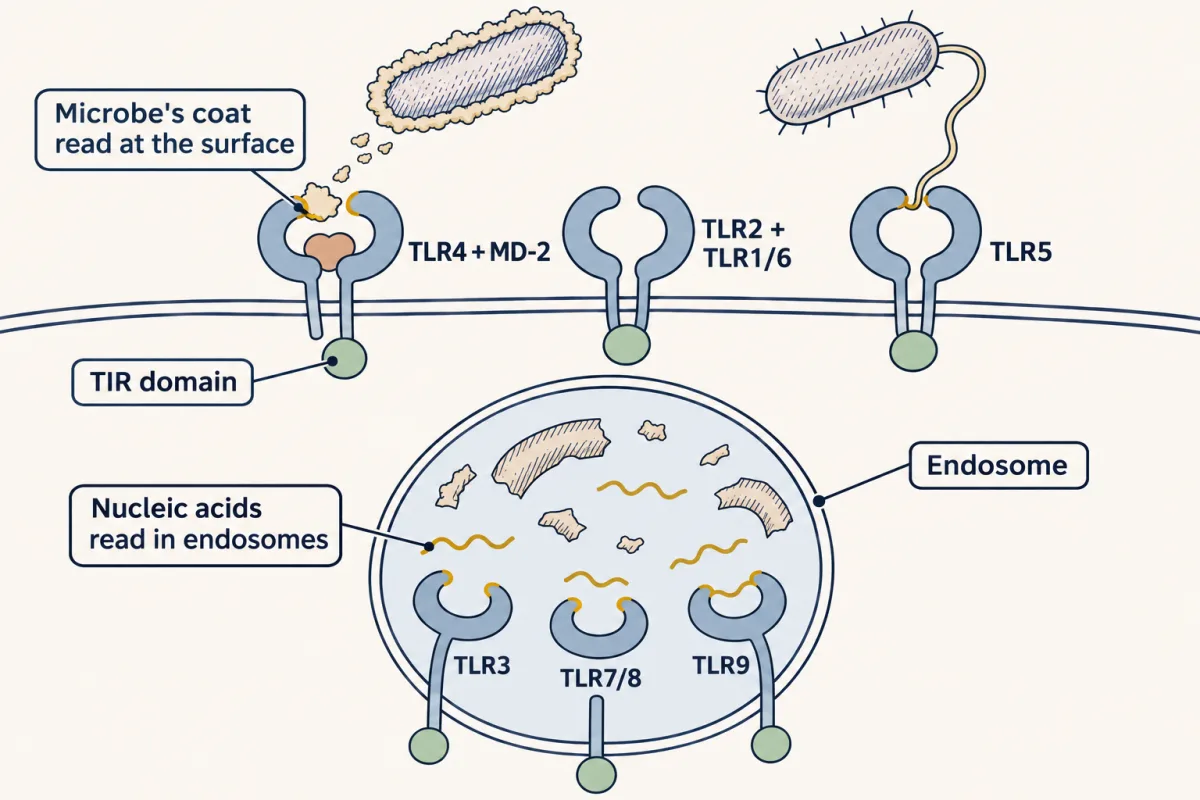
Toll-like receptors that read a microbe's outer molecules sit on the cell surface; those that read nucleic acids sit in endosomes, where swallowed material is broken open. Each has a TIR domain inside the cell. AI-generated illustration -
From receptor to gene: an answer held ready
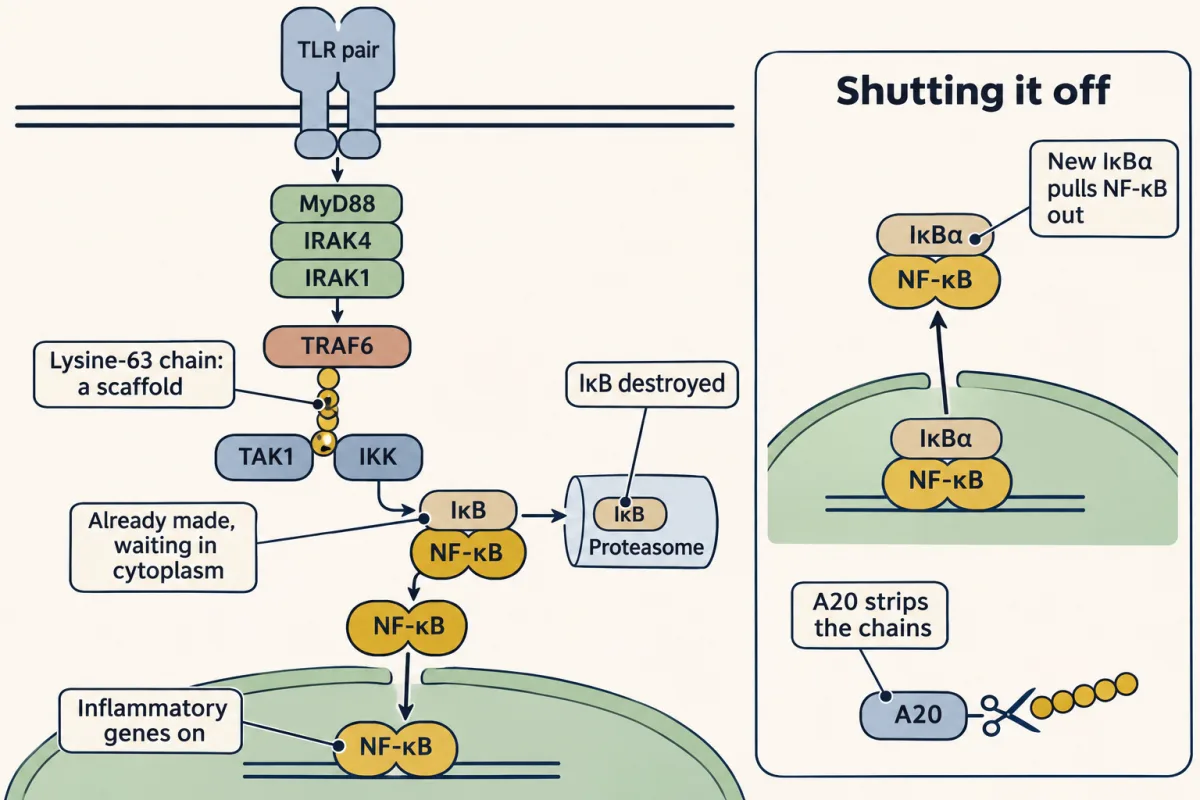
NF-κB is already made and waits in the cytoplasm under IκB. A paired Toll-like receptor gathers MyD88 and the IRAK kinases, TRAF6 builds a lysine-63 chain that switches on IKK, and IκB is destroyed so NF-κB enters the nucleus within minutes. NF-κB then makes new IκBα, which pulls it back out, and A20, which strips the chains. AI-generated illustration -
”The anti-death, death pathway”: one receptor says die and stay alive
-
A second alarm: nucleic acid in the wrong place
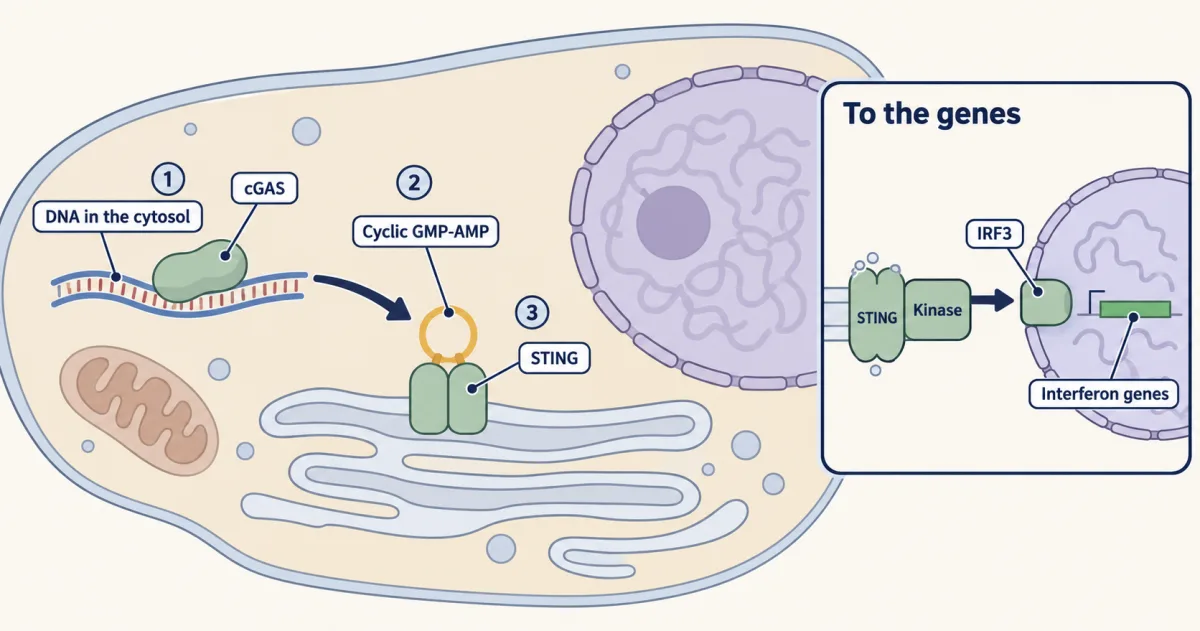
cGAS binds double-stranded DNA in the cytosol and makes the ring cyclic GMP-AMP, which binds STING in the ER membrane. Activated STING moves toward the Golgi and recruits the kinase TBK1, which activates IRF3, and IRF3 switches on interferon genes. AI-generated illustration -
Too little and too much
-
Going deeper
Where this lesson fits
Before thisReview first
- Ubiquitin and Regulated Proteolysis as SignalsThis course · Lesson 8
You need the difference between lysine-48 chains that destroy and lysine-63 chains that scaffold to follow TRAF6 and IκB.
- Phosphorylation: Kinases and PhosphatasesThis course · Lesson 6
IRAK, TAK1 and IKK all pass the signal on by phosphorylating the next kinase or inhibitor.
- Protein Modules: SH2, SH3, PTB, PDZ and PHThis course · Lesson 9
MyD88 and the IRAKs assemble through TIR and death domains, which are protein-binding modules like those taught there.
After thisStudy next
- Antigen Receptors and CheckpointsThis course · Lesson 29
T-cell and B-cell receptors also switch on NF-κB, through a different relay, to drive adaptive immune responses.
- Death Receptors, BCL-2 and CaspasesThis course · Lesson 34
It takes up the death arm of TNF receptor 1 that this lesson leaves for later.
- Stress Signals: p38 and JNK, p53, Unfolded Proteins and OxidantsThis course · Lesson 33
It covers another fast stress response where a transcription factor is held ready and then released.
Suggested by an AI model from the lessons themselves, then checked. How we use AI