Sensory Systems · Skim version
Taste from Tongue to Cortex
Read the full lesson → Skim the whole course →
The guiding idea
A mouse licks sugar water and keeps licking. Which taste does its brain register, and how much does the mouse want it? Are those one signal or two, and where can they be pulled apart?
In the mouse, a taste's identity begins with which taste-cell population is driven, and its value, how much the animal wants it, can be pulled apart by silencing the amygdala.
From the film: Which Taste, and How Good?
- In the mouse, identity (which taste) and value (how much the animal wants it) are two readouts that can be pulled apart.
- In mice, type II taste cells release ATP through channels instead of a conventional vesicular synapse.
- In mice, silencing the amygdala leaves recognition of sweet intact but removes the attraction produced by driving sweet cortex.
- Value also changes with what the body needs.
From the film: Narrow at Threshold, Broader with Strength
- In anaesthetized mice, most responding geniculate neurons were strongly activated by only one of the tested tastes.
- For the bitter-sour class of fibre, acid drives the neuron through bitter cells, so the fibre reports the cell population and not the chemical.
- Tuning broadened as concentration rose in most neurons tested at both strengths, though not all.
- Whether a neuron looks narrow or broad depends on the panel, the concentration and the criterion for a response.
From the film: Opening the Package
- In mice, driving the sweet cortical field drew animals in and driving the bitter field made them turn away.
- Blocking either field impaired recognition of its taste.
- Silencing the amygdala in mice spared trained recognition but abolished the attraction to sweet-field light.
- Value shifts with need: a sodium-depleted animal drinks salt concentrations it would normally reject, in these assays.
-
Where identity starts: two cell types, two synapses
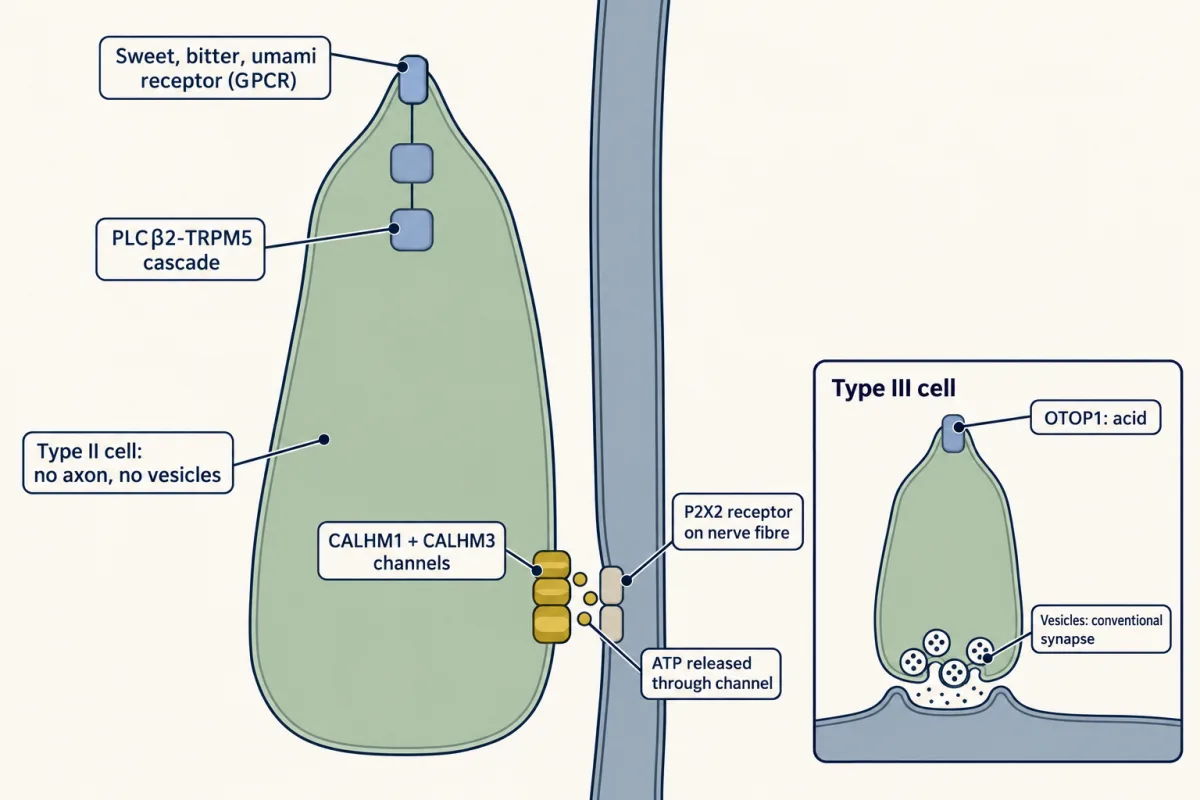
In mice, type II taste cells have no axon or synaptic vesicles and release ATP through CALHM1/3 channels onto afferent fibres carrying P2X2 receptors. Type III cells transduce acid through OTOP1 and make conventional vesicular synapses. OTOP1 is not exclusive to type III cells. ATP signalling is also needed for sour responses, but the cellular source of that ATP remains unresolved in the studies discussed. AI-generated illustration -
One quality per fibre, or one at a time
-
What cortex does with a taste
-
Identity and value can be pulled apart
-
Value that moves with need
-
Going deeper
Where this lesson fits
Before thisReview first
- Smell and TasteNeuroscience · College: going further
It gives the taste cells and receptors whose handoff to nerve fibres this lesson follows.
- Principles of Sensory CodingNeuroscience · College: going further
It teaches labelled-line versus population coding, which the tuning-breadth argument here tests.
- Sensory Neurons by Their Genes: the Atlas EraThis course · Lesson 3
You need to know how neurons are sorted by genes and tuning before judging narrow versus broad fibres.
After thisStudy next
- Combining Senses and Predicting ThemThis course · Lesson 29
It takes the idea further by asking how separate senses, and signals caused by your own movement, are combined.
Elsewhere on the siteFilms, simulations and method films in other courses
- Received Minus PredictedFilm · Neuroscience
It shows how the brain signals how much an animal wants something, the value signal separated from identity here.
- Correction, Threshold and GainFilm · Neuroscience
It shows how a body need changes a drive, as sodium need changes how much an animal wants salt.
Suggested by an AI model from the lessons themselves, then checked. How we use AI