Received Minus Predicted
Read the transcript of “Received Minus Predicted”
Film transcript: Received Minus Predicted
Why would a well-fed mouse suddenly start eating? Researchers put a light-sensitive switch into a small group of neurons at the base of its brain. When they shone light on those neurons, the well-fed mouse began eating within minutes. That raises two questions. Why is food worth seeking? And how does the brain learn where to find it? Hunger answers the first. Hunger changes how much food is worth right now, and circuits in the hypothalamus are thought to help set that. Dopamine neurons in the midbrain help with the second, and what they report is surprising. They do not simply report the reward. They report how much better or worse things went than predicted.
Picture two bars over a cup of juice. One shows what was predicted. The other shows what arrived. The gap between them is the error. When the juice is better than predicted, the gap is positive. The neuron fires a brief burst. Now the juice arrives exactly as predicted. What does the neuron do?
Nothing. With no gap, there is no error, and the firing stays steady. When the reward is worse than predicted, or missing, the gap is negative. Firing pauses briefly. If the same juice comes every trial, the prediction moves part of the way toward it each time. So the error at the juice shrinks toward zero. An uncertain reward always leaves some surprise. With learning, the burst moves to the tone that announces the juice. Good news from a cue counts as an error too. Hunger and satiety change how much the reward is worth in the first place. Keep the scope. This holds for many, not all, dopamine neurons, in trained monkeys and rodents. It describes a signal.
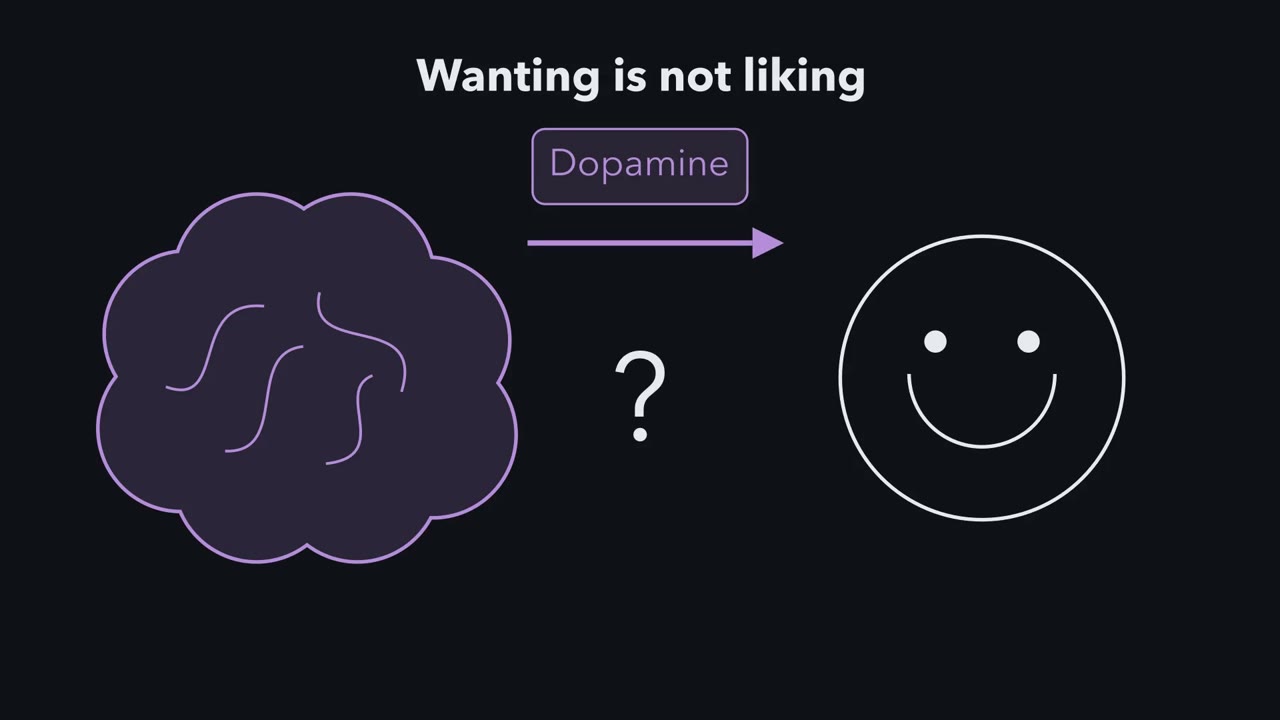
A recording alone does not show that the signal teaches. And it says nothing about pleasure. Carry one idea. Dopamine bursts and pauses report better or worse than predicted, and hunger shapes what the reward is worth.
A well-fed mouse starts eating within minutes when one small group of hypothalamic neurons is switched on with light. What are those neurons for?
Continue in the lesson: Feeding, Motivation and Reward →
2:24 · Free, with captions and a transcript. The lesson has the full text, the questions and the sources.
More films from this lesson
How this film was made. Narration: an AI narrator voice (Kokoro, af_heart) reading narration written from this lesson's text. Animation: AI-generated in code (Manim) by Claude, a schematic with no drawn molecular structures. Captions come from the narration script. See something wrong? Report it.