Physiology · Skim version
Smooth Muscle and the Myogenic Response
Read the full lesson → Skim the whole course →
The guiding idea
Raise the pressure inside a small artery and it narrows against the stretch instead of simply widening. What is the muscle sensing?
How does a muscle with no sarcomeres and no troponin make and hold force, and why does a small artery narrow when the pressure inside it rises?
-
The switch on myosin
-
The balance point: kinase against phosphatase
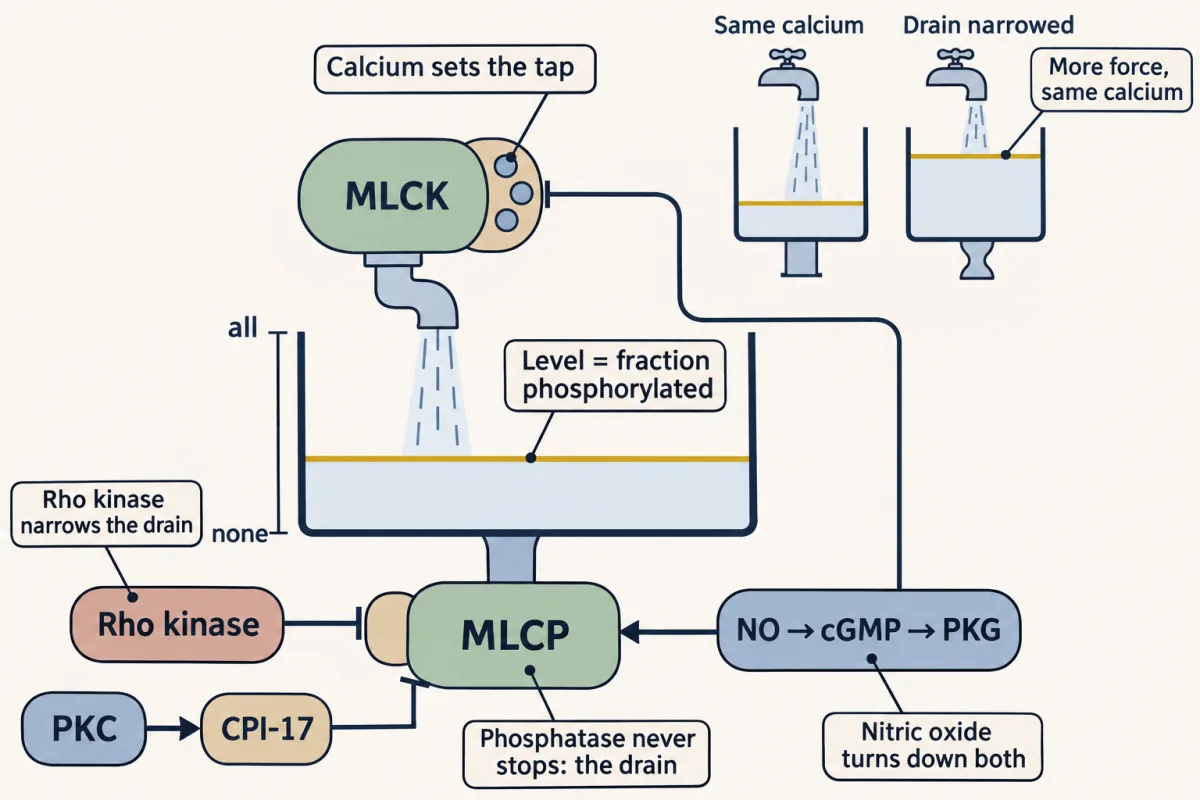
Phosphorylation settles where the kinase adds phosphates as fast as the phosphatase removes them, so narrowing the drain (Rho kinase, PKC through CPI-17) raises force at the same calcium, while nitric oxide relaxes the muscle by turning the tap down and opening the drain. AI-generated illustration -
Latch: force outlasts the phosphate
-
Arterioles answer stretch
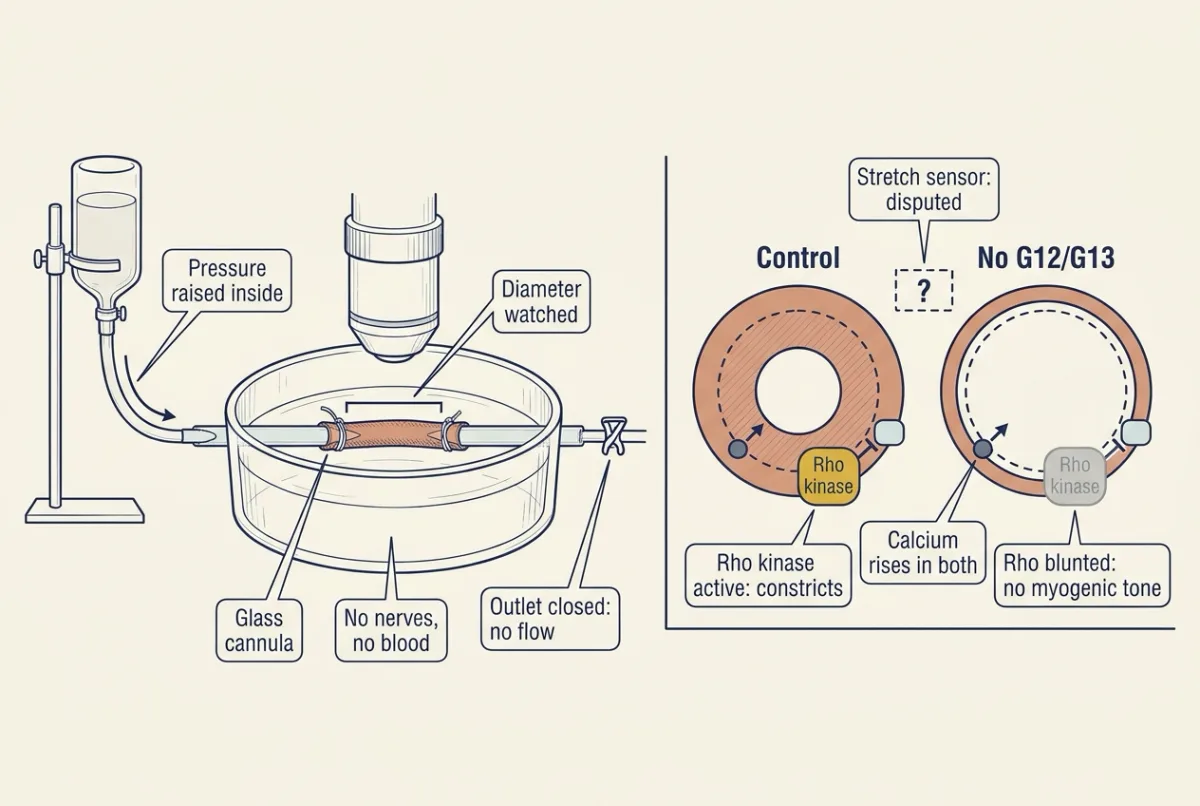
An isolated artery with no nerves and no flow still narrows when the pressure inside it rises, and in mouse mesenteric arteries it needs both a calcium rise and Rho-dependent narrowing of the phosphatase drain; which molecule senses the stretch is still disputed. AI-generated illustration -
Hollow organs and nerves
-
Going deeper
Where this lesson fits
Before thisReview first
- Muscle, Bone and MovementOrganismal Biology · Starting college
It first showed the calcium switch and filament sliding in skeletal muscle, which you compare with smooth muscle here.
- Transport Across MembranesCell Biology · College: the core
Calcium entering through L-type channels down its electrochemical gradient is used here without being re-taught.
After thisStudy next
- Resistance, Compliance and Local Blood FlowThis course · Lesson 8
It uses the myogenic response and Poiseuille's fourth-power law to explain how arteriole radius sets local flow and resistance.
- Regulating Arterial PressureThis course · Lesson 10
Arteriole tone set by stretch, nitric oxide and sympathetic input here feeds into how resistance holds arterial pressure.
- Glomerular Filtration and Renal Blood FlowThis course · Lesson 15
The renal arteriole's myogenic response applies this stretch-contraction idea to keep filtration steady.
Suggested by an AI model from the lessons themselves, then checked. How we use AI