Neuroscience · Skim version
Smell and Taste
Read the full lesson → Skim the whole course →
The guiding idea
One mouse olfactory neuron, one receptor gene out of about a thousand. One bitter cell, one job. Why do the two chemical senses code so differently?
Smell and taste both detect chemicals, yet they code them in very different ways.
From the film: A Cell Cannot Name a Molecule
- A receptor cell reports how strongly it is active, not which molecule activated it.
- To tell molecules apart, a sense needs separate lines, and a stimulus is read from the pattern of activity across them.
- Smell keeps about a thousand receptor types on separate lines, while taste pools its receptors into a few kinds of cell, mostly in mice.
From the film: Smell Keeps Its Lines Apart
- Most mature olfactory neurons in a mouse express one receptor gene at high abundance, so all neurons with one receptor form one line.
- Neurons with the same receptor are scattered across the epithelium, but their axons converge on two fixed glomeruli in each bulb.
- One receptor can recognize several odorants and one odorant can activate several receptors, so odours are read as a combinatorial code that can change with concentration.
From the film: Taste: The Cell Decides
- Sweet, umami and bitter cells run the same chain from receptor to ATP release, so the signal itself is the same and the cell the nerve listens to is what differs.
- Restoring PLCβ2 only in bitter-receptor cells brought back bitter responses and nothing else, and a bitter receptor placed in sweet cells made mice drink a bitter compound.
- In mouse taste each kind of cell acts like a labeled line, and a bitter cell pools many receptors, so by its rate alone it cannot say which bitter compound it met.
-
One coding problem, two answers
-
Smell keeps its lines apart
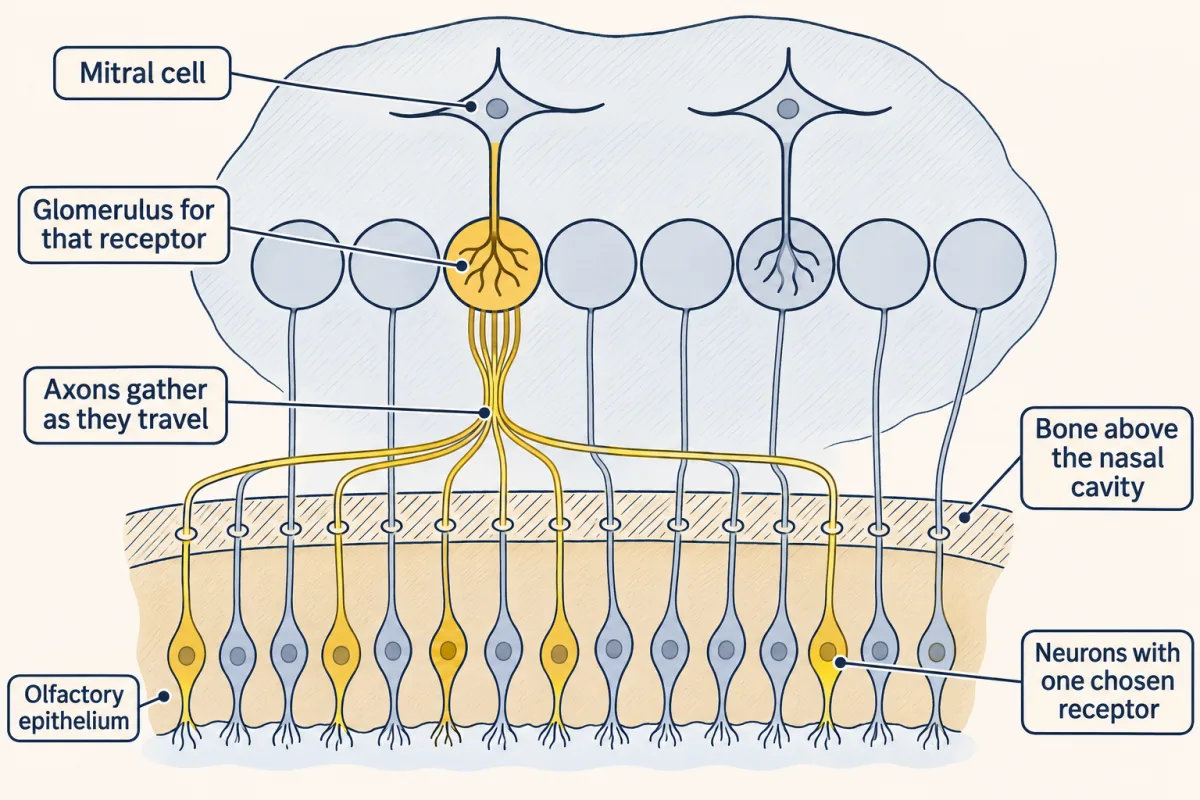
Neurons that chose the same receptor are scattered across the epithelium, but their axons gather onto a fixed glomerulus (two per bulb in the mouse; one drawn here), so each glomerulus collects mainly from one receptor type. AI-generated illustration -
Reading the pattern
-
Taste pools its receptors into cells
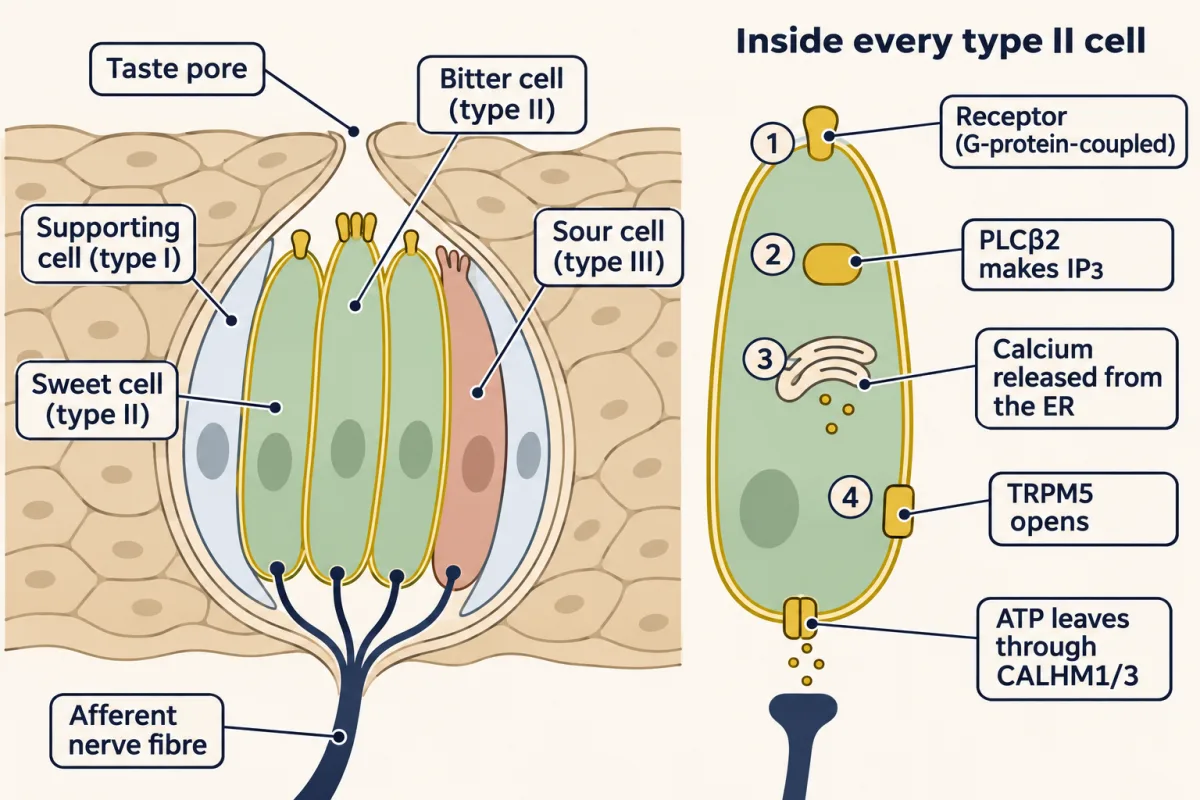
Sweet, umami and bitter cells each run the identical chain from receptor to ATP release, so the cascade alone cannot tell the brain which quality was tasted. AI-generated illustration -
Sour and salt: the channel routes
-
Back to the puzzles, and where the rule stops
-
Going deeper
Where this lesson fits
Before thisReview first
- Principles of Sensory CodingThis course · Lesson 9
It introduces population codes and labeled lines, which this lesson applies to smell and taste.
- Synaptic Transmission and Quantal ReleaseThis course · Lesson 5
Taste cells release ATP and serotonin onto nerve fibres, so you need how a cell transmits to the next.
Elsewhere on the siteFilms, simulations and method films in other courses
- One in Two ThousandFilm · Sensory Systems
It goes deeper into how one olfactory neuron picks a single receptor gene.
- Which Taste, and How Good?Film · Sensory Systems
It shows how taste identity and value are read out separately from taste cells to cortex.
- What the Bulb SendsFilm · Sensory Systems
It follows the glomerular map of receptor types on to piriform cortex.
Suggested by an AI model from the lessons themselves, then checked. How we use AI