Sensory Systems · Skim version
Restoring Senses: Implants, Prostheses and Optogenetic Vision
Read the full lesson → Skim the whole course →
The guiding idea
A cochlear implant skips the damaged hair cells and talks to the auditory nerve, and it gives many deaf adults useful hearing. The same idea in an epiretinal implant often gives streaks, not pixels. What decides how much detail a prosthesis can deliver?
A prosthesis delivers detail only as far as it drives distinct groups of neurons, each in the right place on the map, so a count of contacts or pixels is not a count of usable channels.
From the film: Contacts Are Not Channels
- A prosthesis delivers detail only as far as it drives distinct groups of neurons, so usable channels have to be measured by testing what the listener can tell apart.
- Current spread makes neighbouring contacts excite overlapping neurons, one main reason speech recognition plateaued at 8 to 10 channels in 18 implant users.
- There is no single channel number, since it depends on the listener, the array placement and the test, and the implant still gives large gains.
From the film: Streaks and Pixels
- An epiretinal electrode often gives a streak rather than a dot, because current excites axons of passage that serve other places in the visual field, as a model of axon pathways accounts for.
- PRIMA places pixels beneath the retina with local return electrodes, and its mean acuity of about 1.32 logMAR sits near the pixel limit, which is agreement rather than a precise prediction.
- A zoomed score adds a magnifier, not pixels, and serious device- or procedure-related events came with the benefit.
- In one optogenetic patient the response depended on the goggle light, and one patient cannot show how often this works.
From the film: Writing Touch: Addresses, Then Patterns
- In one man with a spinal cord injury, stimulating electrodes in sensory cortex evoked touch in regions of the hand, so each electrode is an approximate address, not a guaranteed separate channel.
- With touch feedback his median task time with a robotic arm fell from 20.9 s to 10.2 s, about 51 percent, which shows feedback helped him and not a population effect.
- Patterns across electrodes evoked tactile edges and apparent motion, and biomimetic pulse trains felt more like a real press on some electrodes, which supports biomimicry as a strategy but is not a law.
-
Borrowing a map: why place coding is kind to engineers
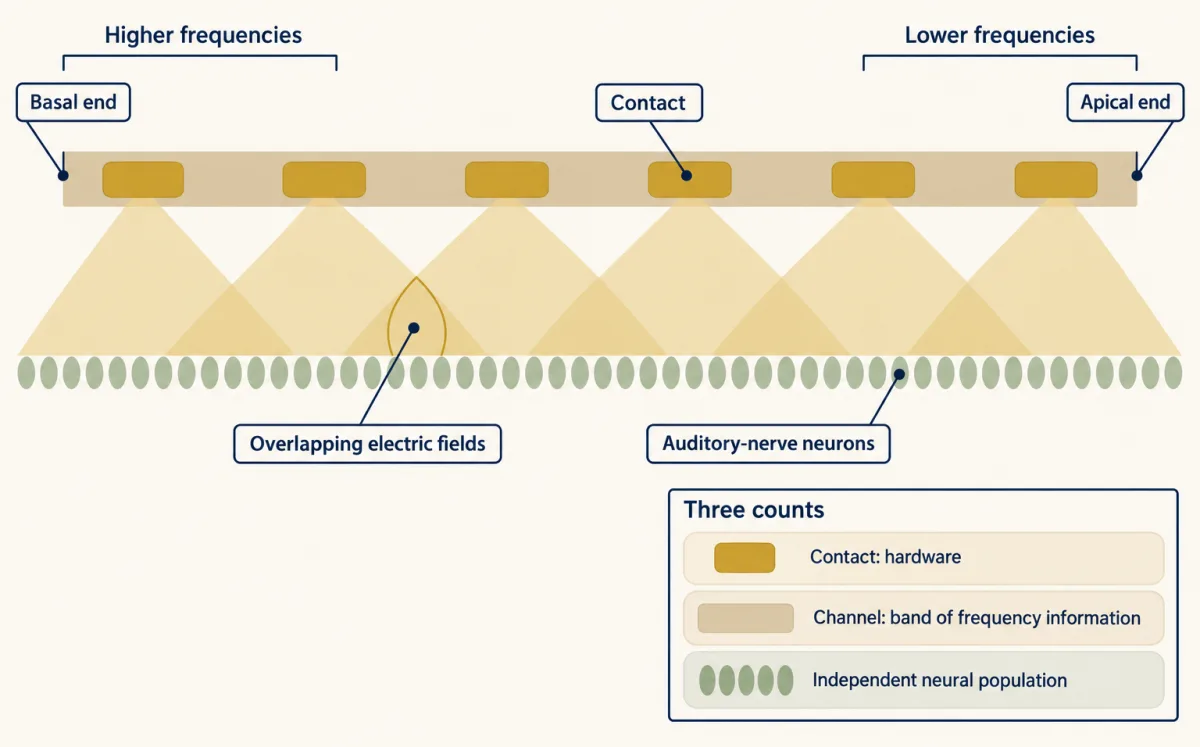
A cochlear implant assigns higher frequencies to more basal contacts and lower to more apical ones, but neighbouring contacts produce overlapping electric fields (channel interaction), so many contacts do not give the same number of independent channels. AI-generated illustration -
Why a retinal electrode does not make a pixel
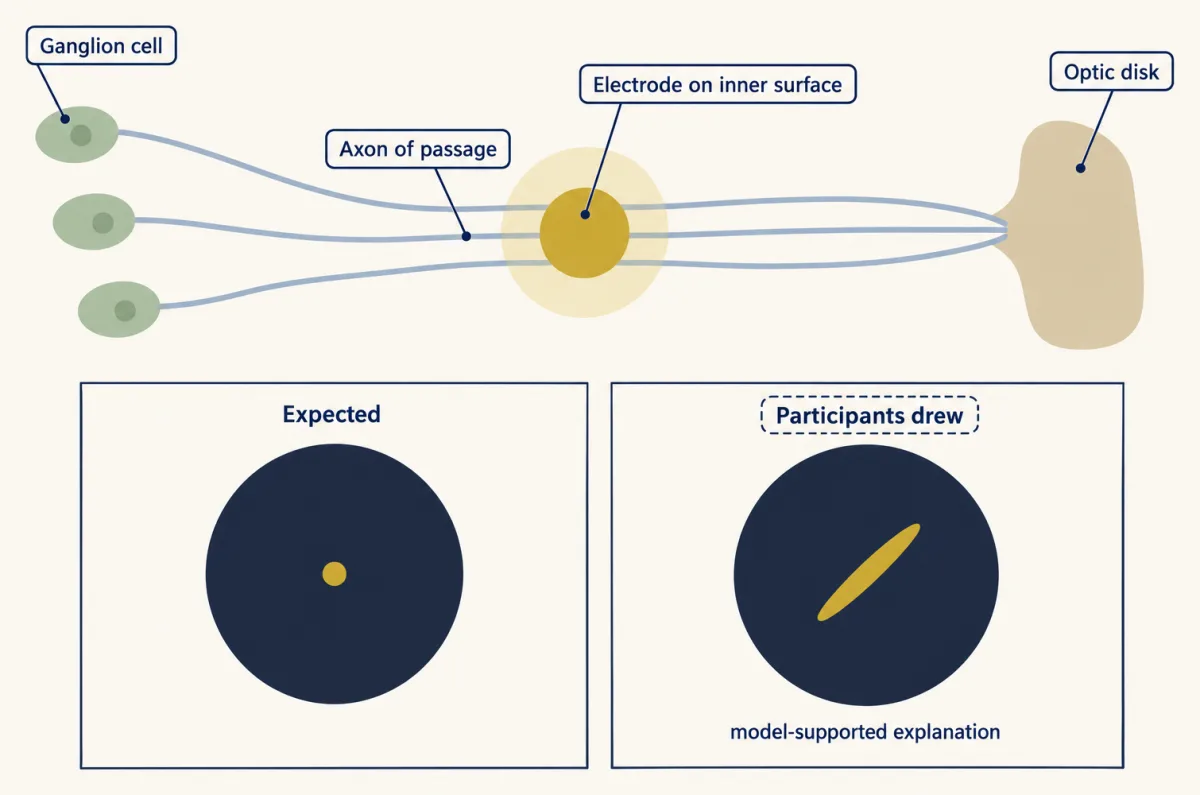
In four adults with retinitis pigmentosa, single-electrode percepts were often elongated or distorted. A model of axon pathways accounted for the shapes: current excites axons of passage and the percept follows the places those axons normally serve. This is a model-supported explanation, not a recording of the axons. AI-generated illustration -
Putting the signal in with light instead of current
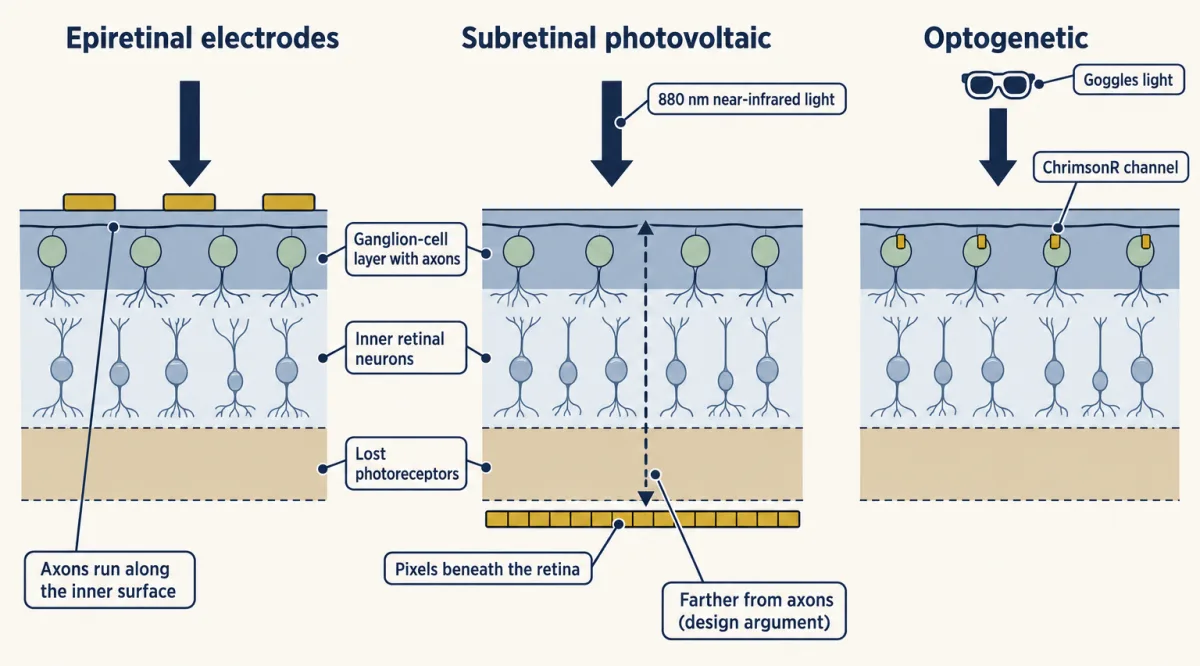
Three approaches to a degenerated retina. Epiretinal electrodes sit on the inner surface beside ganglion-cell axons. PRIMA subretinal photovoltaic pixels sit beneath the retina and stimulate bipolar cells, with local return electrodes confining their fields. In the ChrimsonR approach shown, surviving ganglion cells express a light-gated channel and goggles supply bright amber light (optogenetics is broader than this one target). The diagram shows mechanisms, not useful sight. AI-generated illustration -
Writing touch: addresses, then patterns
-
The second half: sending the right pattern
-
Going deeper
Where this lesson fits
Before thisReview first
- The Cochlear Amplifier and Otoacoustic EmissionsThis course · Lesson 23
The cochlea's frequency place map, which the implant borrows as an addressing scheme, is built up there.
- Calcium Feedback Sets Photoreceptor Gain, and When Photoreceptors DieThis course · Lesson 21
You need to know why photoreceptors die in retinitis pigmentosa to see why implants target inner retinal cells.
- Parallel Channels Out of the EyeThis course · Lesson 18
Ganglion cell axons and bipolar cells are what epiretinal and subretinal stimulation reach, so you need their layout.
Elsewhere on the siteFilms, simulations and method films in other courses
- Ephrin gradient mapper: where does each axon stop?Simulation · Developmental Neuroscience
Prosthesis detail depends on stimulating neurons in the right place on a map, as with ordered retinal maps.
- Cut half the cordSimulation · Neuroscience
It shows how touch is carried and located in the skin and cord, which is what a touch interface must write back.
- Where is the lesion?Simulation · Neuroscience
It shows how visual input is mapped in cortex, which sets what a visual prosthesis must reproduce.
Suggested by an AI model from the lessons themselves, then checked. How we use AI