Developmental Neuroscience · Skim version
The Signal from the Target Travels Home
Read the full lesson → Skim the whole course →
The guiding idea
A neuron hears its survival signal at the far end of its axon. How does the message get home?
A target keeps a neuron alive only if its signal makes the trip from the axon terminal to the cell body and is still able to signal when it gets there.
From the film: Still On When It Gets There
- A survival signal received at the axon terminal has to be able to act on a cell body that can sit centimetres away.
- Diffusion alone would take about two months over a centimetre, and an active signal would fade on the way, with illustrative rates.
- In the favoured signaling endosome model, dynein carries the NGF-TrkA complex home, and what arrives must still be able to signal.
From the film: Courier or Relay?
- In Campenot's compartmented cultures, NGF given only to distal axons can keep many cell bodies alive.
- A dynein block cannot tell a courier from a relay, but a middle-segment TrkA block that left survival intact favours a courier.
- Whether a faster signal also contributes is still open.
From the film: Two Factors, One Receptor
- NGF and NT-3 both activate TrkA at the axon tip and support local axon growth, but only NGF supports survival of cell bodies in cultured sympathetic neurons.
- Only NGF-TrkA complexes were stably carried back to the cell body.
- A factor that acts only locally can steer an axon but cannot by itself keep the neuron alive.
-
Could it just drift?
-
What a long-distance signal needs
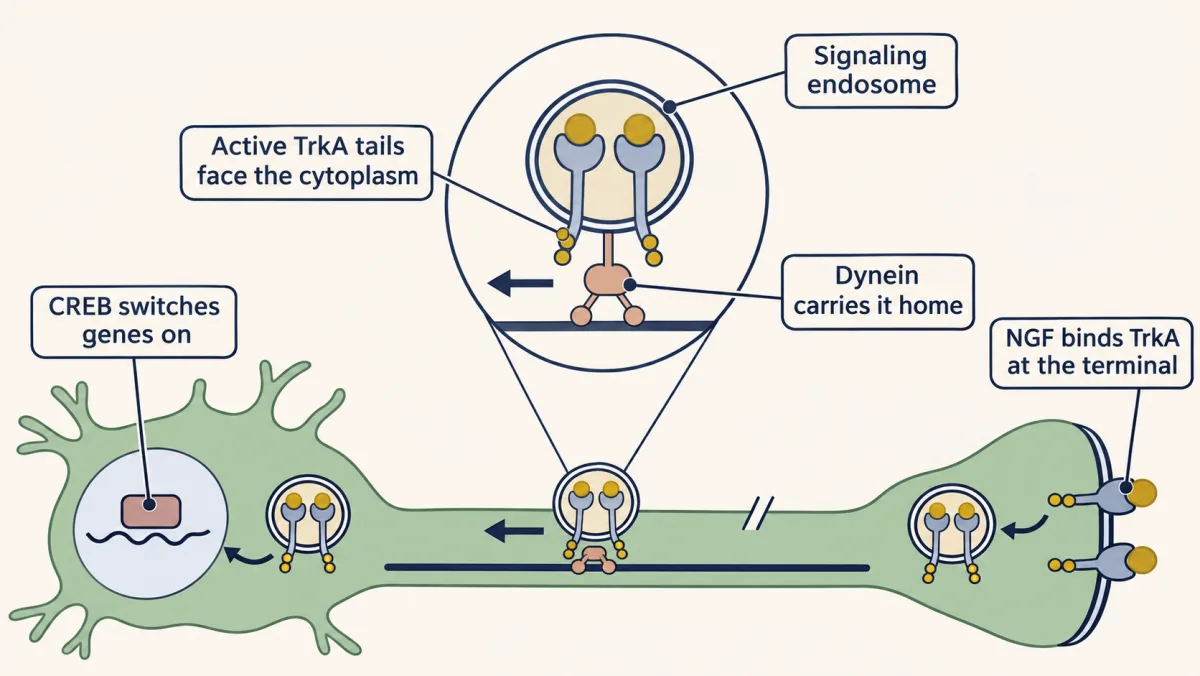
The signaling endosome model, favoured but not proven: NGF and active TrkA are taken in together at the terminal, with NGF inside the vesicle and TrkA's phosphorylated tails facing the cytoplasm; dynein carries the vesicle along microtubules to the cell body, where kinase pathways reach CREB, which switches genes on. AI-generated illustration -
The evidence that something travels
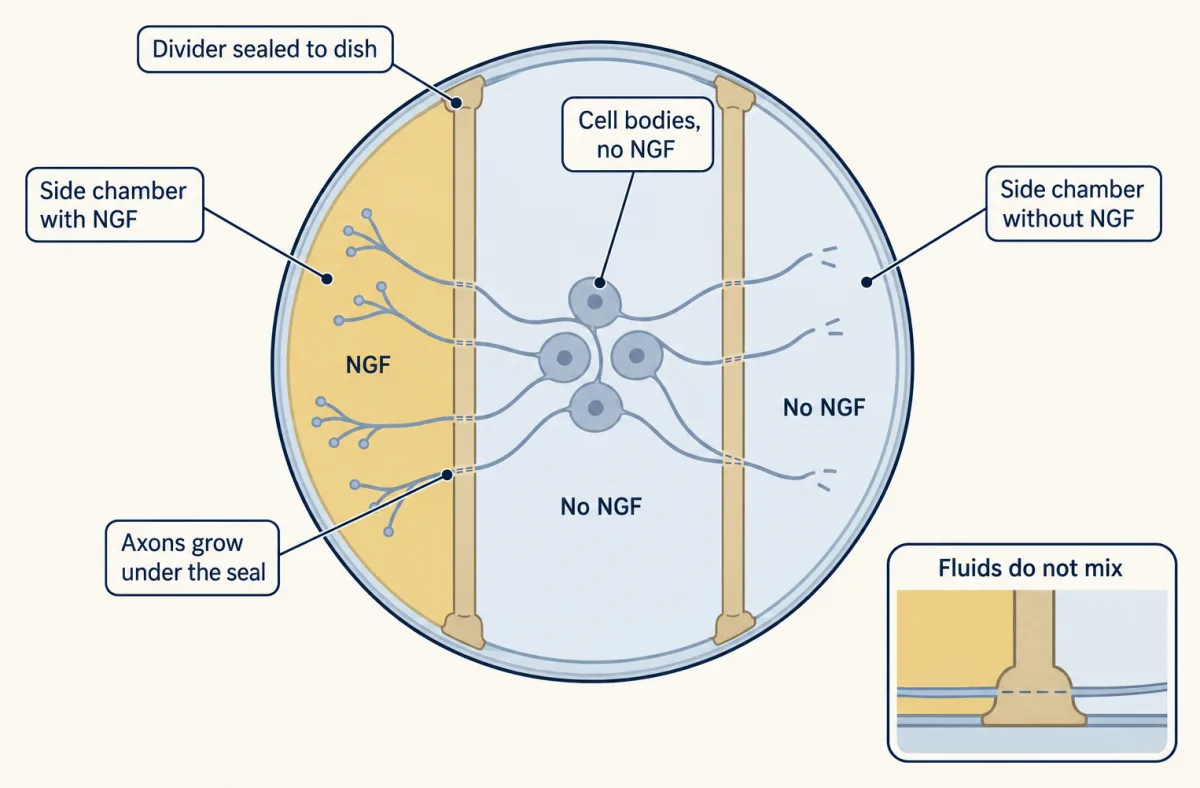
Schematic of Campenot's compartmented culture of rat sympathetic neurons. Sealed dividers separate the chamber fluids, allowing NGF to be supplied to distal axons while the cell-body chamber lacks NGF. Neurons survive when their axons reach the NGF-containing chamber. AI-generated illustration -
Courier or relay?
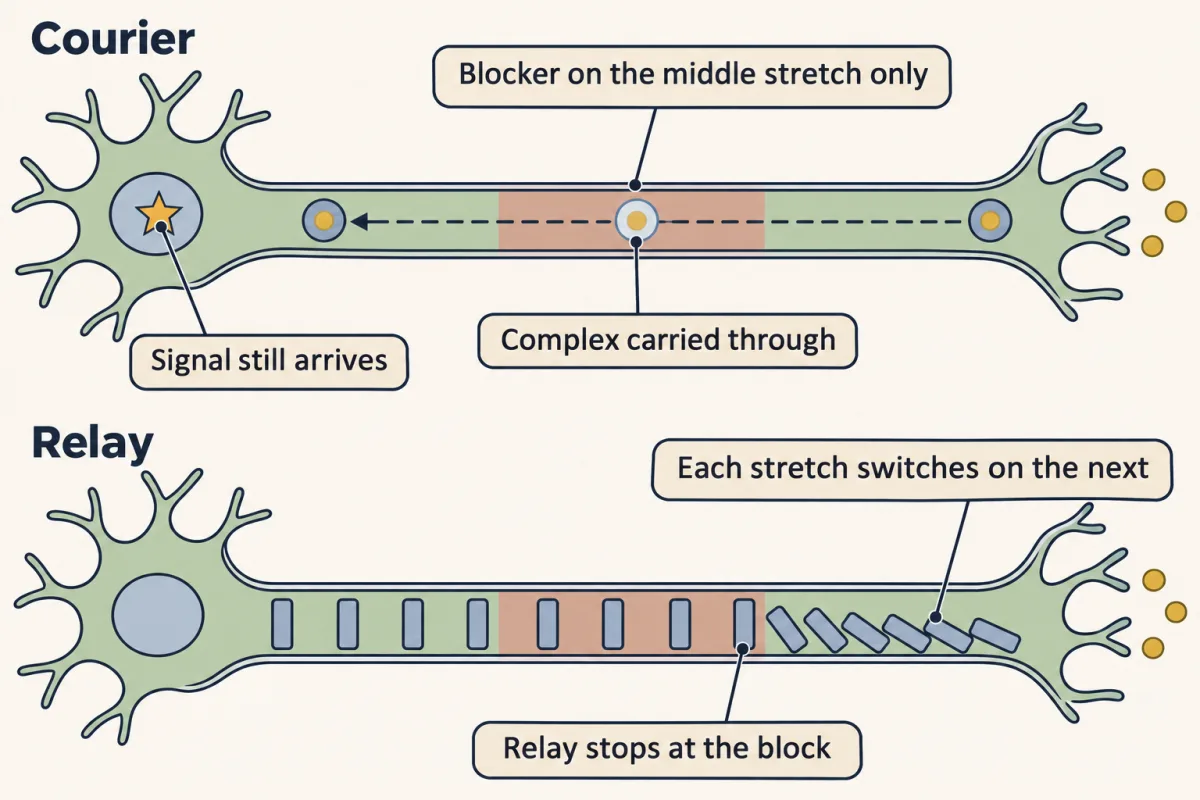
The middle-segment test. A courier carries the complex through a stretch where TrkA kinase is blocked, and the signal still arrives; a relay that needs TrkA kinase in each stretch stops there. Blocking only the middle stretch did not stop the signal or survival, evidence against such a relay, though not against every kind. AI-generated illustration -
NGF versus NT-3: one signal makes the trip
-
Putting it together
-
Going deeper
Where this lesson fits
Before thisReview first
- The Neurotrophic Hypothesis TestedThis course · Lesson 29
This lesson starts from the idea that targets supply a limited survival factor, and asks how that signal reaches the cell body.
- Neurotrophins, Trk Receptors and p75This course · Lesson 30
You need TrkA activation by NGF and the role of p75 from there to follow the NGF versus NT-3 comparison.
- The Death Machinery in NeuronsThis course · Lesson 31
The claim that the survival signal must reach the nucleus rests on death needing new gene expression in the cell body.
Elsewhere on the siteFilms, simulations and method films in other courses
- A neuron can take its survival signal in at the far end of its axonFilm · Cell Signaling
It shows how a survival signal taken in at the axon tip is carried to the nucleus.
- Sealed Inside, a Receptor Goes SilentFilm · Cell Signaling
It covers the signaling endosome that carries a receptor and its signal along the axon.
- Grip, Swing, Let GoFilm · Cell Biology
It shows dynein walking toward the minus end, the motor that carries NGF-TrkA back to the cell body.
- Cell-free extracts and reconstitutionMethod film
It shares the idea of isolating parts of a process in a tube to test which are needed.
Suggested by an AI model from the lessons themselves, then checked. How we use AI