Genetics and Molecular Biology · Skim version
Recombinant DNA, Cloning and PCR
Read the full lesson → Skim the whole course →
The guiding idea
A white colony survives ampicillin and a PCR tube ends with a bright band. How do you know either contains the DNA you wanted?
Amplification solves scarcity, not identity: cut sites and primers set what can be joined or copied, while readouts and controls test what actually was.
From the film: From DNA Fragment to Verified Clone
- Selection finds plasmids; screening narrows candidates; sequencing identifies the construct.
- Matching restriction cuts make compatible ends, and DNA ligase seals the joins.
- A cloning vector needs an origin, a selectable marker and a cloning site.
- Antibiotic survival alone does not show that the intended insert is present.
From the film: Reading a PCR as It Grows
- Copy timing estimates input; endpoint abundance does not.
- Opposite-strand primers point their 3' ends into the target.
- Early ideal copying follows N = N0 x 2^n, for n cycles.
- With matched near-perfect efficiency, a lower Ct means more starting template.
- Controls distinguish target signal from contamination, genomic DNA and assay failure.
-
Cut at a known site, then seal the join
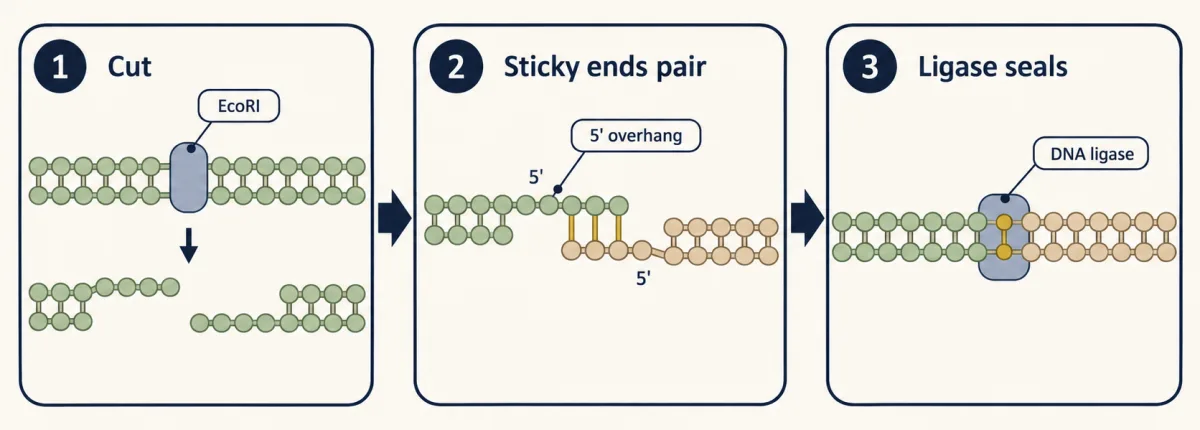
Compatible overhangs let DNA pieces pair, and DNA ligase seals the backbone to make the join permanent. AI-generated illustration -
Into bacteria: retain, screen, confirm
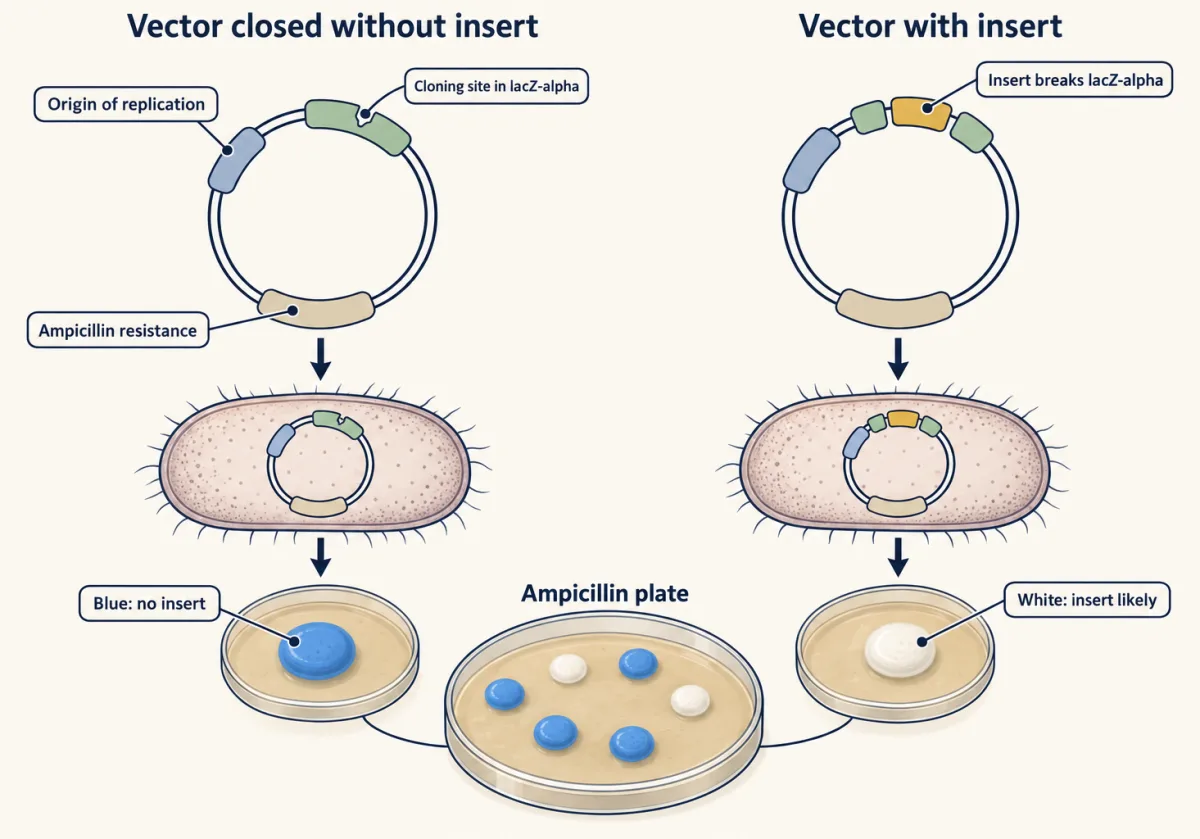
Blue-white screening changes the odds that a colony carries an insert, but restriction analysis or colony PCR and sequencing must test the construct. AI-generated illustration -
PCR: copying one bounded region
-
Reading the result: size, identity and controls
-
Going deeper
Where this lesson fits
Before thisReview first
- Bacterial and Phage Genetics: Conjugation, Transduction and TransformationThis course · Lesson 11
Plasmids, transformation and phage defence against bacteria are used here without being re-taught.
- DNA Replication: Semiconservative Copying and Its MachineryThis course · Lesson 13
PCR extension relies on a polymerase adding nucleotides to a primer's 3' end, as in replication.
- DNA Is the Genetic MaterialThis course · Lesson 12
Cutting, joining and copying DNA assumes you know DNA carries the heritable information.
After thisStudy next
- Sequencing and GenomesThis course · Lesson 23
Sequencing is what finally identifies a construct, which gels and colonies alone cannot do.
- Forward and Reverse Genetics: Screens, RNAi and CRISPRThis course · Lesson 24
Editing and screening tools use cloned guide and vector constructs built with these joining and amplifying methods.
Elsewhere on the siteFilms, simulations and method films in other courses
- How Bacteria Make Human InsulinFilm · Biology
It shows restriction enzyme and ligase joining a gene into a plasmid to make recombinant DNA.
Suggested by an AI model from the lessons themselves, then checked. How we use AI