How Bacteria Make Human Insulin
Read the transcript of “How Bacteria Make Human Insulin”
Film transcript: How Bacteria Make Human Insulin
Bacteria do not naturally carry a human insulin gene. How can they make human insulin? Before engineered microbes, insulin for patients usually came from cattle and pig pancreases. Then bacteria carrying human instructions began making the medicine.
Start with DNA that codes for insulin. Nearly all living things use the same genetic code. But most human genes contain introns, stretches human cells cut out and bacteria cannot. A bacterium can read intron-free DNA for a human protein when bacterial control DNA is present. The gene is the instruction; the control tab helps the bacterium start reading it. A restriction enzyme recognizes a DNA sequence. The yellow tool cuts the green gene and a blue plasmid at matching marks. Many cuts leave single-stranded sticky ends. Their shapes show which pieces can pair. The cuts do not add information. They create pieces that can be rearranged. The matching ends meet inside the opened plasmid.
DNA ligase seals the gaps. The blue loop now carries the green insulin gene. This is recombinant DNA because DNA from different sources has been joined. The plasmid can copy separately from the bacterium's main chromosome. Now change one detail.
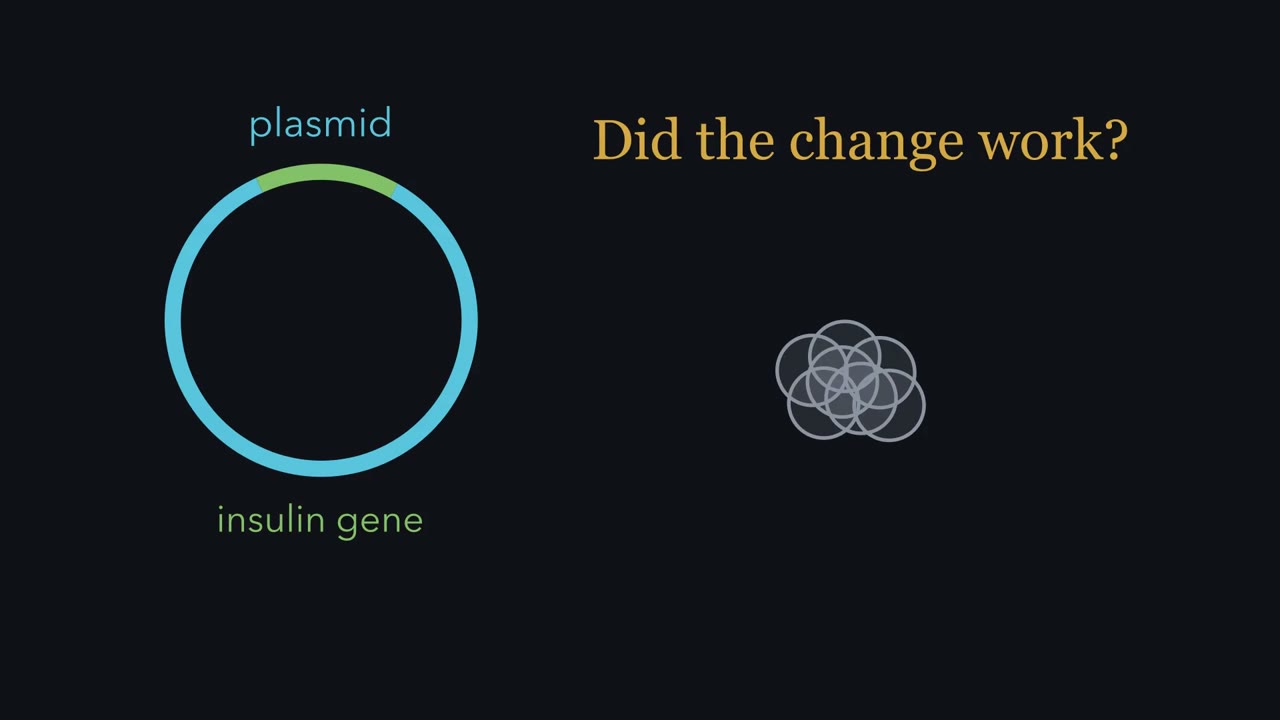
Predict this. The plasmid carries insulin DNA, but its control tab does not work in bacteria. Will the cell make insulin? No. Carrying a gene is not enough. The cell must recognize its control DNA and read the gene. Replace the tab with one the bacterium recognizes. Now the reader moves, and a green insulin-product block appears. The instruction was present before, but it could not direct a product. Only some bacteria take up a plasmid. The plasmid usually carries an antibiotic-resistance gene for a selection step. On antibiotic, cells without a plasmid fail to grow. Surviving colonies are enriched for cells carrying one. The resistance marker travels on the plasmid; insulin itself does not provide resistance.
As selected bacteria divide, they copy the plasmid and its added gene. If the gene is switched on, cells make the product. Scientists then purify and process that product into insulin medicine. Each daughter can inherit plasmid copies, so, with selection, the colony keeps the added instruction. The moving chain is cut, join, carry, select, and read. Each step supports the next, but none guarantees the final effect. Engineering changes a cell's DNA; test the effects, judge each use separately.
Bacteria do not naturally carry a human insulin gene, so how can they make human insulin?
Continue in the lesson: Engineering Genes →
3:30 · Free, with captions and a transcript. The lesson has the full text, the questions and the sources.
More films from this lesson
How this film was made. Narration: written from this lesson's text and read by an AI narrator voice (Kokoro, af_heart). Animation: AI-generated in code (Manim) by Claude, a schematic with no drawn molecular structures. Captions come from the narration script. See something wrong? Report it.