Cell Signaling · Skim version
Receptor Tyrosine Kinases
Read the full lesson → Skim the whole course →
The guiding idea
One helix crosses the membrane. So how does a growth factor outside switch on a kinase inside?
A receptor tyrosine kinase is a cell-surface receptor, most often for a growth factor, whose inner half is an enzyme.
-
The idea: one plan, built 58 times
-
The dimerization question: three ways to make a pair
-
”Ligand activates receptor…now what?” The two kinases switch each other on
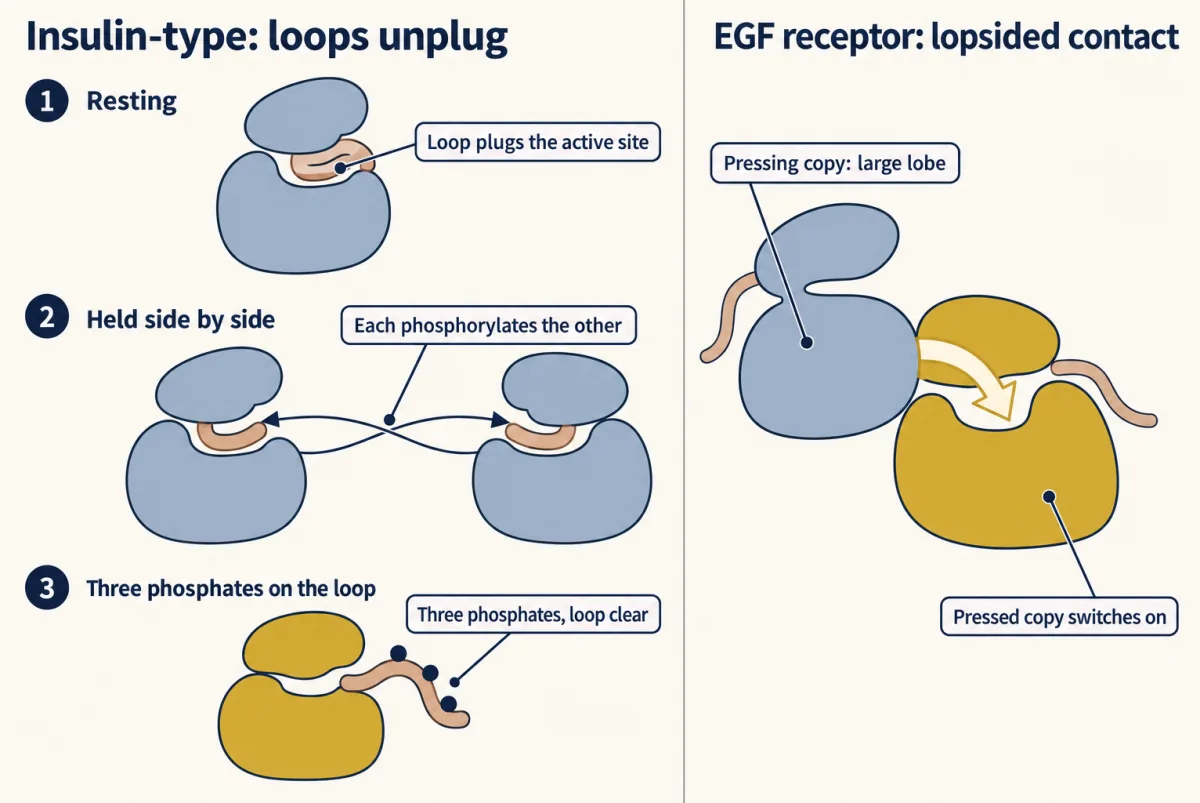
Two ways to throw the switch. In the insulin receptor each kinase phosphorylates the other's activation loop, which swings clear of the active site. In the EGF receptor no loop phosphate is needed: the large lobe of one kinase presses the small lobe of the other, and the pressed copy switches on. AI-generated illustration -
”RTK gets activated…what next?” The tail becomes a set of docking sites
-
RTKs in cancer: three ways to stay on, two kinds of drug
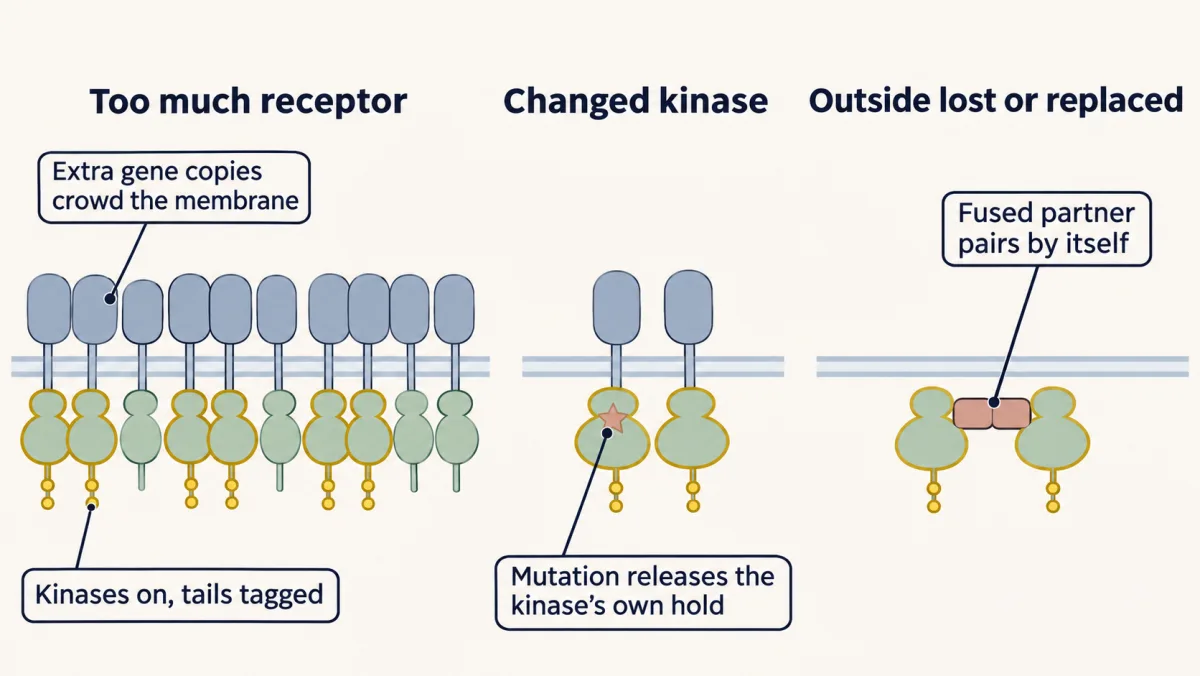
Three ways a tumour keeps a receptor tyrosine kinase on without its ligand: amplify the gene so crowded receptors pair (HER2), change the kinase so it no longer waits for the outside (L858R in the EGF receptor), or lose the outside and fuse the kinase to a protein that pairs by itself (RET fusions). AI-generated illustration
Where this lesson fits
Before thisReview first
- A Field Guide to ReceptorsThis course · Lesson 4
It introduced the three-part receptor architecture that this lesson builds on, including the single-helix enzyme-linked receptors.
- Phosphorylation: Kinases and PhosphatasesThis course · Lesson 6
You need the kinase fold, the activation loop and the role of phosphatases from there to follow how the pair switches on.
- Protein Modules: SH2, SH3, PTB, PDZ and PHThis course · Lesson 9
The SH2 domain's reading of a phosphotyrosine and the residues after it explains which target docks on each tail site.
After thisStudy next
- Ras to MAPK: The Kinase CascadeThis course · Lesson 19
It follows the Grb2 branch from the activated receptor to Ras and the kinase cascade.
- PI 3-Kinase, Akt and InsulinThis course · Lesson 20
It takes the PI 3-kinase docking sites and the insulin receptor's IRS proteins further, through Akt.
- Oncogenes: When the Switch SticksThis course · Lesson 41
It takes further the idea that a stuck receptor kinase, such as an amplified or mutated one, drives cancer.
Elsewhere on the siteFilms, simulations and method films in other courses
- Receptor binding and dose-response analysisMethod film
Ligand-binding and dose-response fits are how receptor affinity and activation by a growth factor are measured.
- Gel electrophoresis, SDS-PAGE and western blotMethod film
Phosphotyrosine western blots show a receptor and its docking partners becoming phosphorylated after ligand.
Suggested by an AI model from the lessons themselves, then checked. How we use AI