Cell Signaling · Skim version
A Field Guide to Receptors
Read the full lesson → Skim the whole course →
The guiding idea
Acetylcholine starts a muscle twitch and slows a heart. Same molecule: what decides what it means?
How does a cell learn that a molecule it cannot let in is sitting outside?
-
Three questions and one idea
-
The membrane problem: three ways across, and one way around
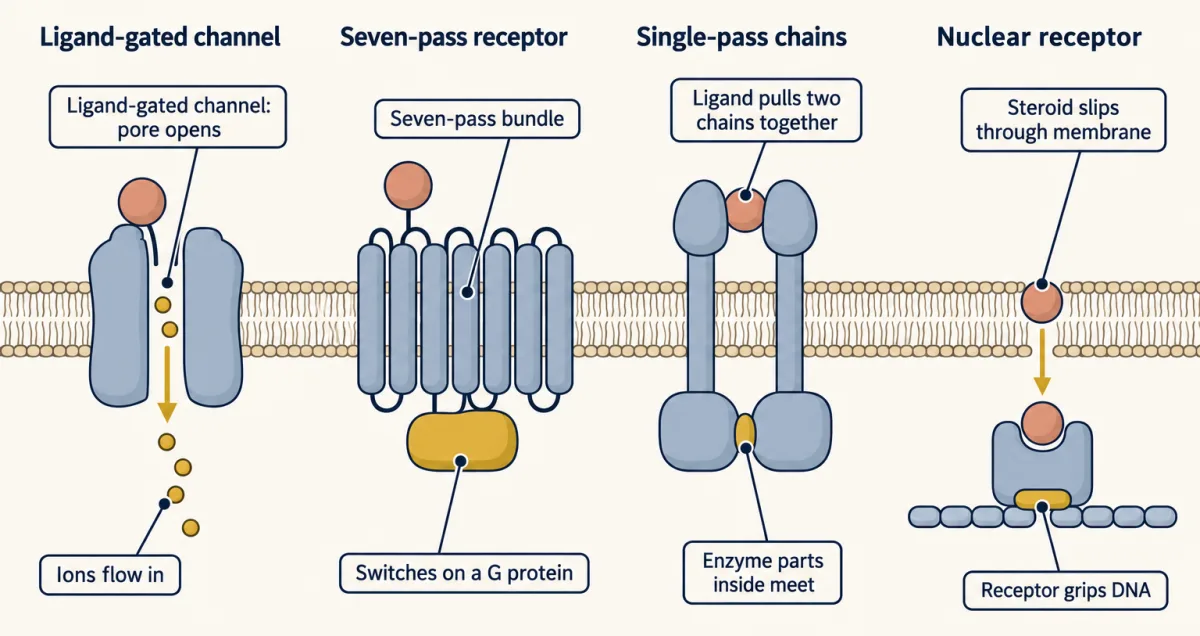
Four common receptor architectures. Ligand-gated channels open a pore; seven-pass receptors change shape and activate a G protein; many single-pass receptors bring chains together or rearrange an existing pair. In the classical nuclear-receptor route, a fat-soluble hormone crosses the membrane and binds an intracellular receptor that acts on DNA. Other receptor mechanisms also exist. AI-generated illustration -
The map: four architectures
-
One ligand, two receptors: acetylcholine
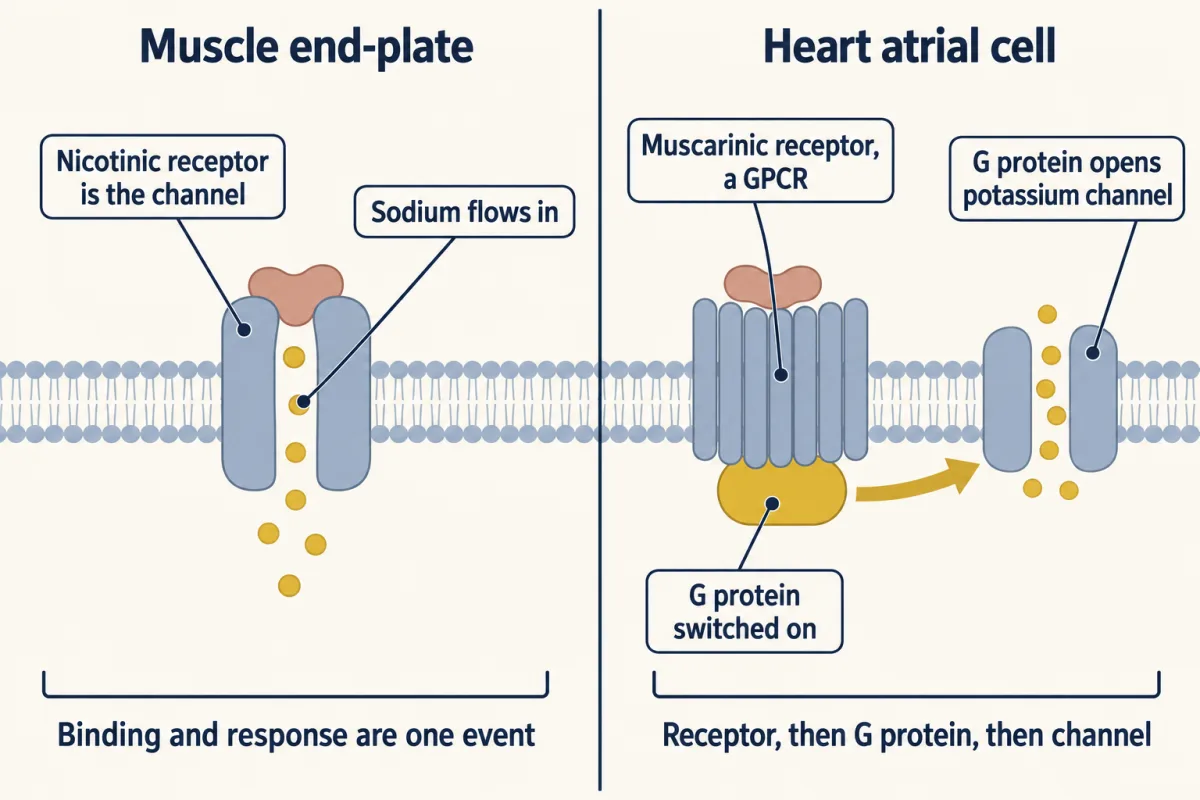
One ligand, two receptors. At the muscle end-plate acetylcholine binds a receptor that is itself a channel, so binding opens the pore directly. In a heart atrial cell it binds a G-protein-coupled receptor, which switches on a G protein that opens a potassium channel. AI-generated illustration -
Add up the waits
-
Going deeper
Where this lesson fits
Before thisReview first
- Binding: Affinity, Occupancy and Dose–ResponseThis course · Lesson 3
The lesson's potency point (half-maximal near 160 nM) uses affinity and occupancy, which that lesson teaches.
- Signals and How Far They TravelThis course · Lesson 1
It sets out why a ligand's signal must be received at the cell surface and passed on, which this lesson maps by receptor type.
After thisStudy next
- GPCRs and Trimeric G ProteinsThis course · Lesson 12
It takes the seven-pass receptor, GDP-for-GTP exchange and the G-protein switch from this map and works through them in full.
- Receptor Tyrosine KinasesThis course · Lesson 18
It expands the single-pass kinase architecture, where the ligand brings two kinase domains together.
- Nuclear Receptors: Receptors That Are Transcription FactorsThis course · Lesson 31
It develops the fourth architecture, receptors that act directly on genes, including the thyroid and glucocorticoid cases.
Suggested by an AI model from the lessons themselves, then checked. How we use AI