Biochemistry · Skim version
The Pyruvate Dehydrogenase Complex: The One-Way Gate to the Cycle
Read the full lesson → Skim the whole course →
The guiding idea
Pyruvate meets a one-way gate: one machine turns it into acetyl-CoA, CO₂ and NADH, and there is no way back.
The pyruvate dehydrogenase complex is the one-way gate between glycolysis and the TCA cycle: it converts pyruvate to acetyl-CoA, releasing one CO2 and banking one NADH, and once a cell walks through it there is no walking back.
-
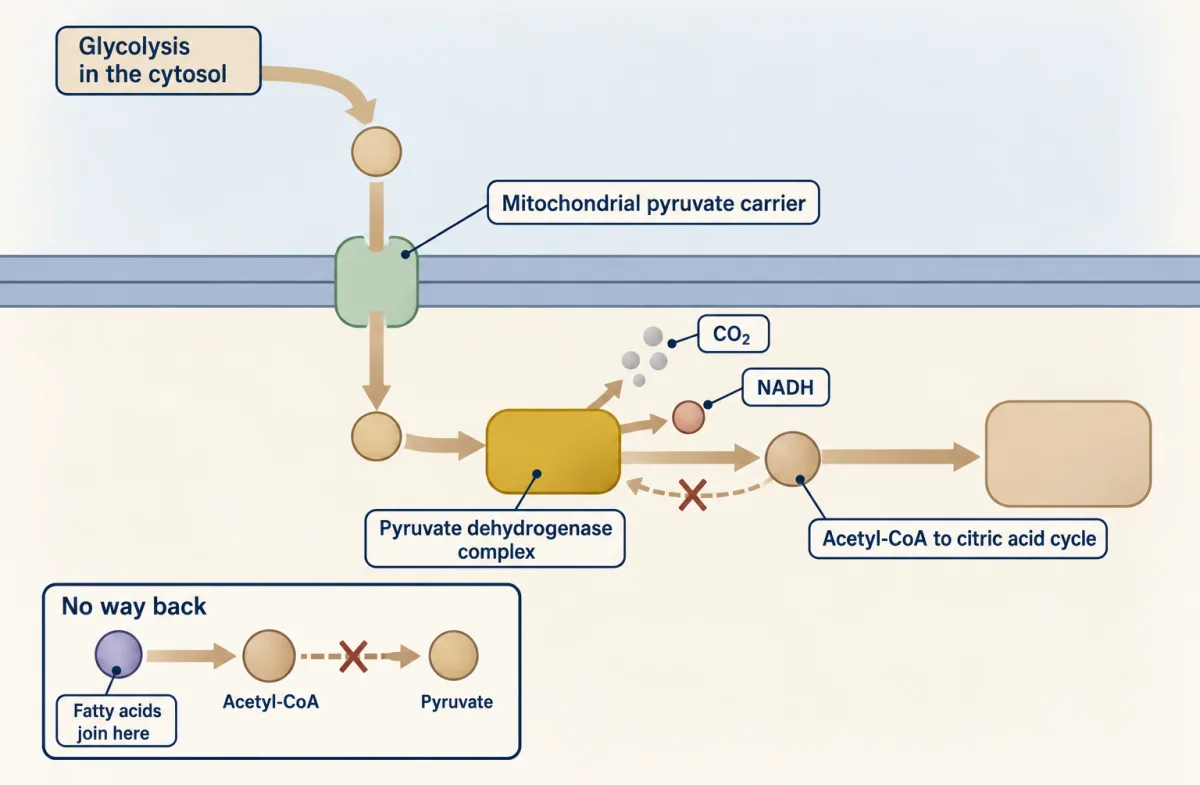
Where the gate sits. Pyruvate crosses the inner mitochondrial membrane through the mitochondrial pyruvate carrier; in the matrix the pyruvate dehydrogenase complex makes acetyl-CoA, CO2 and NADH. The reaction is irreversible in animals, and with no glyoxylate cycle, acetyl-CoA cannot yield net glucose; glycerol and propionyl-CoA from odd-chain fatty acids still can. AI-generated illustration -
Following one pyruvate: two tracks on one arm
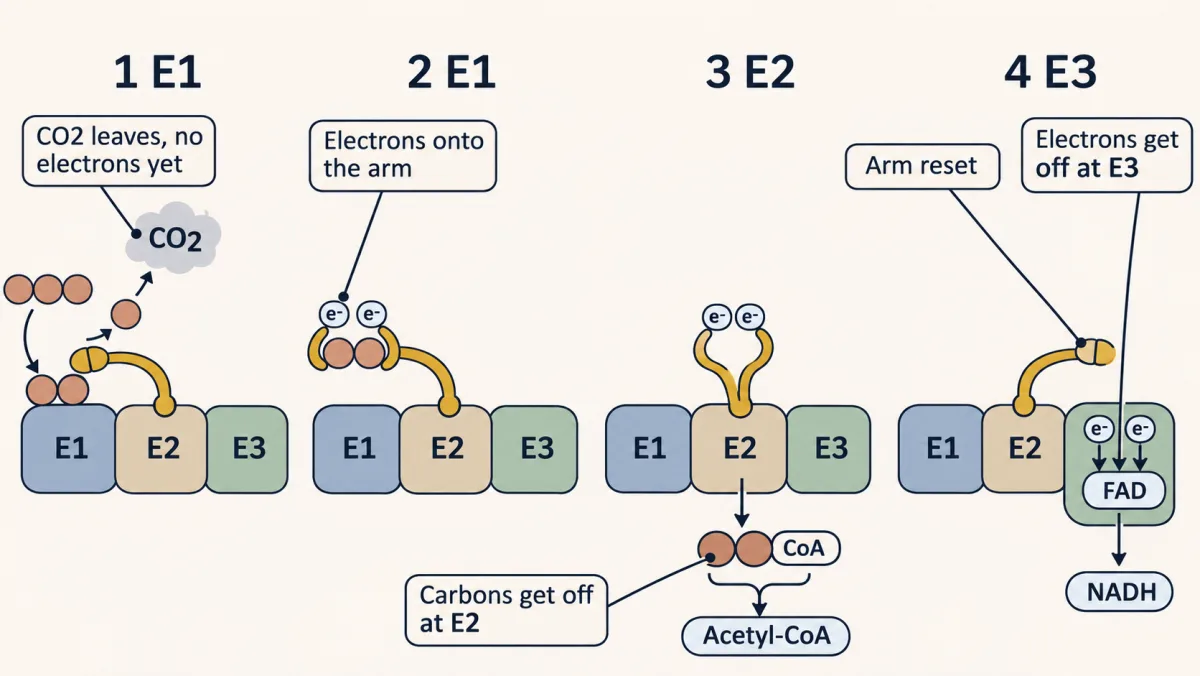
Two tracks on one arm (schematic). The carboxyl carbon leaves as CO2 at E1 before any electrons are removed. The two acetyl carbons and the two electrons taken from them then ride the same lipoamide arm and get off at different stops: the carbons at E2, onto CoA; the electrons at E3, through FAD to NAD+. The oxidation is at E1, but the NADH is made at E3. AI-generated illustration 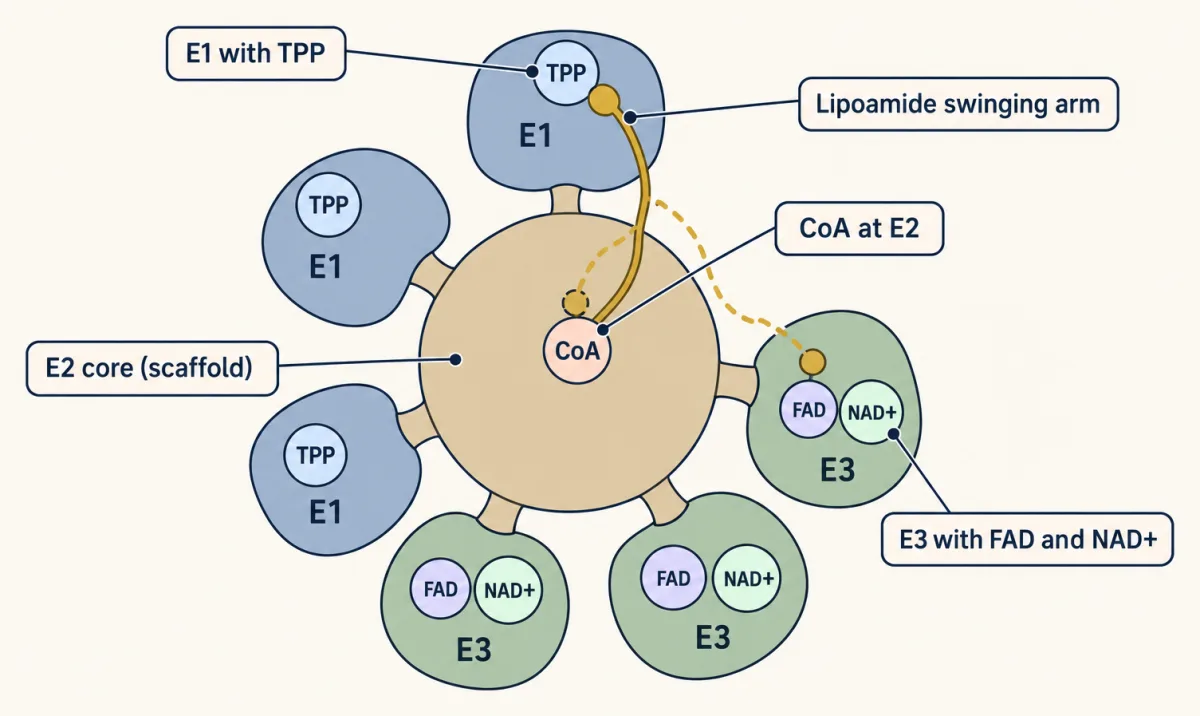
One machine, three enzymes (schematic). E1 and E3 are drawn on the E2 core; in mammals E3 attaches through E3BP. The E2-tethered lipoamide arm takes the acetyl group from E1 to CoA at E2, then visits E3 for reoxidation. TPP works at E1, CoA at E2, FAD and NAD+ at E3. Block numbers are illustrative. AI-generated illustration -
Where the energy goes
-
Two layers of regulation
-
When the gate fails
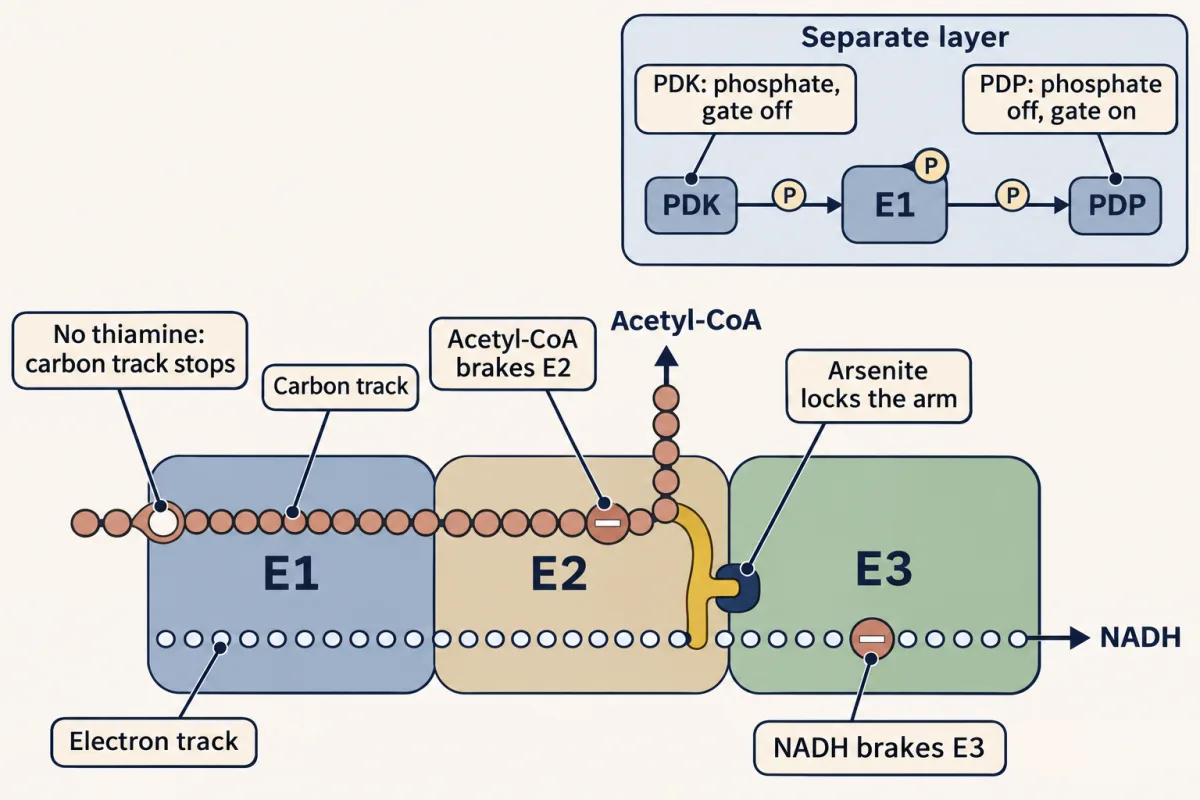
Where the brakes and poisons hit (schematic). Each product slows the stop where it leaves: acetyl-CoA competes with CoA at E2 on the carbon track, NADH with NAD+ at E3 on the electron track. Without thiamine the carbon track never starts; arsenite locks the reduced arm so neither track can reset. The PDK/PDP phosphate switch on E1 (inset) is a separate layer on top. AI-generated illustration -
Next: the same relay, again
-
Going deeper
Where this lesson fits
Before thisReview first
- Glycolysis: The Investment-and-Payoff PathwayThis course · Lesson 16
Glycolysis makes the pyruvate this gate receives, and its PFK-1 energy-charge logic is reused here.
- Metabolism: Basic Concepts and DesignThis course · Lesson 15
You need free energy, coupling and activated carriers like NADH and thioesters to follow the energy ledger.
- Basic Concepts of Enzyme ActionThis course · Lesson 7
Coenzymes, intermediates and catalysis of an irreversible step are used here without being re-taught.
After thisStudy next
- The Citric Acid Cycle: Harvesting ElectronsThis course · Lesson 19
Acetyl-CoA from this gate is the fuel the cycle burns, and it uses the NADH relay again.
- Fatty Acid Synthesis: Building the Chain Two Carbons at a TimeThis course · Lesson 26
Acetyl-CoA made at this gate is the starting material for building fat.
Suggested by an AI model from the lessons themselves, then checked. How we use AI