Biochemistry · Lipid Metabolism
Fatty Acid Synthesis: Building the Chain Two Carbons at a Time
Rewritten on : new text, figures and flashcards. Your notes and highlights stay, but the text around them may have moved.
Cytoplasm, ACP, NADPH: three choices that keep building fat from colliding with burning it.
Pause when the reading reaches a film, and offer to play it. Saved on this device.
Watch the film now, or keep listening
Builds on:Fatty Acid Degradation: The β-Oxidation SpiralThe Citric Acid Cycle: Harvesting ElectronsThe Pentose Phosphate Pathway: NADPH and Five-Carbon SugarsWhy these?
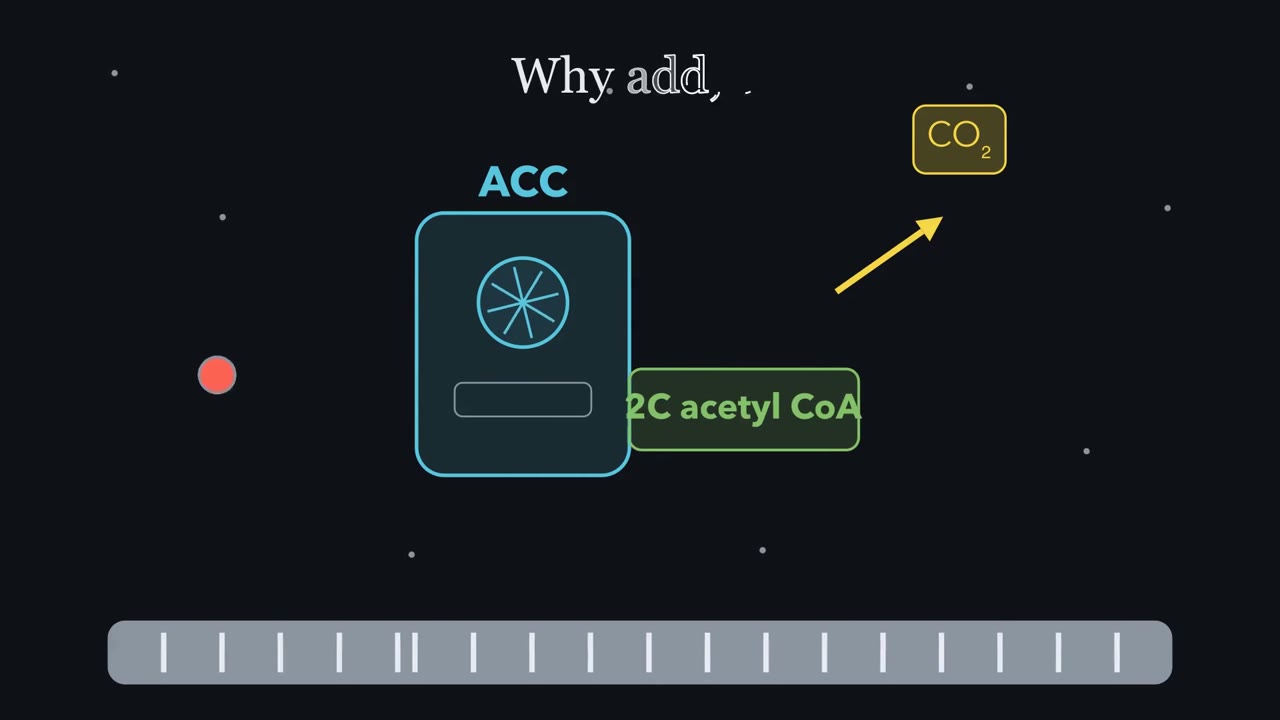 ▶ Watch The carbon fatty acid synthesis throws away · 3:21
Read the transcript of “The carbon fatty acid synthesis throws away”
Film transcript: The carbon fatty acid synthesis throws away
Why does a cell pay to attach CO₂, only to throw it away two steps later? That apparent waste is the trick that makes fatty acid synthesis move forward. In its simplest form, begin with acetyl CoA already in the cytoplasm. Its two carbons are the primer. Every later pair enters through malonyl CoA, the extender made by acetyl CoA carboxylase, or ACC. ACC combines acetyl CoA with bicarbonate and spends one ATP.
The product is malonyl CoA, carrying an extra carboxyl group. Because the malonyl CoA made for synthesis has essentially one fate, this is the committed step. Now predict. After fatty acid synthase uses malonyl CoA, where will that newly attached carboxyl carbon end up? In the chain, or somewhere else?
Fatty acid synthase joins the extender to the primer. During condensation, the extra carboxyl group leaves as CO₂. So little to none of a labeled bicarbonate carbon remains in palmitate. That loss is useful. Joining two acetyl units directly is uphill. Releasing CO₂ is strongly downhill, so coupling the events pulls the new carbon–carbon bond forward. The cell spent ATP to load this molecular spring. Condensation leaves a carbonyl that the chain cannot keep. Fatty acid synthase then finishes CRDR: reduction, dehydration, reduction.
Two NADPH supply the four electrons needed to turn that carbonyl carbon into a saturated segment. Here is the rule. After the primer, each CRDR turn adds two carbons as one malonyl CoA. That addition costs one ATP at ACC and two NADPH at fatty acid synthase. The four-carbon chain returns for another turn. The same machine repeats until seven malonyl units have added fourteen carbons to the two-carbon primer. Fatty acid synthase then releases palmitate, a saturated 16-carbon fatty acid. In mammals, fatty acid synthase mostly stops there. Longer chains and double bonds are handled later. So this film’s rule covers the saturated chain built to palmitate.
It starts from acetyl CoA already in the cytoplasm. So the discarded carbon was never a building block. It was a temporary handle, bought with ATP, whose release drives each condensation. Count the malonyl additions, and you count both the two-carbon gains and their cost.
From the film
- ACC spends one ATP to make each malonyl CoA extender.
- The added carboxyl group leaves as carbon dioxide and helps drive condensation.
- Each CRDR turn adds two carbons and uses two NADPH.
- In the simplest case, seven turns build palmitate from a two-carbon primer.
One cookie. One slice of pizza. If you don’t burn it, your body stores it. Most of the fat in it is stored as it is. The sugar and starch refill glycogen first, and some of the surplus is turned into new fat by this pathway, running mainly in your liver and fat cells. That carbon becomes acetyl CoA, and in the fed state acetyl CoA is stitched into long fatty acid chains two carbons at a time.
This lesson answers two questions. What does it cost to build one fatty acid? And how does a cell that is building fat avoid burning it at the same time? The film above follows the ATP-for-CO₂ trick through one turn, then all seven turns to palmitate; the sections below add the chemical detail, full ledger, delivery bill and carnitine palmitoyltransferase I (CPT-I) control.
The film’s rule: after the acetyl primer, every two carbons arrive as one malonyl CoA, for one ATP at acetyl CoA carboxylase (ACC) and two NADPH at fatty acid synthase (FAS). The rule covers saturated chains built from acetyl CoA already in the cytoplasm. Delivering the acetyl groups and finding the NADPH are separate bills, paid later. Odd-chain fats start from a different primer (Going deeper, “Where the rules bend”), and double bonds are added after the chain is built.
Why it is not beta-oxidation in reverse
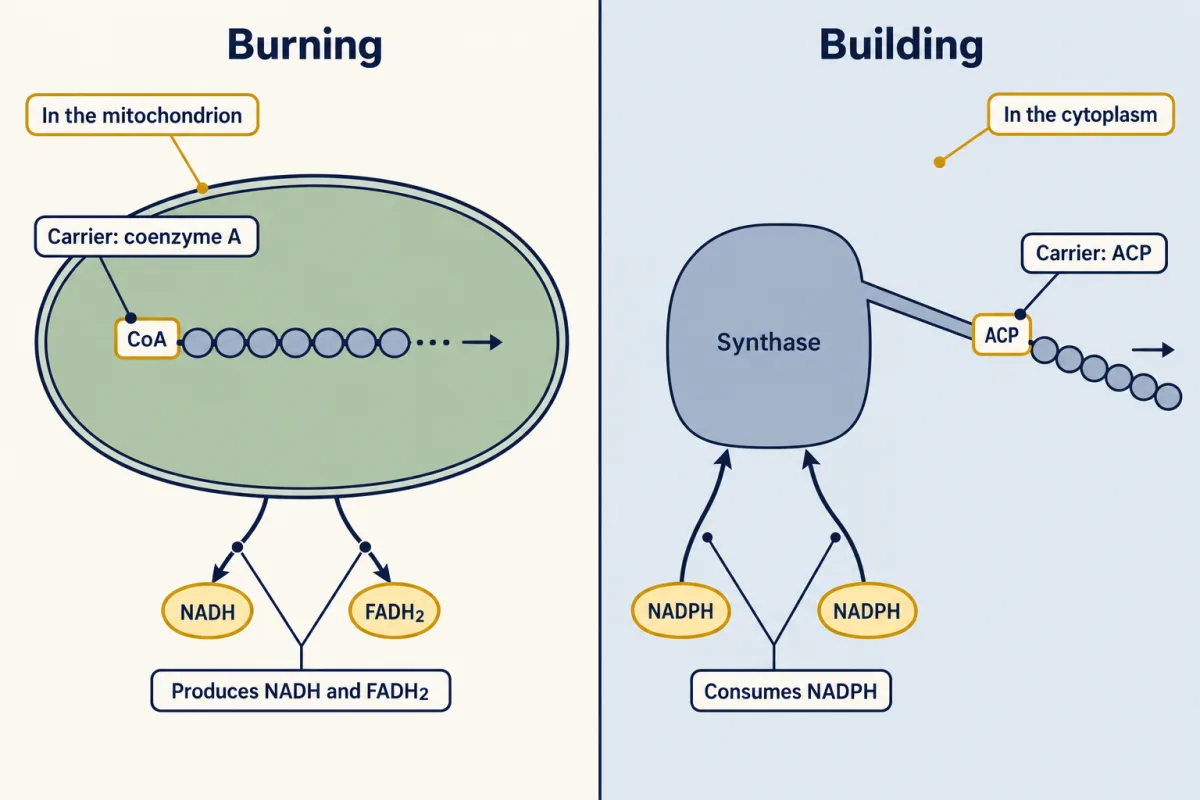
You have met beta-oxidation, the pathway that takes fat apart. It is tempting to assume synthesis runs it backward, but three differences set the two apart.
Location. Degradation happens mainly in the mitochondrion. Synthesis happens mainly in the cytoplasm. The cell physically separates the factory from the demolition crew.
Carrier. Beta-oxidation carries its intermediates on coenzyme A. Synthesis carries them on a dedicated acyl carrier protein, ACP, using a long phosphopantetheine arm that swings the growing chain from one active site to the next without ever letting it float free.
Reducing power. Degradation produces NADH and FADH2. Synthesis consumes NADPH. The extra phosphate on NADPH is a tag that enzymes read, so NAD and NADP form two separate pools kept in opposite states. In the cytoplasm NAD is kept mostly oxidized, as NAD⁺, ready to accept electrons from burning fuel; NADP is kept mostly reduced, as NADPH, ready to hand electrons to building. The two pools do not mix on their own: moving electrons from NADH to NADPH costs the cell energy (Paying the bill).
Predict. Suppose synthesis were the exact reverse of beta-oxidation: in the mitochondrial matrix, on CoA, using NADH. What could the cell no longer do?
Check your prediction
Switch one direction on while holding the other off. With one place, one carrier and one electron pool, new chains would sit beside the enzymes that burn them: a futile cycle, building and tearing down the same molecule at once and paying for both. Separation lets the cell regulate each direction independently.
Stage 1: Transport. Citrate carries the acetyl group out
Acetyl CoA is made in the mitochondrion, but it cannot cross the inner mitochondrial membrane. So the cell sends the acetyl group across in disguise.
Citrate is the disguise. The first step of the tricarboxylic acid (TCA) cycle joins acetyl CoA to oxaloacetate to make citrate, and when fuel is plentiful, citrate builds up and is exported to the cytoplasm. There, ATP-citrate lyase spends an ATP to cleave it back into acetyl CoA and oxaloacetate. Think of citrate as an Uber for acetyl groups.
The leftover oxaloacetate helps pay for the build; we return to it once we know the bill.
Stage 2: Activation. The committed step
The film above shows acetyl CoA carboxylase (ACC) spending one ATP to attach a carboxyl group, supplied as bicarbonate, to cytoplasmic acetyl CoA, making malonyl CoA.
ACC carries biotin, a vitamin tethered to a lysine. Biotin is a swinging arm, a CO₂ taxi in the informal picture: it picks up the carboxyl group at one active site and drops it onto acetyl CoA at another. If you met pyruvate carboxylase in gluconeogenesis, this is the same trick.
More precisely, the malonyl CoA made by ACC1, the form that feeds synthesis, has essentially one fate: addition to a fatty acid. That is why ACC1 is the committed step and why the cell’s fast controls act here rather than later.
Stage 3: Elongation, one turn at a time
The film above animates fatty acid synthase (FAS) repeating Condensation, Reduction, Dehydration, Reduction, or CRDR. In mammals FAS is one enormous protein, a pair of identical chains (a homodimer), and each chain carries every tool the cycle needs.
| FAS domain | What it does |
|---|---|
| Malonyl/acetyl transferase (MAT) | loads the acetyl primer and each malonyl unit |
| Ketoacyl synthase (KS) | C: joins the chain to the malonyl unit |
| Ketoreductase (KR) | R: C=O to CH–OH, using NADPH |
| Dehydratase (DH) | D: removes water, leaving a C=C |
| Enoyl reductase (ER) | R: C=C to CH₂–CH₂, using NADPH |
| Thioesterase (TE) | releases the finished chain |
ACP holds the chain by a thioester, the same sulfur link CoA uses.
Turn one, drawn out
Start with the two pieces loaded. The primer is an acetyl group, parked on a cysteine of the KS domain. The extender is a malonyl group on ACP: an acetyl group carrying the extra carboxyl that acetyl CoA carboxylase (ACC) added.
CH₃–CO–S–KS (acetyl, the primer)
⁻OOC–CH₂–CO–S–ACP (malonyl, the extender)
Condensation. KS joins them. The malonyl unit loses its extra carboxyl as CO₂, and the carbon that was next to it attacks the primer’s C=O. The result is a four-carbon chain on ACP, acetoacetyl-ACP:
CH₃–CO–CH₂–CO–S–ACP + CO₂
Predict. A researcher gives a liver extract bicarbonate labeled with carbon-14, so the carbon that ACC adds is radioactive. After palmitate is made, where is the label?
Check your prediction
Little to none of it is in the palmitate. The carbon ACC added leaves as CO₂ at condensation, in every turn: the classic proof that the CO₂ is a leaving group, not a building block.
Why pay for a carbon that leaves again? Joining two acetyl groups directly is uphill; losing CO₂ is strongly downhill, and coupling the two makes each join effectively one-way. The enzyme thiolase can make the direct join (cholesterol synthesis starts that way), but the equilibrium lies far toward the separate pieces, so each join would be easily undone and the chain would grow only as fast as later steps could pull it along.
The film’s two-NADPH bill now gets a chemical meaning. Condensation left a C=O on the β-carbon, two carbons along from the thioester carbon. Turning it into the CH₂ of a fatty acid takes four electrons: the carbon’s oxidation state falls from +2 to −2. Each NADPH delivers two electrons as a hydride, in two reductions separated by dehydration.
Reduction (KR, 1 NADPH): CH₃–CH(OH)–CH₂–CO–S–ACP. The C=O becomes an alcohol.
Dehydration (DH): CH₃–CH=CH–CO–S–ACP + H₂O. Water leaves, leaving a double bond.
Reduction (ER, 1 NADPH): CH₃–CH₂–CH₂–CO–S–ACP. The double bond is saturated.
That is butyryl-ACP, four carbons and fully saturated, for one malonyl CoA (so one ATP, spent at ACC) and two NADPH. It moves back to the KS cysteine, a new malonyl unit loads onto ACP, and CRDR runs again. Each turn adds two carbons at the end nearest the sulfur, so the primer’s two carbons end up at the far, methyl end of the finished fatty acid.
The bill for any chain
Because every turn has the same price, the whole cost follows from one count: how many turns?
In words Subtract the primer's two carbons and halve what is left to get the number of turns. Each turn uses one malonyl CoA, which cost one ATP, and two NADPH. The primer adds one acetyl CoA that costs no ATP.
- n“n”
- carbons in the finished saturated chainan even number
- t“t”
- turns of the CRDR cycle, one per malonyl CoA addedcount
Sanity check For n = 4, one turn: 2 acetyl CoA, 1 ATP and 2 NADPH, matching turn one above.
Try one number
Stearate has 18 carbons. FAS stops at 16 and releases free palmitate. The cell reactivates it as palmitoyl CoA, for one more ATP (split to AMP), and an elongase on the endoplasmic reticulum adds the last two carbons at the same per-turn price.
Turns: t = (18 − 2) / 2 = 8.
ATP at ACC = 8, plus the one ATP to reactivate palmitate. NADPH = 2 × 8 = 16. Acetyl CoA = 8 + 1 = 9: one primer and eight that became malonyl CoA.
Need a refresher? reading an equation
Predict. Use the box: how many acetyl CoA, ATP and NADPH does one palmitate (C16) take?
Check your prediction
Seven turns: 8 acetyl CoA, 7 ATP, 14 NADPH. If you got 8 ATP, you charged the primer; it is used as acetyl CoA and never goes through ACC.
Everything in and out gives the full ledger:
8 acetyl CoA + 7 ATP + 14 NADPH + 7 HCO₃⁻ → palmitate + 7 CO₂ + 8 CoA + 14 NADP⁺ + 7 ADP + 7 Pᵢ + 6 H₂O (protons omitted)
Every term is the rule again. Seven bicarbonates go in at ACC and seven CO₂ come out at condensation. Seven dehydrations release seven waters, and the thioesterase uses one to cut palmitate free, leaving six.
The map below lays out the route in eight steps. Its running total counts one pass through the cycle, −1 ATP, −2 NADPH and 0 CO₂ (the carboxyl goes in and comes back out), and leaves the delivery step out. Open every step and it multiplies by seven turns for palmitate.
For palmitate (×7 turns):0 ATP,0 NADPH,0 CO₂
regulated step − used up · + produced
Carbon delivery (a preamble to the tally). Citrate made in the mitochondrion is exported and cleaved in the cytoplasm, spending one ATP to release the acetyl group onto CoA — citrate is the shuttle that carries acetyl groups across a membrane acetyl-CoA itself cannot cross. The leftover oxaloacetate helps pay the NADPH bill; see Paying the bill below.
Clinical. Targeted by the cholesterol drug bempedoic acid, activated mainly in liver and not in muscle, which lowers LDL with less muscle effect than statins.
The committed step. A biotin arm acts as a CO₂ taxi (the same trick pyruvate carboxylase uses), carrying a carboxyl group from bicarbonate onto acetyl-CoA at the cost of one ATP, counted here as −1 CO₂ (from bicarbonate). The malonyl-CoA made by ACC1 has essentially one fate, fat. The carbon added here is released again at condensation, so it is a thermodynamic lever, not a building block.
Regulation. Activated by citrate, inhibited by palmitoyl-CoA and by AMPK phosphorylation. Malonyl-CoA also blocks CPT-I, so the cell tends not to burn and build fat at once.
Clinical. AMPK, the cell's low-energy sensor, switches ACC off during exercise — part of the logic behind exercise, and possibly metformin, restraining fat synthesis.
The acetyl primer is loaded onto the acyl carrier protein arm and handed on to a cysteine on the ketoacyl synthase; the malonyl group is then loaded onto the ACP arm. Fatty acid synthase is a multidomain homodimer. ACP carries intermediates on a long phosphopantetheine swinging arm — the same chemistry as CoA, but tethered so the growing chain never floats free.
The C of CRDR. The units join into a four-carbon β-ketoacyl chain, and the malonyl CO₂ — the one ACC just added — is released. That decarboxylation is the engine: joining two acetyl units directly is uphill and would barely proceed, so the cell pays an ATP at ACC to attach the carboxyl group and lets it go here as CO₂ to pull condensation forward.
The R of CRDR. The keto group is reduced to a hydroxyl using NADPH. Synthesis makes the D-isomer here; mitochondrial β-oxidation runs through the L-isomer — same atoms, opposite stereochemistry, one more sign the two pathways are genuinely separate machines.
The D of CRDR. Water leaves, creating a trans double bond. The chain is now one reduction away from being fully saturated.
The second R of CRDR. A second NADPH saturates the double bond, finishing one turn with a chain two carbons longer. The cycle then repeats: each turn adds one malonyl-CoA (two carbons) and spends two NADPH. Seven turns build C16.
After seven CRDR cycles the chain reaches sixteen carbons and thioesterase cleaves it free as palmitate. The balanced ledger: 8 acetyl-CoA + 7 ATP + 14 NADPH + 7 HCO₃⁻ → palmitate + 7 CO₂ + 8 CoA + 14 NADP⁺ + 7 ADP + 7 Pᵢ + 6 H₂O. Elongation past C16 and double bonds are added later, on the endoplasmic reticulum.
Clinical. Mammals lack the desaturases for the omega-6 and omega-3 positions, so linoleate and alpha-linolenate are essential fatty acids that must come from the diet.
Paying the bill: NADPH and delivery
The oxaloacetate left over from Stage 1 supplies part of the 14 NADPH. It is reduced to malate, which spends an NADH, and malic enzyme decarboxylates the malate to pyruvate, making NADPH. The pyruvate returns to the mitochondrion, where pyruvate carboxylase spends an ATP to make oxaloacetate again. In effect the shuttle turns an NADH into an NADPH for the price of an ATP. It runs once per acetyl group delivered, so it can supply up to 8 of the 14 NADPH. The pentose phosphate pathway and other routes supply the rest, and the real split varies by tissue.
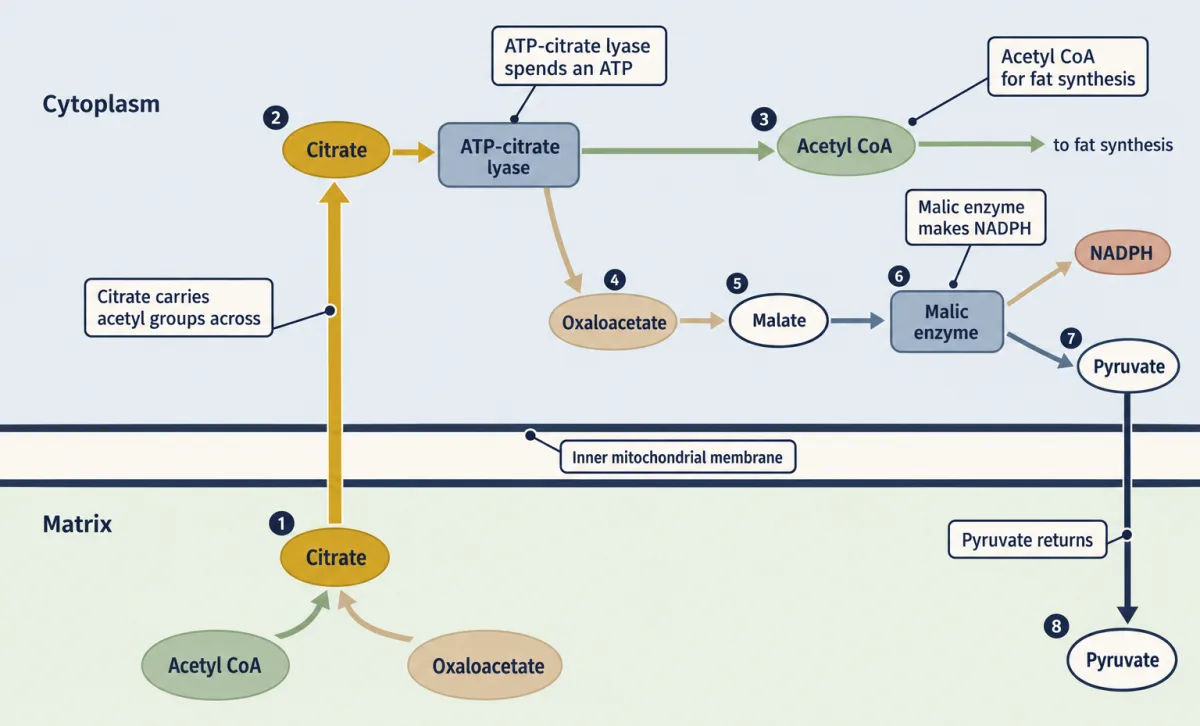
Delivery has an ATP price too. The ledger’s 7 ATP count only the building; delivering 8 acetyl groups as citrate costs 8 more at ATP-citrate lyase, and the rest depends on where the oxaloacetate goes:
| Oxaloacetate returns as | ATP-citrate lyase | Pyruvate carboxylase | ACC | Total ATP | NADPH from the shuttle |
|---|---|---|---|---|---|
| malate (no NADPH made) | 8 | 0 | 7 | 15 | 0 |
| pyruvate, via malic enzyme | 8 | 8 | 7 | 23 | 8 (for 8 NADH), leaving 6 for the pentose phosphate pathway |
Regulation: malonyl CoA’s second job
Back to the rule: Acetyl CoA carboxylase (ACC) is where the cell decides whether to build. It is controlled three ways.
| Layer | Turns ACC on | Turns ACC off |
|---|---|---|
| Phosphorylation | PP2A removes the phosphate | AMPK, the cell’s low-fuel sensor, phosphorylates ACC |
| Allostery | citrate (abundant fuel) makes ACC polymerize into active filaments | palmitoyl CoA (the end product) depolymerizes them, a clean feedback brake |
| Hormones | insulin | glucagon and epinephrine |
Over hours to days, insulin and glucose also switch on the ACC and fatty acid synthase (FAS) genes, through the transcription factors SREBP-1c and ChREBP.
Exercise switches AMP-activated protein kinase (AMPK) on, and so, in experiments, may the diabetes drug metformin; the mechanism is debated (Going deeper).
The second job is the elegant part: malonyl CoA blocks carnitine palmitoyltransferase I (CPT-I). Much of the malonyl CoA that does this blocking is made by a second form of the enzyme, ACC2, which sits on the mitochondrion; ACC1 mostly feeds synthesis. So when the cell is building fat, it also tends to close the door on oxidation. ACC1’s malonyl CoA is mainly a substrate; ACC2’s is mainly a signal.
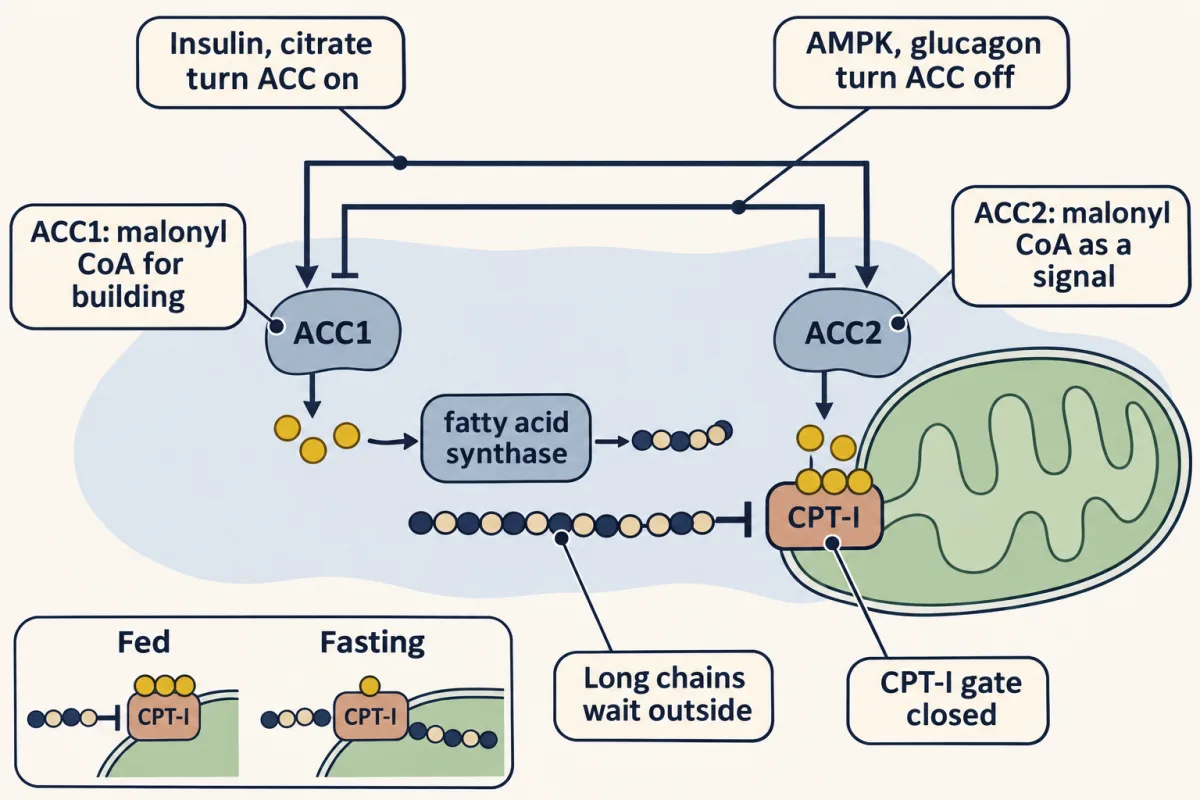
Try the see-saw below: toggle fed and fasting, or drag ACC activity, and watch malonyl CoA turn synthesis on while it closes the CPT-I gate.
Fed state: insulin activates ACC, malonyl-CoA climbs, fatty acid synthesis runs, and CPT-I is blocked — the cell stockpiles fat and burns little of it.
ACC is the hinge. Insulin activates it (build); glucagon and the low-energy sensor AMPK shut it off (burn). Because ACC's product is both the building block (ACC1) and the CPT-I signal (ACC2), one enzyme tilts the cell between storing and spending fat.
Predict. Glucagon arrives at a fasting liver. Follow it to ACC, then malonyl CoA, then CPT-I. What happens to fat burning?
Check your prediction
It rises. Glucagon inhibits ACC, so less malonyl CoA is made. Synthesis slows for lack of its building block, and the block on CPT-I lifts, so fat enters the mitochondrion and is burned.
Predict. Now a harder case. Metabolizing ethanol floods the liver with NADH, turns AMPK down and turns the fat-making genes up. Predict what happens to ACC, malonyl CoA, CPT-I and beta-oxidation.
Check your prediction
ACC runs harder, malonyl CoA rises and CPT-I closes. Beta-oxidation is hit twice: the gate is shut, and the high NADH-to-NAD⁺ ratio slows beta-oxidation directly. Less burning plus more building and storing produces the fatty liver of heavy drinking.
After palmitate
Fatty acid synthase (FAS) mostly stops at sixteen carbons. Longer chains and double bonds are added afterward, mainly on the endoplasmic reticulum. Elongases extend the chain from malonyl CoA at the same per-turn price, as in the stearate example. Desaturases install double bonds by a different chemistry, using O₂, NADH and cytochrome b5. Mammals cannot put a double bond near the methyl end of the chain, so linoleate and alpha-linolenate are essential fatty acids you must eat. Downstream, arachidonate becomes the eicosanoids, the signals that aspirin blocks.
Next, in chapter 29, acetyl CoA and the fatty acids you just built go on to become storage fat, membrane phospholipids, and cholesterol, and cholesterol gets its own committed enzyme and its own famous drug.
Going deeper
The main line does not depend on these details, except that the metformin section fills in the hedge on a drug named in the objectives.
Biotin and the 1927 egg-white rats
Biotin, ACC’s CO₂ taxi, was found the hard way. In 1927, Margaret Boas in London fed rats raw egg white and watched them sicken. The culprit was avidin, an egg-white protein that binds biotin so tightly (a dissociation constant near 10 to the minus 15 molar) that it sequesters the vitamin and starves the enzymes that need it. That observation started the hunt that later identified biotin as the missing vitamin.
Why two fats are essential
Counting from the carboxyl carbon, mammalian desaturases can place a double bond as far out as carbon 9, and no farther. The omega-6 and omega-3 positions are counted from the other, methyl end; in an 18-carbon chain they sit at carbons 12 and 15 from the carboxyl end, beyond carbon 9, so we cannot put double bonds there. Burr and Burr showed the consequence between 1929 and 1932: rats raised on fat-free diets sickened, linoleate cured them, and alpha-linolenate proved essential too.
Aspirin and the platelet
Downstream of the essential fats, arachidonate becomes the eicosanoids: cyclooxygenase turns it into prostaglandins and thromboxanes. Aspirin works by permanently acetylating that enzyme. Platelets have no nucleus, so they make little or no replacement enzyme. That is why the effect of a single dose fades only gradually, over about a week, as new platelets replace the old ones.
Metformin and AMPK
This is one proposed way metformin helps in diabetes: in experiments it inhibits Complex I, the AMP-to-ATP ratio climbs, and AMP-activated protein kinase (AMPK) switches on and phosphorylates acetyl CoA carboxylase (ACC). Malonyl CoA falls, so synthesis slows and carnitine palmitoyltransferase I (CPT-I) opens, and oxidation rises. How metformin lowers blood sugar is still debated, and much of that effect does not need AMPK. (Metformin descends from French lilac, also called goat’s rue, a folk remedy for high blood sugar.)
One more tell: D and L
Beyond location, carrier and reducing power, a fourth difference: the first reduction (KR) makes D-3-hydroxyacyl intermediates, while mitochondrial beta-oxidation runs through the L-isomers. Same atoms, opposite stereochemistry: one more sign that synthesis and degradation are different machines.
The ledger’s protons
The ledger is printed with protons omitted. Every carbon, nitrogen, oxygen, phosphorus and sulfur in it balances, and so does the water, but the protons are left out. Textbooks print different proton counts because they use different conventions for how charged each molecule is. The water count works because the oxygen that ends up on the phosphate comes from bicarbonate, not from water.
Where the rules bend
- “Mainly” in the location rule matters. Very-long-chain fatty acids start their oxidation in peroxisomes, and a separate set of small enzymes inside the mitochondrion (mitochondrial fatty acid synthesis) makes an octanoyl group, the starting point for lipoic acid.
- Odd-chain fatty acids start from a three-carbon primer, propionyl CoA, instead of acetyl CoA.
- Not all malonyl CoA becomes fat: besides ACC2’s signalling pool, malonyl CoA decarboxylase can break it down.
Your notes
Select any text in the lesson to highlight it or add a note to it. Your highlights and notes are saved in this browser and collected in your notebook.
This browser is not letting the site save anything (a private window or strict privacy settings), so highlights and notes will be lost when you leave the page.
How we measure it
Radioisotope and stable-isotope tracing
Feed an animal acetate labeled with deuterium or carbon-14 and find the label inside its fat and cholesterol. This is how Schoenheimer showed body lipids are in constant turnover and how Bloch proved animals build sterols from two-carbon acetate. The same logic, run with a labeled bicarbonate, demonstrates that the CO2 added by ACC is the one released during condensation, never incorporated into the chain.
Avidin-biotin affinity capture
Egg-white avidin binds biotin with a dissociation constant near 10 to the minus 15 molar, one of the tightest non-covalent interactions known. Biochemists exploit it to pull biotin-tagged molecules out of a mixture. Historically the same binding starved rats fed raw egg white of their biotin, the 1927 London observation that started the hunt for biotin as a vitamin and, later, led to it as ACC's CO2 carrier.
Enzyme assay of a regulated polymer
ACC is active as a citrate-induced long filament and inactive as a dissociated dimer (though other, inactive filament forms also exist). Adding citrate to the purified enzyme drives polymerization and switches it on; adding palmitoyl CoA depolymerizes it and switches it off. Watching velocity rise and fall as you titrate one effector at a time is how the allosteric controls on the committed step were mapped.
Practice questions on this lesson (3) → MCAT-style, original, each with an explanation
Where this lesson fits
Before thisReview first
- Fatty Acid Degradation: The β-Oxidation SpiralThis course · Lesson 25
You need beta-oxidation from there to see why synthesis is a separate pathway, not its reverse.
- The Citric Acid Cycle: Harvesting ElectronsThis course · Lesson 19
Citrate made in the cycle is the form that carries acetyl groups out to the cytoplasm here.
- The Pentose Phosphate Pathway: NADPH and Five-Carbon SugarsThis course · Lesson 24
This pathway supplies part of the 14 NADPH that each palmitate needs.
After thisStudy next
- Integration of Metabolism: How the Body Switches FuelsThis course · Lesson 30
The malonyl CoA see-saw between building and burning fat is part of how fed and fasting states switch.
Suggested by an AI model from the lessons themselves, then checked. How we use AI
Finish line
Test yourself
8 questions
Practice and MCAT-style, with explained answers.
Play it · about 3 min
Wire the Cell: Store the surplus
Turn extra glucose into fat, and find where the NADPH comes from.
Play →Next · Lesson 27
Lipid Synthesis: Building Cholesterol from Acetyl-CoA
Skin cells from children whose blood is flooded with cholesterol keep making more of it. Why would a cell bathed in cholesterol keep building it?
Continue →Also in the arcade for this lesson: Ledger Rush: Fatty acid synthesis
← Lesson 25 · Fatty Acid Degradation: The β-Oxidation Spiral