Developmental Neuroscience · Skim version
Proneural Genes and Lateral Inhibition
Read the full lesson → Skim the whole course →
The guiding idea
Every cell in the cluster could become the neuron. Why does only one?
In the fly, proneural factors say which cells may become neural and Notch says which one does, by comparing each cell with its neighbours.
From the film: Equal Cells, One Winner
- In the fly, proneural genes make a group of cells able to become neural, and Notch signaling then picks which one does.
- Notch does not place the clusters; it narrows them, so placing a cluster and picking a cell within it are separate events.
- The same logic applies on three maps: the fly embryo's ectoderm, the fly notum and the vertebrate neural tube.
From the film: The Casting Call
- Proneural genes such as achaete and scute make cells in a cluster able to become neural: remove them and bristles are missing, and switch them on in extra places and extra bristles form.
- Different proneural genes tend to start different kinds of sense organ: achaete-scute mostly external ones, atonal mostly chordotonal organs.
- Proneural proteins are basic helix-loop-helix transcription factors that work as a pair with a partner, Daughterless in the fly and E proteins in vertebrates.
- In the embryo regulatory DNA places the clusters, so proneural factors say who may become neural and Notch says who does.
From the film: The Loop, One Arrow at a Time
- Delta on one cell activates Notch on its neighbour, which turns on Enhancer of split repressors that switch off proneural genes.
- Each cell inhibits its neighbour, so A inhibits the cell that inhibits A; two inhibitions in a row act as positive feedback, and a small lead can grow.
- In an idealised pair, with no Notch in either cell both become neural, and with Notch switched on in both neither does.
From the film: When Does the Tie Break?
- Between two equal cells the tie breaks only if the loop is steep, so that a small difference comes back round the loop larger than it left.
- On a steep loop the pair is bistable, with two stable outcomes and an unstable even state; on a shallow loop the pair settles back to even.
- In a model sheet, touching-neighbour inhibition spaces winners, with about one cell in three winning, and does not by itself guarantee one winner per cluster.
From the film: Neighbours Compare
- Fly embryos lacking Notch or Delta make far too many neuroblasts and too little epidermis, so these genes are called neurogenic.
- In fly mosaics, cells mutant for Notch became neural on their own but cells mutant for Delta did not, so losing the receptor and losing the ligand are not the same.
- In these mosaics, a cell's fate depended on its Notch activity relative to the cells beside it.
From the film: Vertebrates: a Brake, a Clock and Identity
- In the vertebrate neural tube, Notch-Hes lateral inhibition works as a brake on how fast progenitors are used up, because a cell held back stays a dividing progenitor.
- Hes1 oscillates in cultured cells and in mouse neural progenitors; in culture, steady Ascl1 pushed cells toward neurons while oscillating Ascl1 kept them dividing.
- The Ascl1 and Neurog2 swaps in mouse forebrain were not mirror images, so a proneural factor carries part of a neuron's identity and the tissue and the cell's history shape the rest.
-
The layout
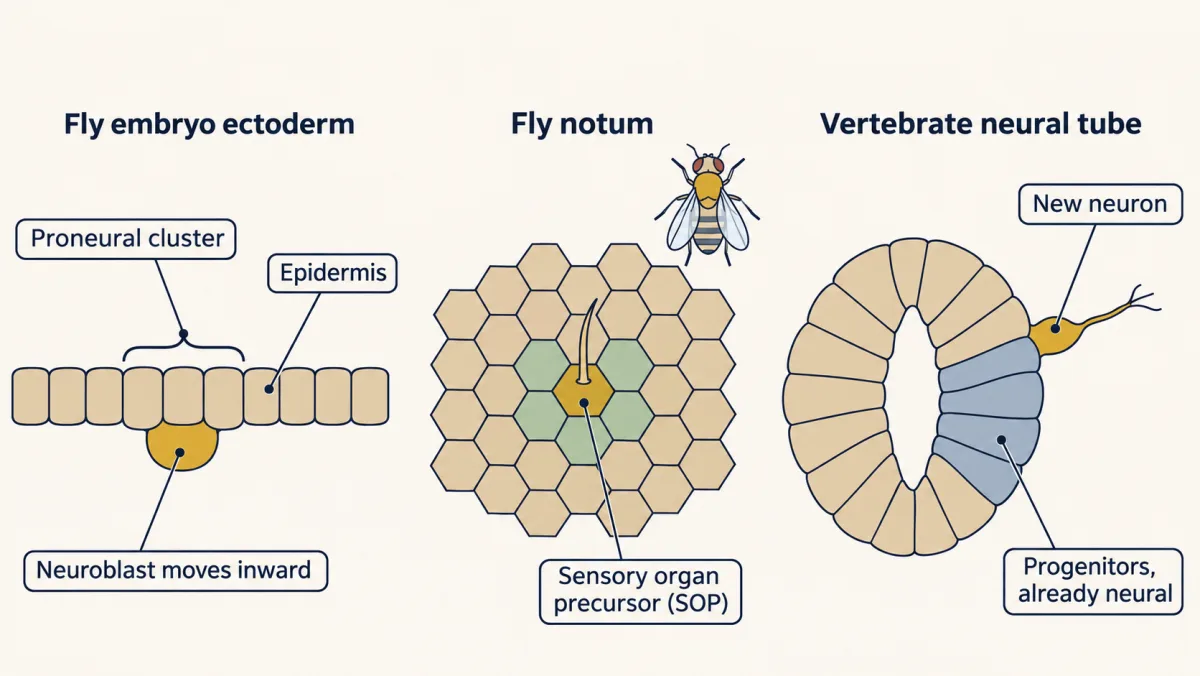
Three maps carry the arguments in this lesson: the fly embryo's ectoderm, where one cell of a cluster moves inward as a neuroblast; the fly notum, where one cell of a cluster becomes the precursor of a bristle; and the vertebrate neural tube, where the cells are already neural. AI-generated illustration -
Step 1: a cluster becomes competent
-
Step 2: one cell is picked
-
When does the tie break? The loop must be steep
-
The evidence: neighbours compare
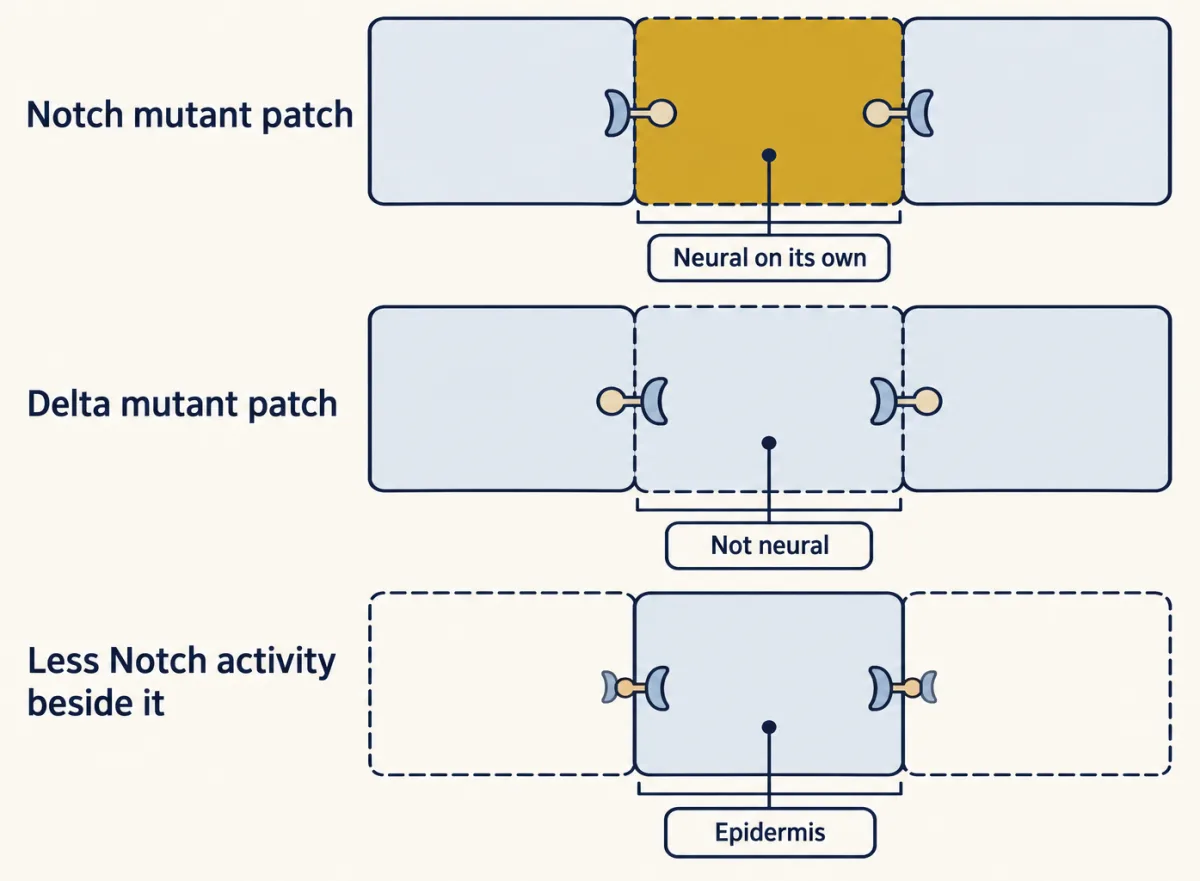
Key: the ball on a stick is Delta and the crescent is Notch. In fly mosaics, Notch-mutant cells adopt neural fate autonomously beside normal cells, whereas Delta-mutant cells do not. A normal cell beside neighbours with lower Notch activity than its own adopts epidermal fate. These comparisons show that relative Notch activity influences fate in these mosaics (Heitzler and Simpson, 1991). AI-generated illustration -
Vertebrates: a brake and a clock
-
Do proneural genes carry identity? The Ascl1 and Neurog2 swap
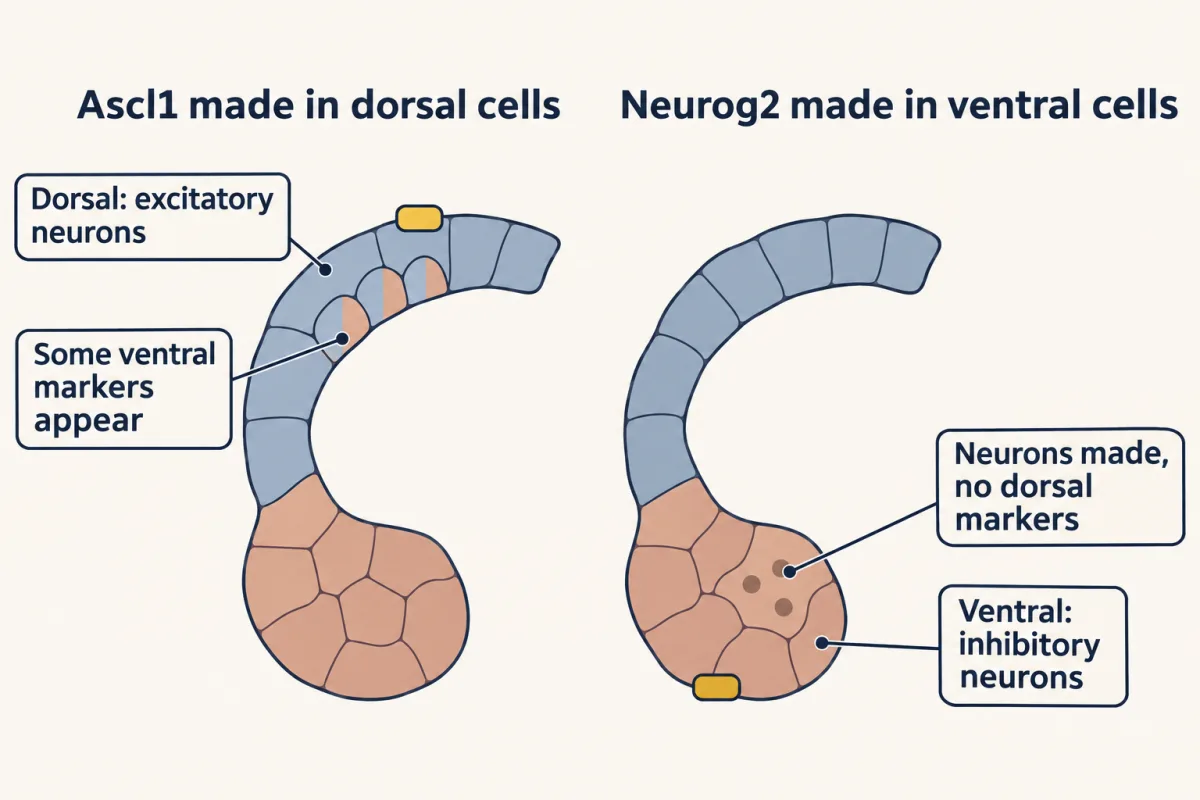
The two swaps were not mirror images. Ascl1 made in dorsal cells switched on a subset of ventral markers there, while Neurog2 made in ventral cells restored neuron production and the ventral markers without switching on dorsal ones. AI-generated illustration -
Putting it together
-
Going deeper
Where this lesson fits
Before thisReview first
- Neural Induction: The Default ModelThis course · Lesson 6
You need the idea that BMP signaling sets neural versus skin fate from there, since proneural genes act in already-neural tissue.
- Ventral to Dorsal: Sonic Hedgehog and BMP in the Neural TubeThis course · Lesson 10
It shows how the neural tube is patterned into progenitor domains, which proneural clusters and Notch then narrow.
- Transcription Factor Codes: Building a Motor NeuronThis course · Lesson 11
It shows how transcription factor codes set neuron identity, which this lesson uses when asking whether proneural factors carry identity.
After thisStudy next
- Asymmetric Division: Numb and the NeuroblastThis course · Lesson 15
It shows how a dividing progenitor gives its daughters different Notch activity, which this lesson only mentions.
- Birth Order and Fate: Temporal Identity and the Inside-Out CortexThis course · Lesson 16
It takes up when in a lineage identity instructions arrive, the question left open after the swap experiments.
- Where Glia Come FromThis course · Lesson 43
It uses Notch-Hes signalling to explain how progenitors switch from making neurons to making glia.
Elsewhere on the siteFilms, simulations and method films in other courses
- The Receptor Is the MessageFilm · Cell Signaling
This film shows the Notch receptor as the message and how contact between two cells decides which becomes the nerve cell.
Suggested by an AI model from the lessons themselves, then checked. How we use AI