Genetics and Molecular Biology · Skim version
Probability, Crosses and the Chi-Square Test
Read the full lesson → Skim the whole course →
The guiding idea
A 9:3:3:1 ratio predicts 312.75 round yellow seeds among Mendel's 556, and he counted 315. How far off can a count be before chance stops being a good explanation?
A cross predicts probabilities, and a probability predicts a spread of counts, not one exact count, so real offspring seldom match the ratio exactly.
From the film: A Ratio Predicts a Spread
- A cross predicts probabilities, and real counts scatter around them.
- For independent steps, multiply along a path: round and yellow is 3/4 × 3/4 = 9/16.
- When several different outcomes count, add their paths.
- These rules hold for unlinked genes; genes close together on one chromosome tend to be inherited together, and multiplying their single-gene chances fails.
- Counts seldom match a ratio exactly; the question is how far a count can stray by chance.
From the film: How Far Is Too Far?
- Chi-square scores how far counts lie from a ratio, judging each miss against its expected count.
- If the ratio holds, chi-square averages its degrees of freedom: three for four classes.
- With 3 degrees of freedom, only 5% of chance results score above 7.81.
- The p-value is the share of chance results at least as far off as yours, computed as if the ratio and the other assumptions held.
- A large p-value gives no reason to reject the ratio; it does not prove it.
-
Two rules: and means multiply, or means add
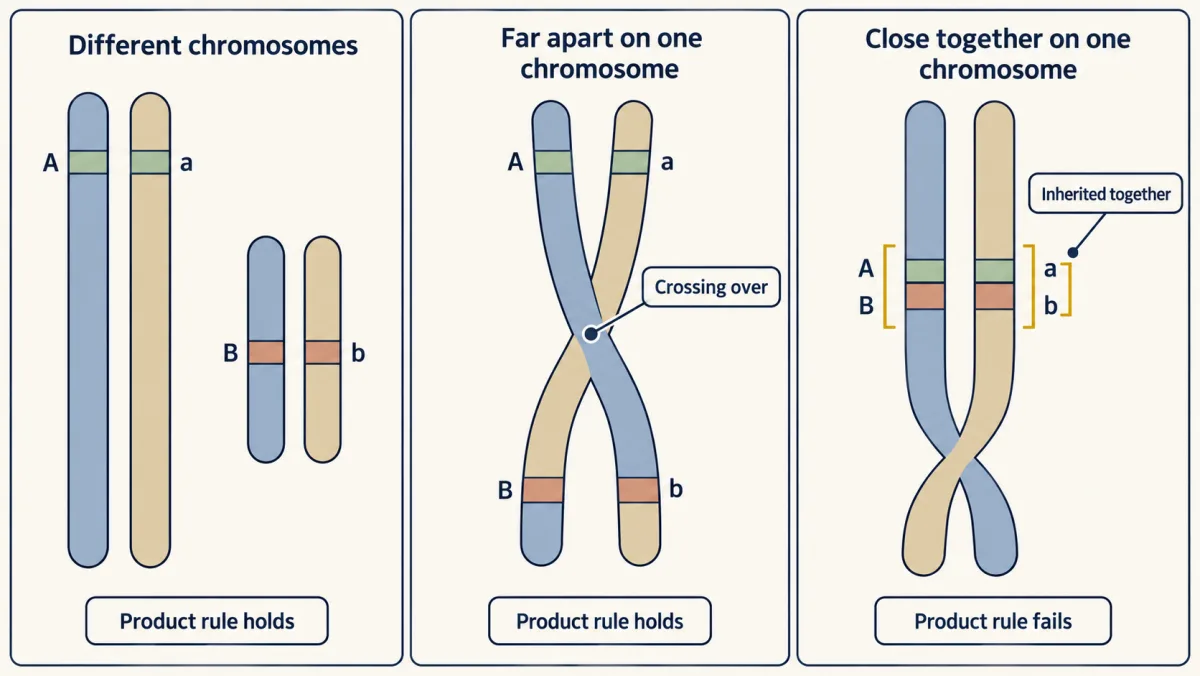
Genes on different chromosomes assort independently, and genes far apart on one chromosome behave almost as if unlinked, so the product rule applies. Genes close together on one chromosome tend to be inherited together, so their single-gene chances cannot simply be multiplied. AI-generated illustration -
Many genes at once: multiply along the branches
-
Families: the binomial counts the birth orders
-
Is the deviation chance? The chi-square test
-
Going deeper
Where this lesson fits
Before thisReview first
- Mendel's Peas: Segregation and Independent AssortmentThis course · Lesson 1
You need Mendel's 3:1 and 9:3:3:1 ratios and independent assortment from there to know which ratio to test.
- Chromosomes and Meiosis: The Physical Basis of Mendel's LawsThis course · Lesson 2
It shows why genes on different chromosomes assort independently, which is what lets you multiply their chances here.
After thisStudy next
- Reading Pedigrees: Human InheritanceThis course · Lesson 5
Carrier risks in families use the product and sum rules and the binomial counting of affected children.
- Linkage and Recombination MappingThis course · Lesson 8
It tests for linkage by asking whether test-cross counts deviate from 1:1:1:1 more than chance allows.
- Extending Mendel: Dominance, Multiple Alleles and Gene InteractionThis course · Lesson 4
Ratios such as 9:7 are checked against counts with the chi-square test learned here.
Elsewhere on the siteFilms, simulations and method films in other courses
- Cross and countSimulation · Biology
Crossing and counting offspring there shows how real counts scatter around a predicted ratio.
- Where Can White Flowers Hide?Film · Life Science
It shows that Punnett squares give chances, not exact offspring counts.
Suggested by an AI model from the lessons themselves, then checked. How we use AI