Cell Signaling · Skim version
Phosphorylation: Kinases and Phosphatases
Read the full lesson → Skim the whole course →
The guiding idea
How can one small chemical mark change what a protein does without rebuilding it?
A stable, removable phosphate changes protein behavior through its charge and shape.
From the film: The Charge That Changes the Odds
- A stable, removable phosphate changes protein behavior through its charge and shape.
- Kinases transfer phosphate from ATP to proteins, and phosphatases remove it with water.
- Phosphorylation may change activity, docking, location or a later modification.
- A phosphate can favor activity or inhibition; it is not an automatic on signal.
From the film: Two Enzymes Set the Level
- Phosphorylation level depends on both the kinase and the phosphatase.
- At simple first-order rates, their ratio sets the steady phosphorylated fraction.
- Either activating the kinase or inhibiting the phosphatase can raise that fraction.
- Faster opposing rates make the level settle faster but spend more ATP.
-
Write the mark, erase the mark
-
Four consequences of one added phosphate
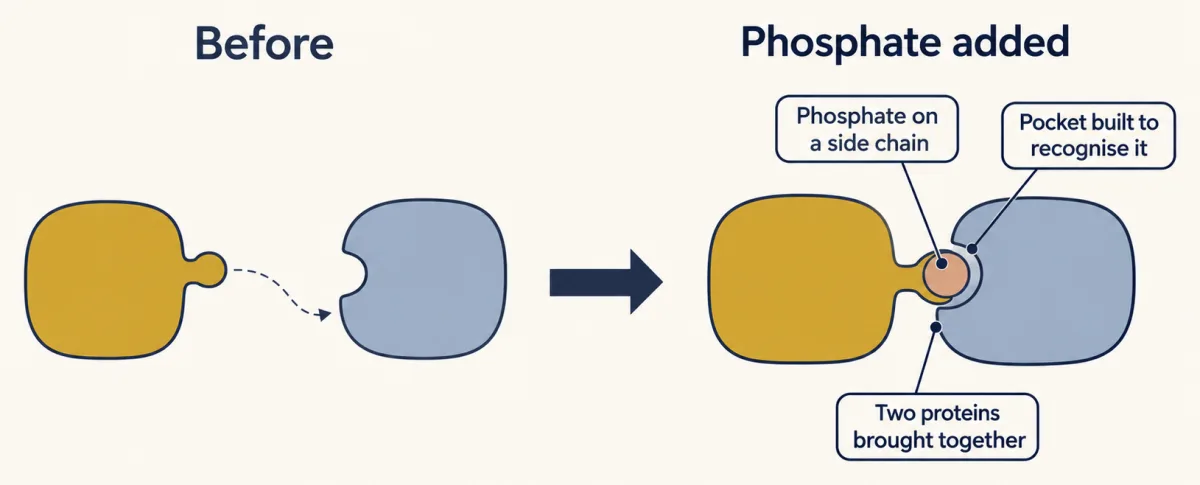
A phosphate can create a docking surface that brings two proteins together without changing either protein's catalytic rate. AI-generated illustration 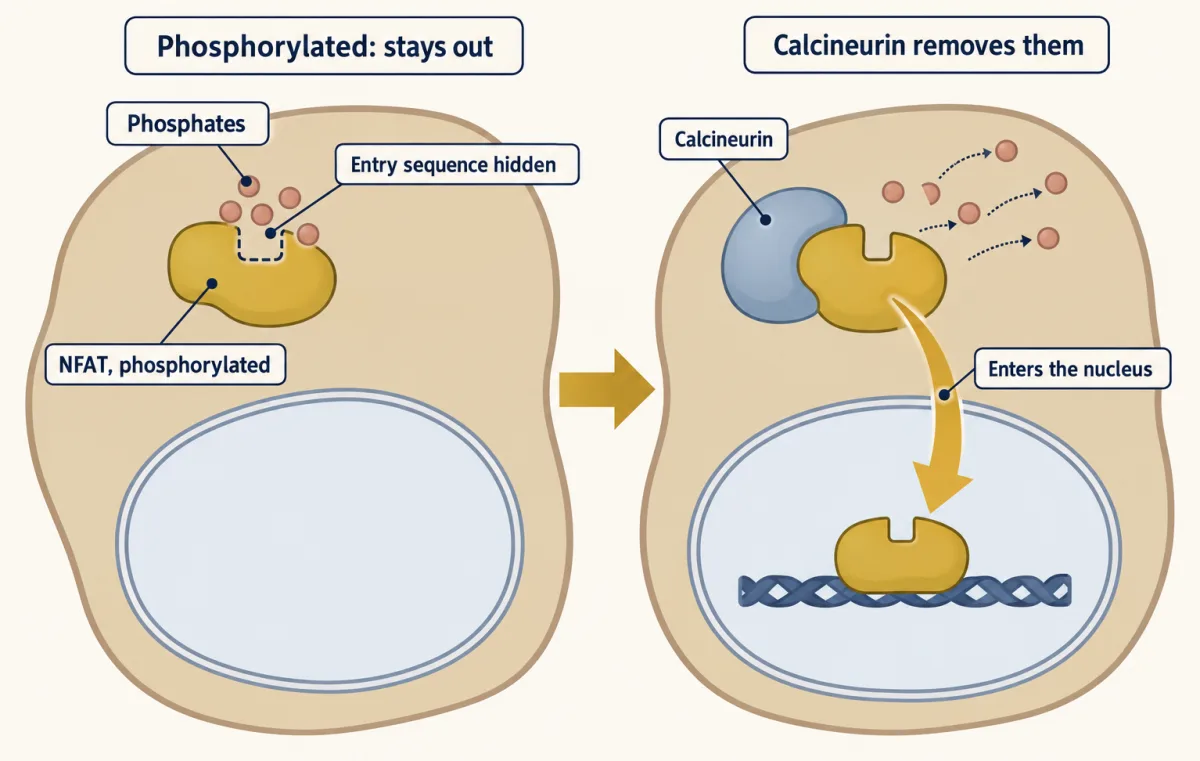
Calcineurin removes NFAT's phosphates, exposing its nuclear-entry sequence, so the erasing enzyme carries this signal. AI-generated illustration -
How much protein carries the phosphate?
-
How the enzymes find the right targets
-
Build the evidence: detect, map, test
-
When the switch breaks: kinases in disease and the clinic
-
Going deeper
Where this lesson fits
Before thisReview first
- Circuits: Amplification, Feedback, Adaptation and SwitchesThis course · Lesson 5
You need the idea of switches and feedback from there to see why a kinase and phosphatase pair sets a signal's level.
- Binding: Affinity, Occupancy and Dose–ResponseThis course · Lesson 3
The binding and occupancy ideas there underlie how a drug competes with ATP in the kinase pocket.
After thisStudy next
- Protein Modules: SH2, SH3, PTB, PDZ and PHThis course · Lesson 9
These domains read the phosphate marks introduced here, turning a phosphate into a docking site.
- Receptor Tyrosine KinasesThis course · Lesson 18
This takes the idea of tyrosine phosphorylation to receptors that phosphorylate themselves and their partners.
- Ras to MAPK: The Kinase CascadeThis course · Lesson 19
A relay of kinases, each phosphorylating the next, shows the writer-and-eraser logic working in a pathway.
Suggested by an AI model from the lessons themselves, then checked. How we use AI