Biochemistry · Skim version
The Pentose Phosphate Pathway: NADPH and Five-Carbon Sugars
Read the full lesson → Skim the whole course →
The guiding idea
It makes no ATP, and that is the point: NADPH and ribose-5-phosphate are the products that matter.
Glycolysis is not the only fate of glucose-6-phosphate.
-
Why NADPH, not NADH
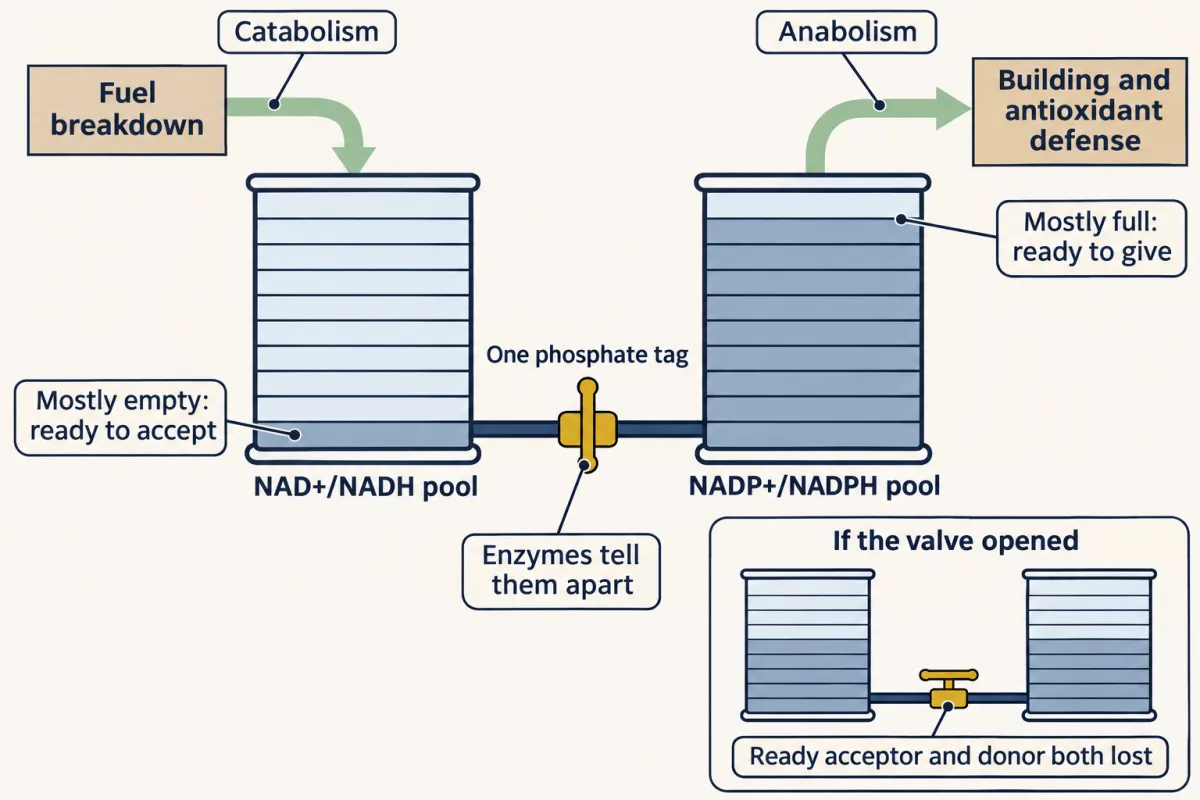
Same carriers, different fill. NAD and NADP hold electrons about equally strongly, but the cell keeps the NAD pool mostly oxidized, ready to accept electrons from catabolism, and the NADP pool mostly reduced, ready to give them for biosynthesis and glutathione regeneration. The one-phosphate tag lets enzymes keep the pools apart; if electrons could flow between them, both would settle at the same level. The fill levels are schematic. AI-generated illustration -
The tap: the oxidative phase
-
The mismatch
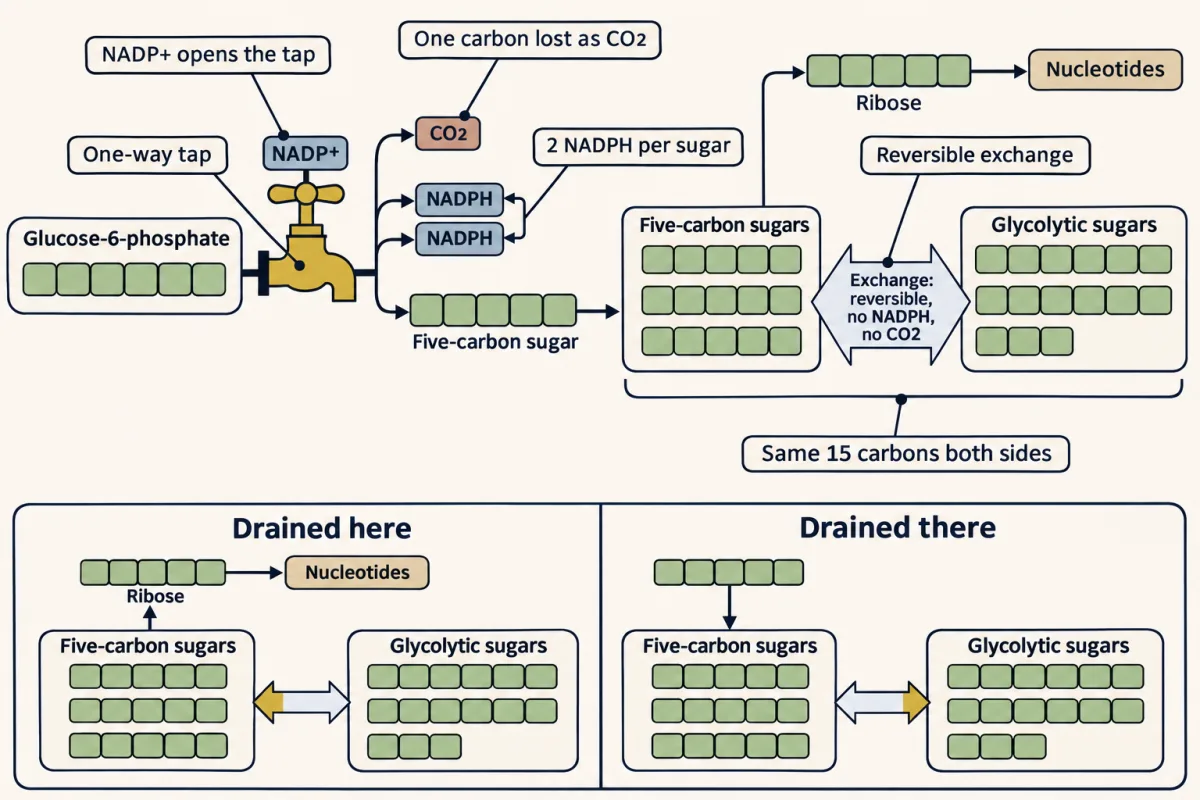
The pathway as a tap and an exchange. The tap is one-way: each glucose-6-phosphate gives 2 NADPH, 1 CO2 and one five-carbon sugar, and NADP+ opens it. The exchange is reversible and makes no NADPH: three five-carbon sugars trade places with two fructose-6-phosphate and one glyceraldehyde-3-phosphate, fifteen carbons either way, running toward whichever end the cell is draining. AI-generated illustration -
The exchange: the non-oxidative phase
-
Four demands, four tallies
-
The red cell: when the tap breaks
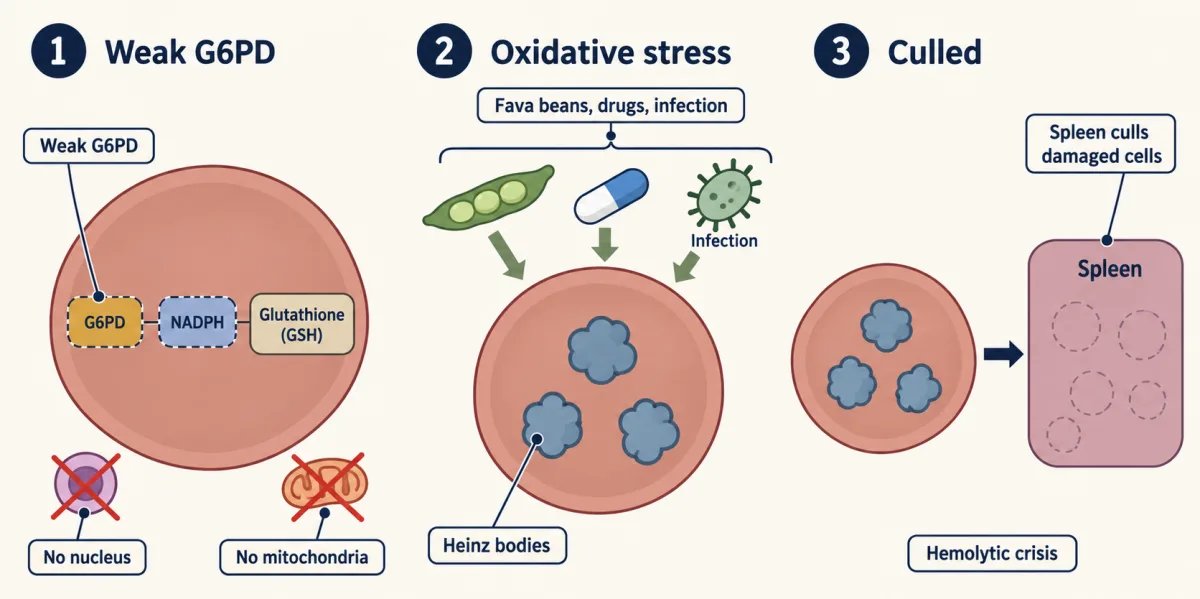
In mature red blood cells the pentose phosphate pathway is the main source of NADPH. With weak G6PD, NADPH and glutathione run short, so oxidative stress from fava beans, certain antimalarial or sulfa drugs, or infection clumps hemoglobin, and the damaged cells burst in the circulation or are removed by the spleen. AI-generated illustration -
Where the NADPH goes next
-
Going deeper
Where this lesson fits
Before thisReview first
- Glycolysis: The Investment-and-Payoff PathwayThis course · Lesson 16
You need glucose-6-phosphate as the branch point, and glycolysis, to follow where the exchange phase sends its sugars.
- Metabolism: Basic Concepts and DesignThis course · Lesson 15
It explains why NAD and NADP pools are kept differently filled, and how cells couple energy-releasing steps to building steps.
- Gluconeogenesis: Pushing Glucose Back UphillThis course · Lesson 17
Mode 3 uses gluconeogenesis enzymes to turn fructose-6-phosphate and glyceraldehyde-3-phosphate back into glucose-6-phosphate.
After thisStudy next
- Fatty Acid Synthesis: Building the Chain Two Carbons at a TimeThis course · Lesson 26
Fat building spends the NADPH this pathway makes, so you see where that reducing power goes.
- Nucleotide Metabolism: Build It, Recycle It, or Pay in Uric AcidThis course · Lesson 29
Ribose-5-phosphate from here is turned into PRPP, the start of building nucleotides.
- Integration of Metabolism: How the Body Switches FuelsThis course · Lesson 30
It shows how hormones and fuel state switch pathways like this one up or down.
Suggested by an AI model from the lessons themselves, then checked. How we use AI