Ecology and Evolution · Skim version
Nutrient Cycling
Read the full lesson → Skim the whole course →
The guiding idea
Cut a forest, leave the logs where they fall and keep it from growing back. Nobody adds fertiliser, yet its stream starts carrying far more nitrogen. Where does that nitrogen come from?
An ecosystem's store of an element changes only through what crosses its boundary, while a loop of recycling inside, often much larger, cancels in the sum.
From the film: The Loop Inside the Line
- An element's store inside a boundary changes only by what crosses it: change in stock = inputs - outputs, for a stated boundary and interval.
- Inside a forest, decomposers and plants pass nitrogen round a loop that is often several times larger than all the inputs.
- That loop never crosses the boundary, so it cancels in the budget, yet here it is the largest flux.
- Cut the trees and stop regrowth, and decomposers keep releasing nitrogen that no plant takes up; much of it leaves in the stream as nitrate.
- At Hubbard Brook the stream from the cut watershed carried far more nitrate and calcium than the uncut one: the broken loop had crossed the boundary.
From the film: Two Halves of One Lake
- In Lake 226 both basins received nitrogen and carbon, but only the basin that also received phosphorus became highly eutrophic.
- In Lake 227, nitrogen fertiliser stopped in 1990 while phosphorus continued, and the lake stayed highly eutrophic.
- Nitrogen-fixing cyanobacteria took nitrogen from the air and made up the nitrogen that was no longer added.
- No microbe can fix phosphorus from the air, so in these lakes phosphorus supply set how much algae the lake could hold.
- These are two Ontario lakes; other lakes and many estuaries can respond to nitrogen.
-
Pools, fluxes and residence time
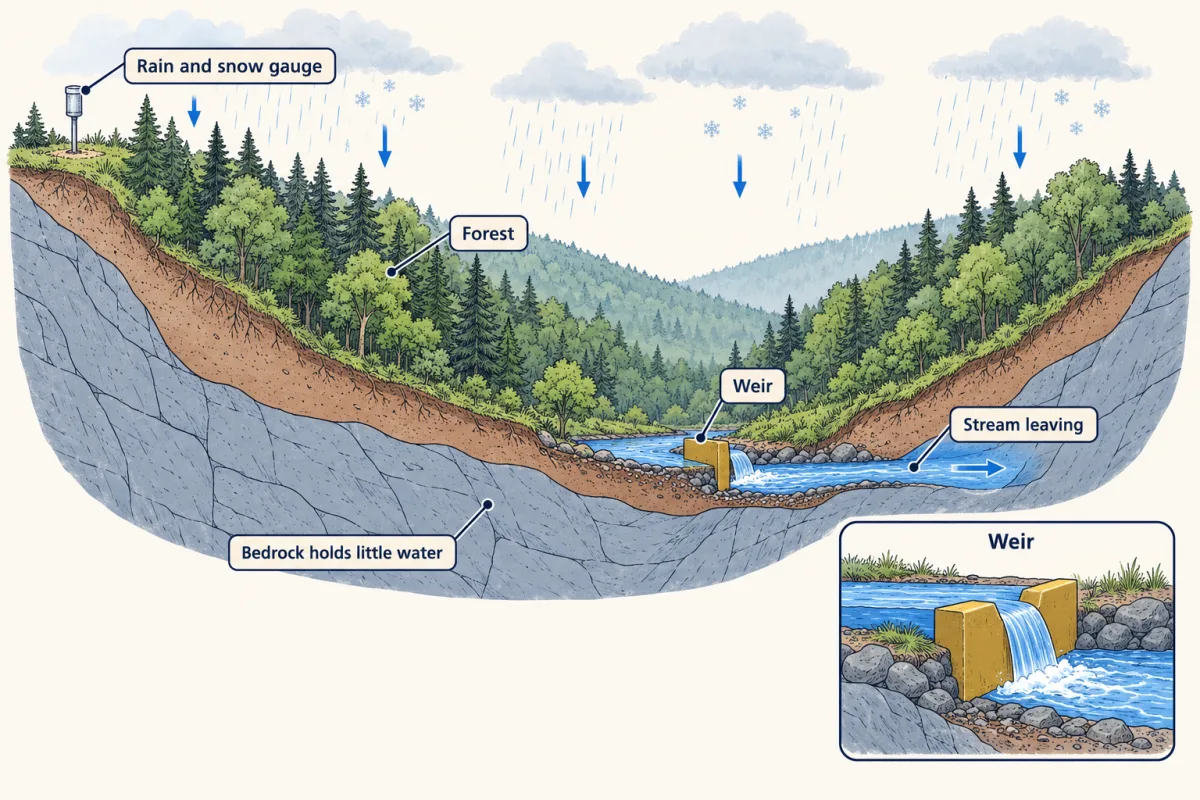
A small watershed on watertight bedrock: gauges measure the rain and snow coming in, and a weir on the stream measures nearly everything leaving in water. AI-generated illustration -
The carbon cycle: fast exchanges laid over slow stores
-
The nitrogen cycle: microbes run most of the transformations
-
Phosphorus: the element no microbe can fix
-
What the second film left out
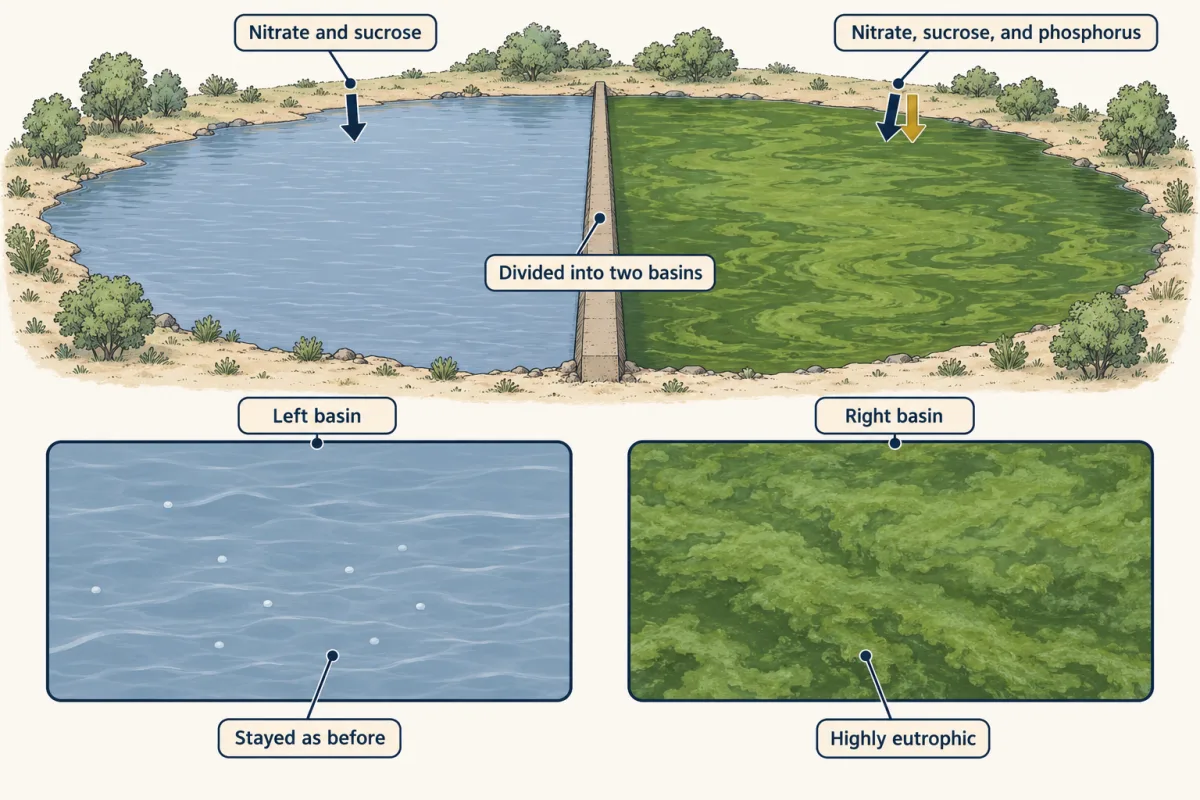
Lake 226: with nitrate and sucrose in both basins, only the basin that also received phosphorus became highly eutrophic. AI-generated illustration 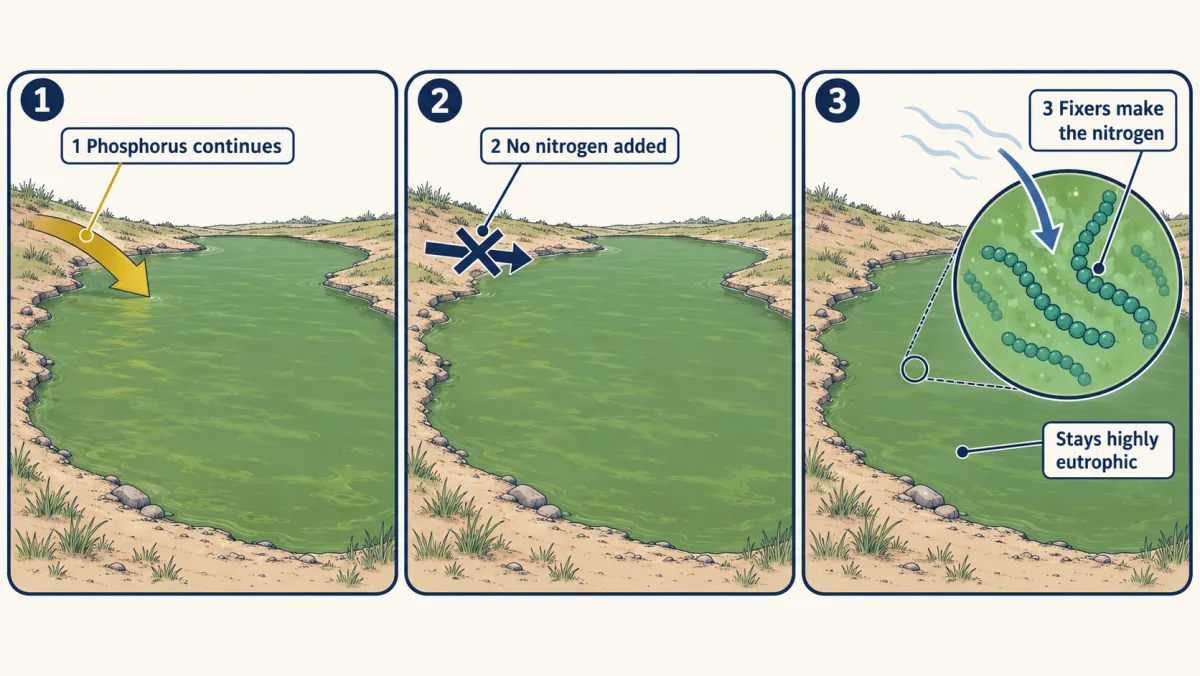
Lake 227, one lake: nitrogen-fixing cyanobacteria made up the nitrogen, so the lake stayed highly eutrophic on phosphorus alone. AI-generated illustration -
What a budget can and cannot show
-
Going deeper
Where this lesson fits
Before thisReview first
- Energy Flow and ProductivityThis course · Lesson 21
You need its mass-balance and pools-and-fluxes bookkeeping here, where atoms are reused instead of leaving as heat.
After thisStudy next
- Biodiversity and Ecosystem FunctionThis course · Lesson 23
It asks how the species present change the uptake and cycling of nutrients that this lesson budgets.
- Global Change: Species on the MoveThis course · Lesson 24
It applies budgets and boundary fluxes to how added carbon and nitrogen change ecosystems.
Elsewhere on the siteFilms, simulations and method films in other courses
- Follow an atomSimulation · Biology
It lets you follow an atom through reservoirs and processes, the pools-and-fluxes picture used here.
- Design a watershed fixSimulation · Biology
It shows nitrogen and phosphorus leaving a watershed and driving algae and low oxygen.
- Switch off a microbe groupSimulation · Biology
It shows what a system loses when nitrogen-handling microbes are switched off.
- Nitrogen Everywhere, and Not a Bit to UseFilm · Life Science
It shows why nitrogen gas in air is unusable until microbes convert it.
Suggested by an AI model from the lessons themselves, then checked. How we use AI