Genetics and Molecular Biology · Skim version
Mutation: Where Variation Comes From
Read the full lesson → Skim the whole course →
The guiding idea
Ten bacterial cultures meet the same virus: why does one leave 52 resistant colonies while five leave none?
Mutation creates heritable DNA variants; selection changes how common they become.
From the film: Before the Phage Arrives
- Mutation creates heritable DNA variants; selection changes how common they become.
- In the fluctuation-test system, resistant variants arose while cultures grew, before phage exposure.
- An early mutation can leave many resistant descendants, while a late mutation leaves few.
- Selection can make a rare pre-existing variant easy to see.
From the film: When Damage Becomes Mutation
- Damage becomes mutation when repair or copying leaves a heritable sequence change.
- Repair can restore the original sequence before a change is inherited.
- Spontaneous mutations arise from internal chemistry and ordinary copying; mutagens are outside agents that raise mutation.
- A mutation is the inherited sequence change, not the first chemical lesion.
-
Classify the sequence change, then its consequence
-
Does selection cause the mutation? Luria and Delbrück
-
Replica plating: seeing the mutants before the test
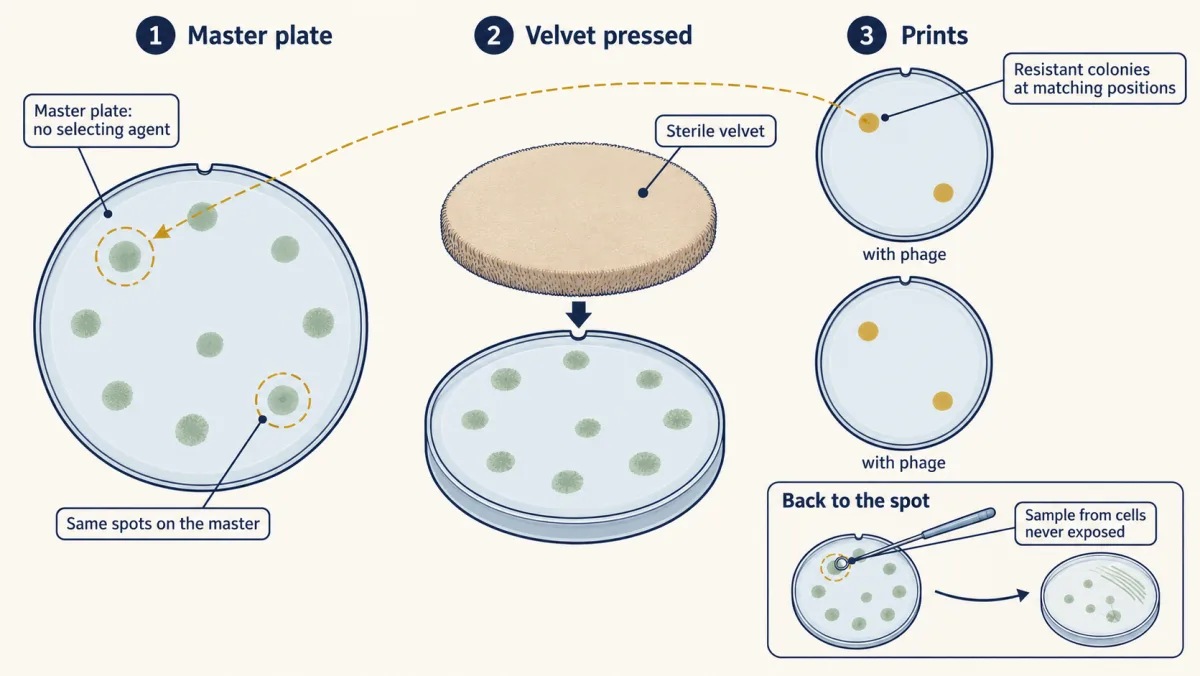
Matching resistant colonies on separate selective prints trace back to cells on the unexposed master plate, so those mutants existed before selection. AI-generated illustration -
Where mutations come from: spontaneous and induced
-
The Ames test and what it can and cannot say
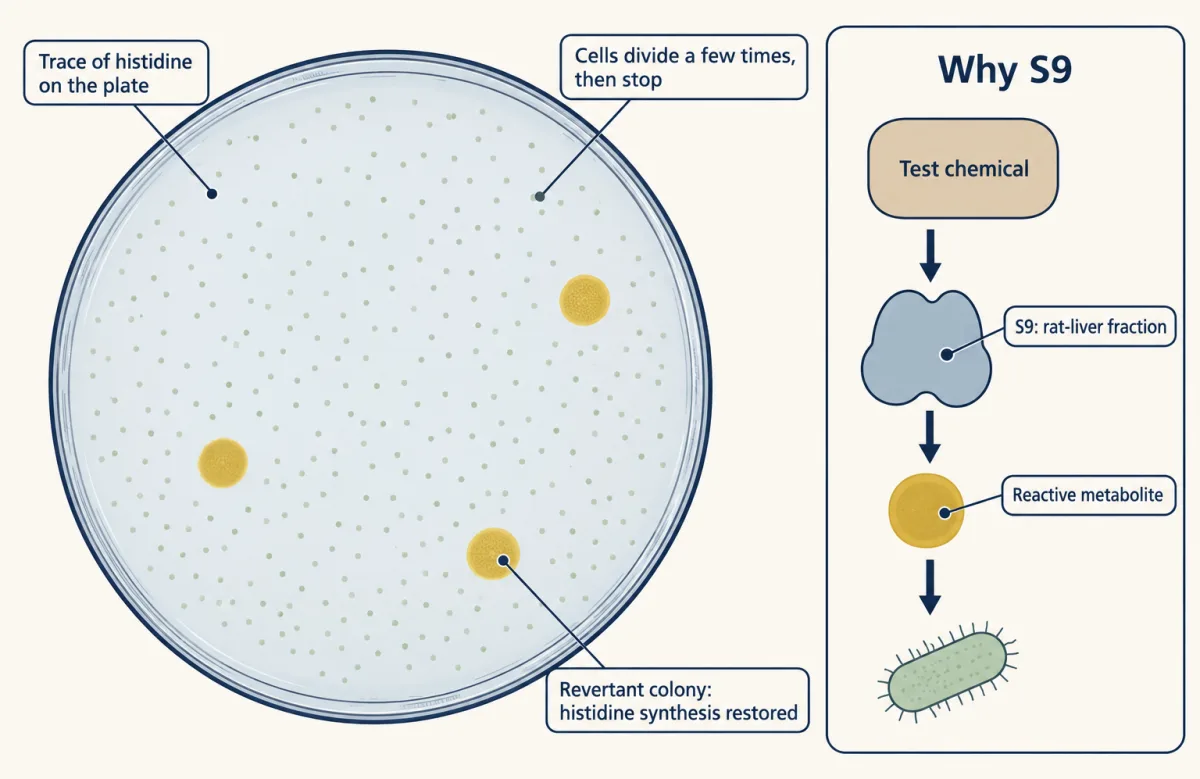
Each revertant colony marks a new mutation that restored histidine synthesis; plates with and without S9 test whether liver metabolism makes a chemical mutagenic. AI-generated illustration -
Going deeper
Where this lesson fits
Before thisReview first
- DNA Replication: Semiconservative Copying and Its MachineryThis course · Lesson 13
You need to know how polymerase copies DNA to see how copying errors become mutations.
- Probability, Crosses and the Chi-Square TestThis course · Lesson 3
The zero-class rate estimate and variance-to-mean reasoning here rely on probability and counts scattering around expectations.
- DNA Is the Genetic MaterialThis course · Lesson 12
You need to know DNA carries heritable information before treating changes in its sequence as heritable variants.
After thisStudy next
- DNA Repair and RecombinationThis course · Lesson 15
It shows how cells fix damage before it becomes a mutation, and which repair failures leave one.
- The Genetic Code and TranslationThis course · Lesson 18
Silent, missense, nonsense and frameshift effects are read from the codon table and reading frame taught there.
- Population Genetics: Hardy-Weinberg and Evolutionary ForcesThis course · Lesson 25
It follows how new mutations rise or fall in frequency through selection and drift.
Elsewhere on the siteFilms, simulations and method films in other courses
- Where Differences BeginFilm · Life Science
It shows how chance mutations add new genetic differences that selection can later act on.
- How Populations ChangeFilm · Biology
It shows mutation making new alleles and how inherited variation changes populations across generations.
- From Gene Copy to Protein ChainFilm · Biology
It shows how one changed DNA letter alters codons and the amino acid chain.
Suggested by an AI model from the lessons themselves, then checked. How we use AI