Neuroscience · Skim version
Motor Units, Reflexes and Locomotion
Read the full lesson → Skim the whole course →
The guiding idea
A knee tap makes the quadriceps kick and inhibits the hamstrings, yet the sensory axon that starts both only ever excites. How?
Every command to a limb muscle arrives as synaptic current onto motor neurons, Sherrington's final common path, and a motor neuron fires when the net current, times its input resistance, lifts it to threshold.
From the film: Where Every Command Ends
- Every command to a muscle, from the brain, a stretch, pain or a rhythm circuit, ends as synaptic current on motor neurons.
- A motor neuron fires when the net current, times its input resistance, lifts it to threshold.
- Under shared input, small motor neurons usually fire before large ones, which is a strong tendency rather than a law.
From the film: One Stretch, Two Opposite Commands
- A stretch excites the muscle's own motor neurons and, through an inhibitory interneuron on the same side, pushes its antagonist's motor neurons down.
- A Ia fibre only ever excites, yet it holds back the antagonist by way of a second synapse onto an inhibitory interneuron.
- Gamma motor neurons contract the spindle's ends so it stays in range and keeps signalling while the muscle shortens.
From the film: Rhythm Without a Conductor
- In cats, a spinal cord cut off from the brain and from sensory roots can still make alternating flexor and extensor contractions.
- A network in the cord that does this is a central pattern generator, and its rhythm arises within the cord.
- Sensory input adjusts the timing of the rhythm, and which spinal neurons make it, and how much holds for human walking, is still open.
-
Motor units: where every command ends
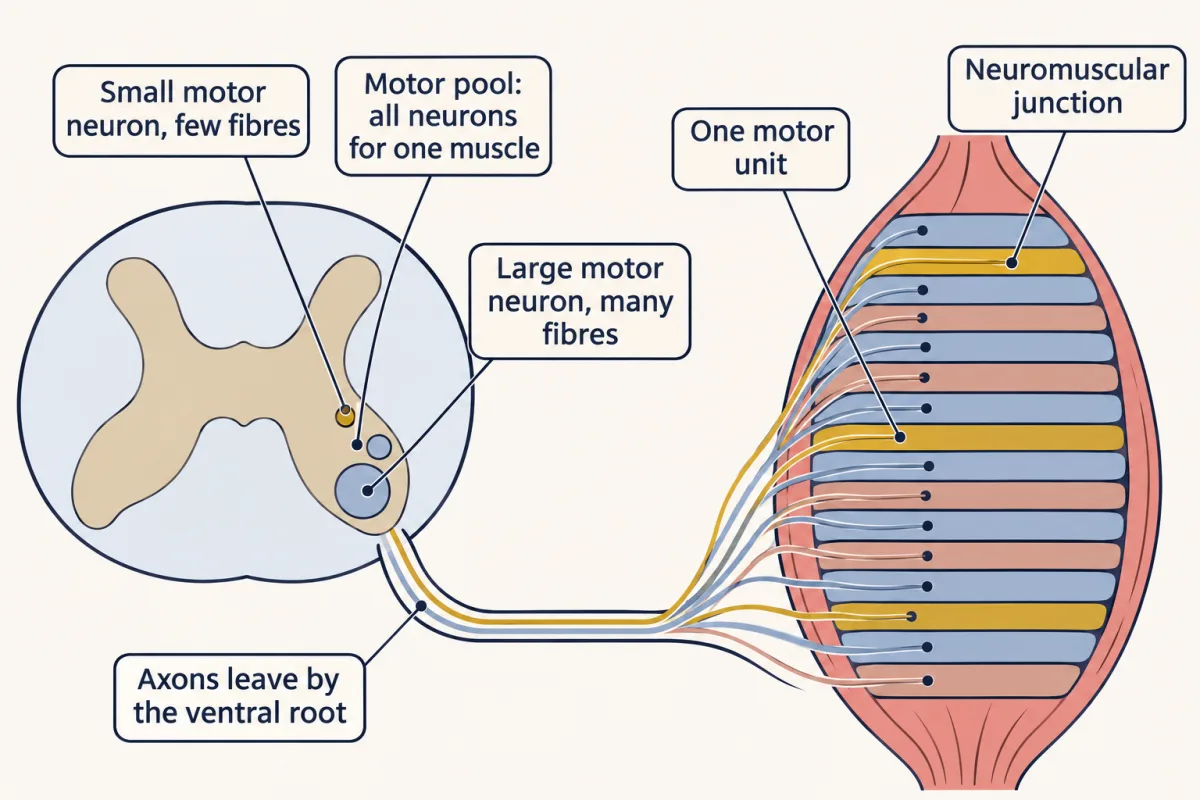
A motor pool is all the motor neurons for one muscle, and a motor unit is one neuron with all the fibres it supplies: small neurons supply few fibres, large ones many. AI-generated illustration -
The size principle: small before large
-
Grading force: recruitment and rate
-
One stretch, two commands
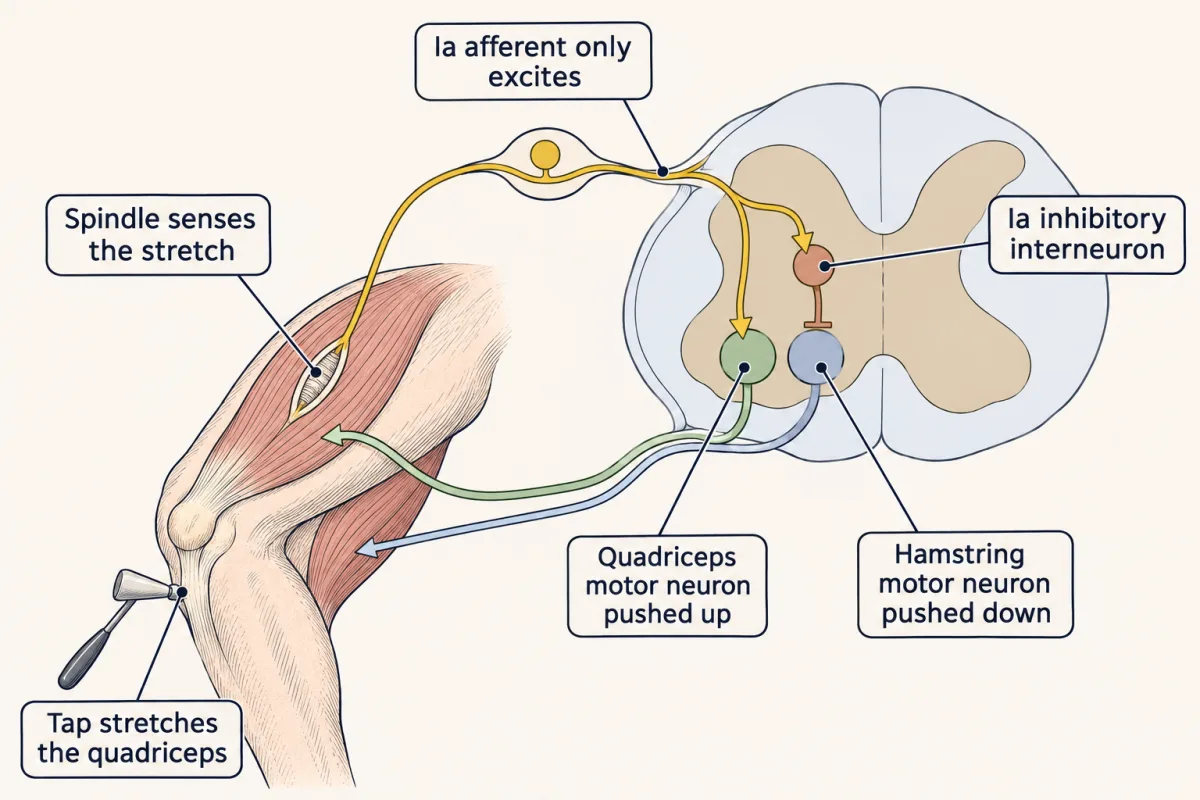
One stretch, two commands: the Ia afferent excites the quadriceps motor neuron directly and, through a Ia inhibitory interneuron on the same side, pushes the hamstring motor neuron down. AI-generated illustration -
Gamma: keeping the spindle in range
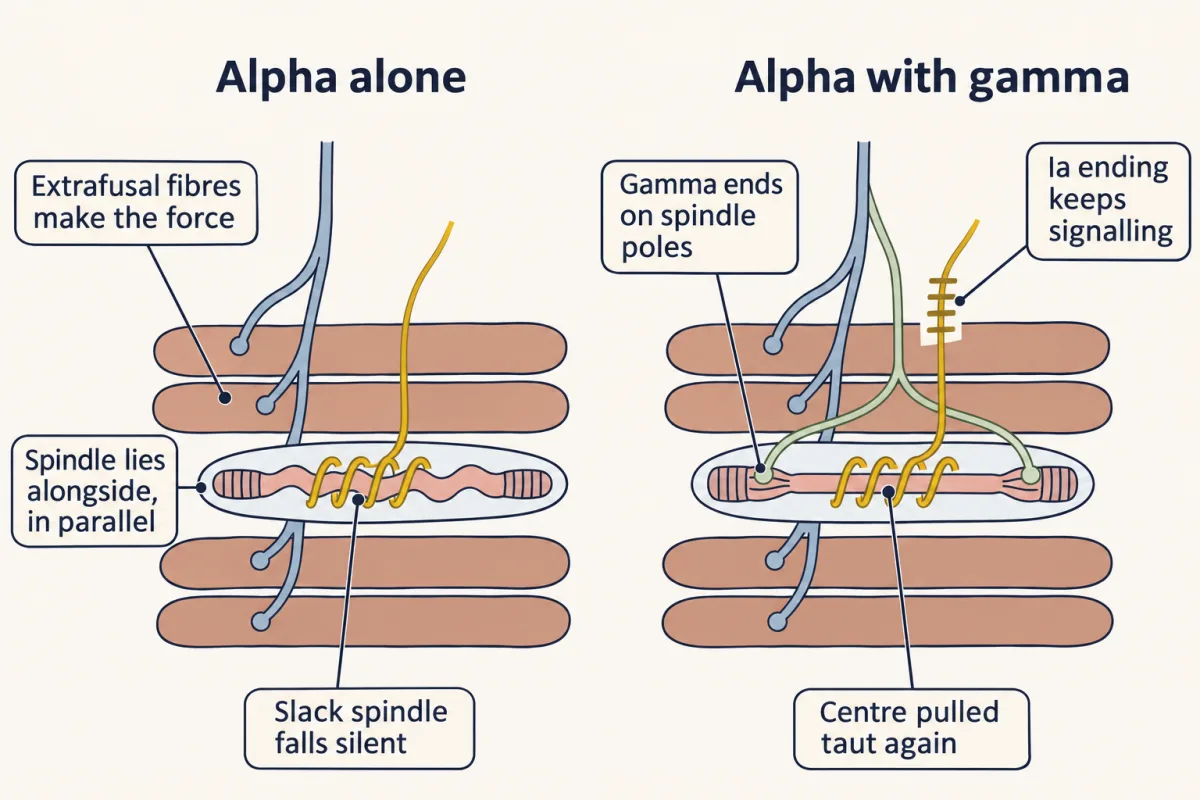
With alpha drive alone a shortening muscle leaves its spindle slack and silent; gamma motor axons contract the spindle's poles, pulling its centre taut so the Ia ending keeps signalling. AI-generated illustration -
Rhythm without a conductor
-
Where this leads
-
Going deeper
Where this lesson fits
Before thisReview first
- The Resting Membrane and Passive SignalsThis course · Lesson 3
Input resistance and how current becomes a voltage change in a cell come from the passive membrane there.
- Integration, Inhibition and NeuromodulationThis course · Lesson 7
You need how inhibition opens channels and shunts current there to see how pools are pushed up or down here.
- Synaptic Transmission and Quantal ReleaseThis course · Lesson 5
Acetylcholine release at the junction and quantal transmission from there underlie why each motor neuron spike twitches its unit.
After thisStudy next
- Descending Control and the Basal GangliaThis course · Lesson 16
Descending commands and the signs after damage to them act on the same motor neuron final common path.
- The CerebellumThis course · Lesson 17
The cerebellum tunes movement that ends on these motor pools, as shown in how it adapts reflexes and commands.
- When Mature Neurons Fail: NeurodegenerationThis course · Lesson 26
Diseases that kill motor neurons remove the final common path described here.
Elsewhere on the siteFilms, simulations and method films in other courses
- Every Response Has a Running TimeFilm · Organismal Biology
This film traces the knee-jerk route from receptor to effector, the simpler version of the stretch reflex here.
- Sliding, Not ShrinkingFilm · Organismal Biology
It shows how muscle fibres produce force, the output that motor units grade here.
- Length, load and powerSimulation · Physiology
It shows how muscle force depends on length, load and speed, which motor unit recruitment grades.
Suggested by an AI model from the lessons themselves, then checked. How we use AI