Biochemistry · Skim version
Metabolism: Basic Concepts and Design
Read the full lesson → Skim the whole course →
The guiding idea
Metabolism is an energy economy; learn its grammar before any pathway teaches its vocabulary.
Metabolism is an energy economy: a cell earns ATP by burning fuel (catabolism) and spends it to build (anabolism), move, and pump.
From the film
- A reaction runs forward only when its actual ΔG is negative.
- ATP pays only when its downhill chemistry is joined to the uphill reaction.
- A following step can pull a reaction forward by keeping its product scarce.
- Every step carrying forward flux must have a negative actual ΔG.
-
The rule: ΔG, not ΔG°’
-
Coupling, the first way: one enzyme, one reaction
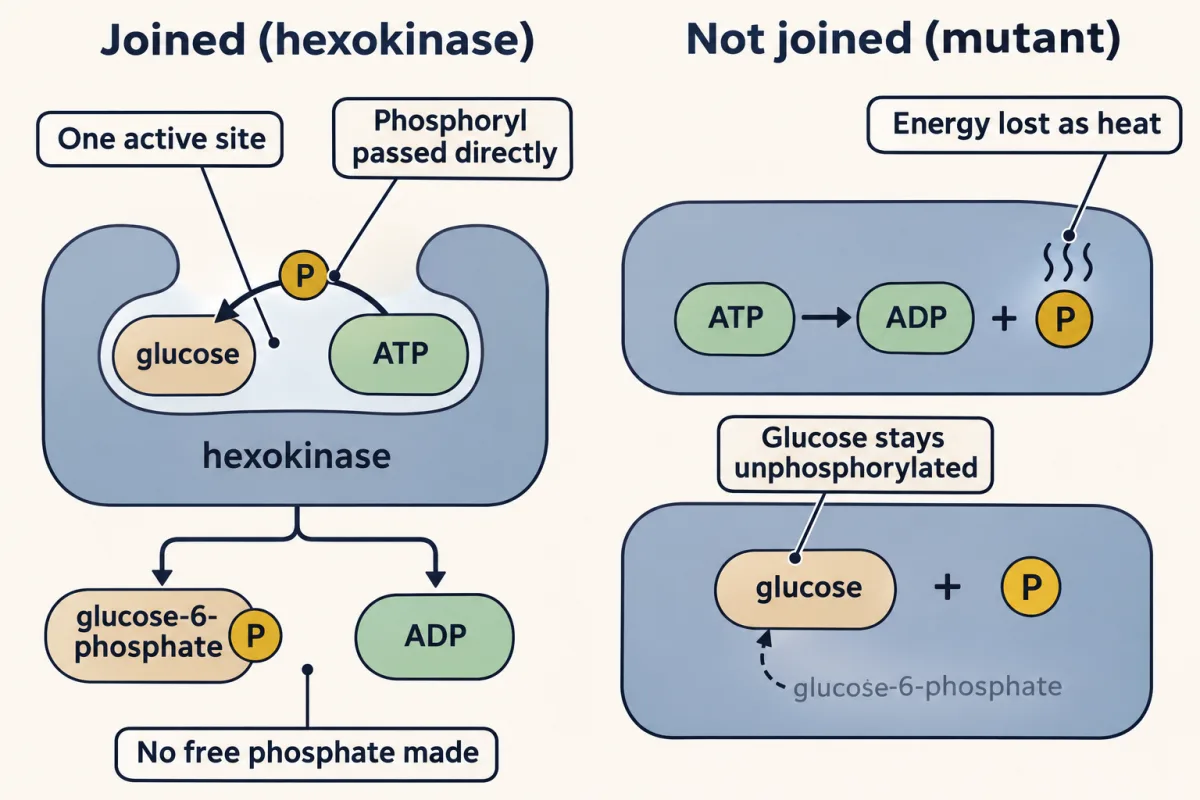
Free energies add only when the chemistry is joined. In hexokinase (left) the phosphoryl group that leaves ATP is the one glucose receives, so the free phosphate in the bookkeeping is never made. Split the two reactions between unlinked sites (right) and ATP's free energy leaves as heat while glucose phosphorylation still runs backward. AI-generated illustration -
Coupling, the second way: keep the product scarce
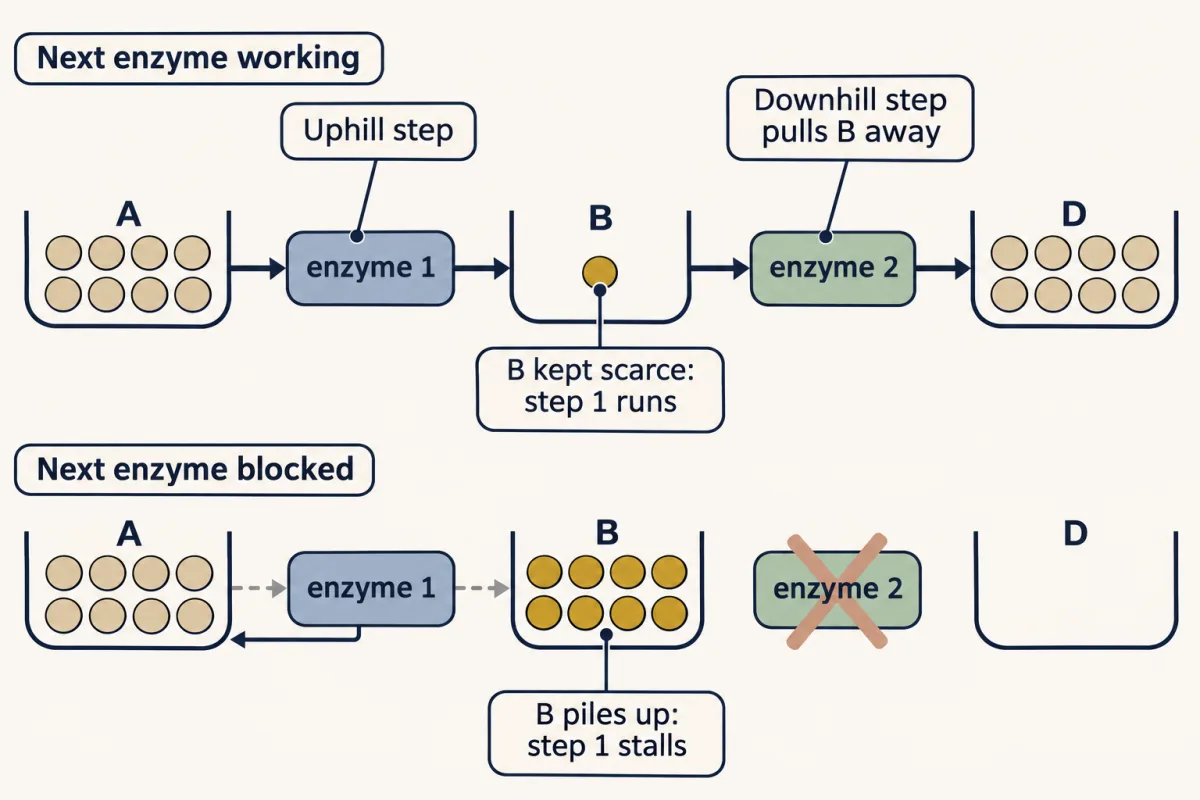
An uphill step can run without ATP when the next step keeps its product scarce. With B drained away (top), the first step's own ΔG is negative; block the second enzyme (bottom) and B accumulates until the first step stops. Every step in a pathway carrying flux has a negative ΔG of its own. AI-generated illustration -
Why ATP can pay
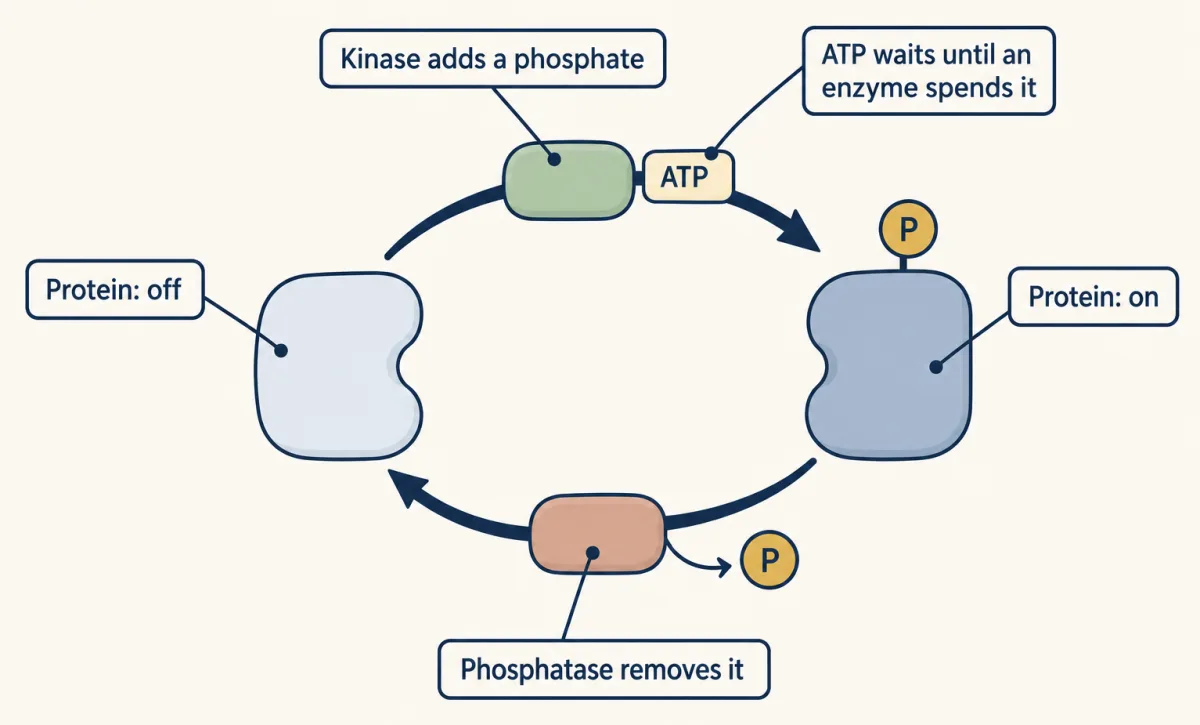
A kinase adds a phosphate to flip this protein on and a phosphatase removes it to flip it off (other proteins are switched off by phosphorylation); because ATP and the phosphate stay put until an enzyme acts, nothing happens in between. AI-generated illustration -
The phosphoryl-transfer ladder
-
Earning: how fuels recharge the carriers
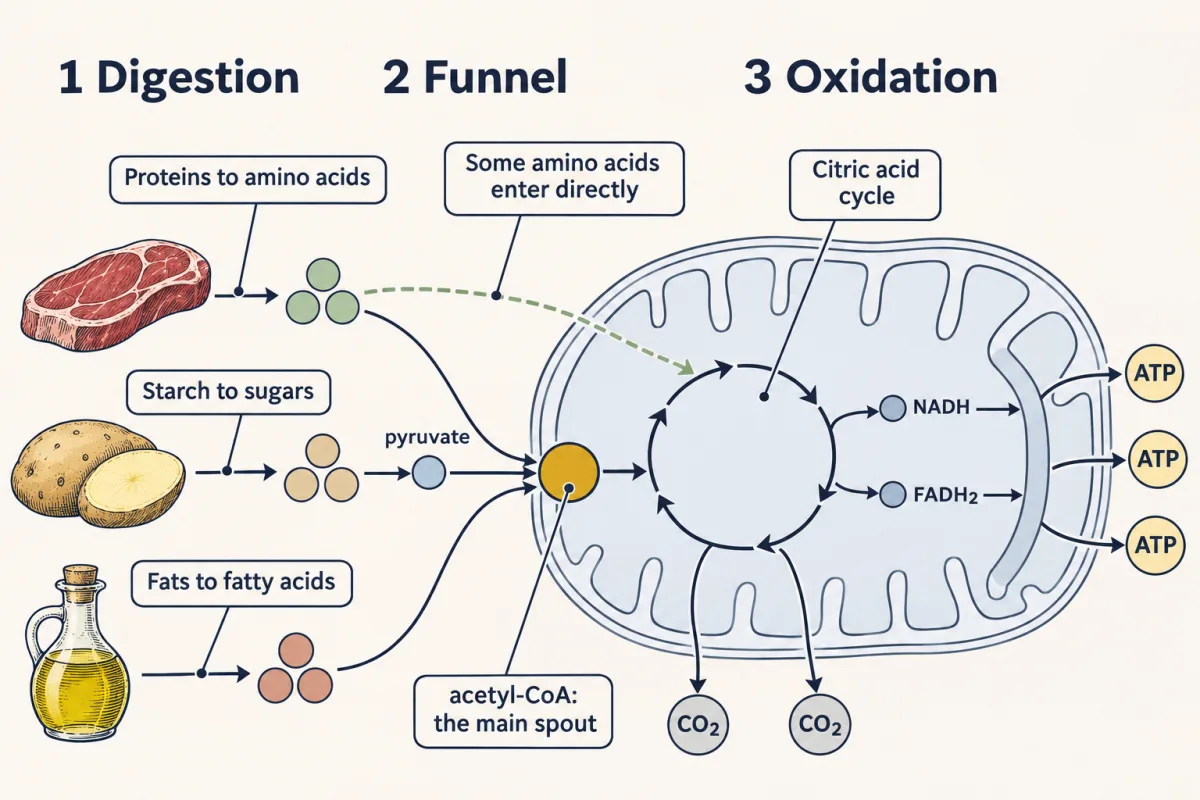
Three stages of fuel oxidation. Digestion makes small molecules, most of their carbon converges on acetyl-CoA in the mitochondrion, and the citric acid cycle oxidizes it to CO2 while loading electrons onto NADH and FADH2, whose reoxidation at the inner membrane drives ATP synthesis. Some amino acids enter through pyruvate or the cycle itself. AI-generated illustration -
Regulation: what can run versus what does
-
Going deeper
Where this lesson fits
Before thisReview first
- Basic Concepts of Enzyme ActionThis course · Lesson 7
You need free energy, equilibrium and why enzymes speed only possible reactions before coupling makes sense.
- Water, Weak Bonds, and the Generation of OrderThis course · Lesson 3
Hydration and charge repulsion in ATP's products come from the water and weak-bond ideas taught there.
After thisStudy next
- Glycolysis: The Investment-and-Payoff PathwayThis course · Lesson 16
Hexokinase coupling, substrate-level phosphorylation and energy-charge control are all seen working in one ten-step pathway.
- Oxidative Phosphorylation: The Electron-Transport ChainThis course · Lesson 20
NADH and FADH2 electrons recharged here are spent in the chain, which makes most of the ATP.
- Integration of Metabolism: How the Body Switches FuelsThis course · Lesson 30
The three modes of regulation and energy charge are applied to whole-body fuel switching.
Elsewhere on the siteFilms, simulations and method films in other courses
- Build an energy pyramidSimulation · Biology
The idea that energy transfers are never complete is a simple everyday version of energy accounting in cells.
- Spending ATP, Rebuilding ATPFilm · Biology
It shows cells spending ATP to do work and rebuilding it, the currency idea developed here in more depth.
- A cell’s energy budgetSimulation · Biology
It lets you balance a cell's ATP budget, which the energy charge and earning-versus-spending ideas here develop further.
Suggested by an AI model from the lessons themselves, then checked. How we use AI