Sensory Systems · Skim version
Merkel Cells: Touch Receptors That Are Not Neurons
Read the full lesson → Skim the whole course →
The guiding idea
A skin cell that is not a neuron helps a nerve keep firing for as long as you press. How does it hold the press, and what does it tell the nerve?
In mouse touch domes the ending mainly feels the change and the Merkel cell mainly holds the press.
From the film: Two Receptors, One Nerve
- In macaque fingertips, SA1 firing carried the spatial layout of millimetre-scale features, with a dynamic onset burst and a static hold phase.
- In mouse touch domes, the ending mainly feels the change and the Merkel cell mainly holds the press.
- The word mainly matters, because rat whiskers give a different reading in which Merkel cells drive both phases.
From the film: Take One Route Away
- Taking one route away, the Merkel cell's, and watching which phase is left shows what each receptor contributes.
- In mouse skin, light on Merkel cells was enough to make the afferent fire, and silencing them suppressed sustained firing during a held press.
- Deleting epithelial Piezo2 left the onset similar and the hold weakened, but developmental loss of Merkel cells also lowered onset, so each route acts mainly, not only, on one phase.
From the film: A Brief Current That Holds a Press
- Compare charge, not peaks: in a thought experiment, a small steady current through a one-second hold carried most of the charge.
- Irregular spike timing in the hold is a clue, not proof, that packets of transmitter help sustain firing.
- How the Merkel cell signals to the nerve is still argued, with noradrenaline on beta-2 receptors in mouse touch domes and protons acting on ASIC channels in rodent whiskers.
-
An epithelial cell that feels force
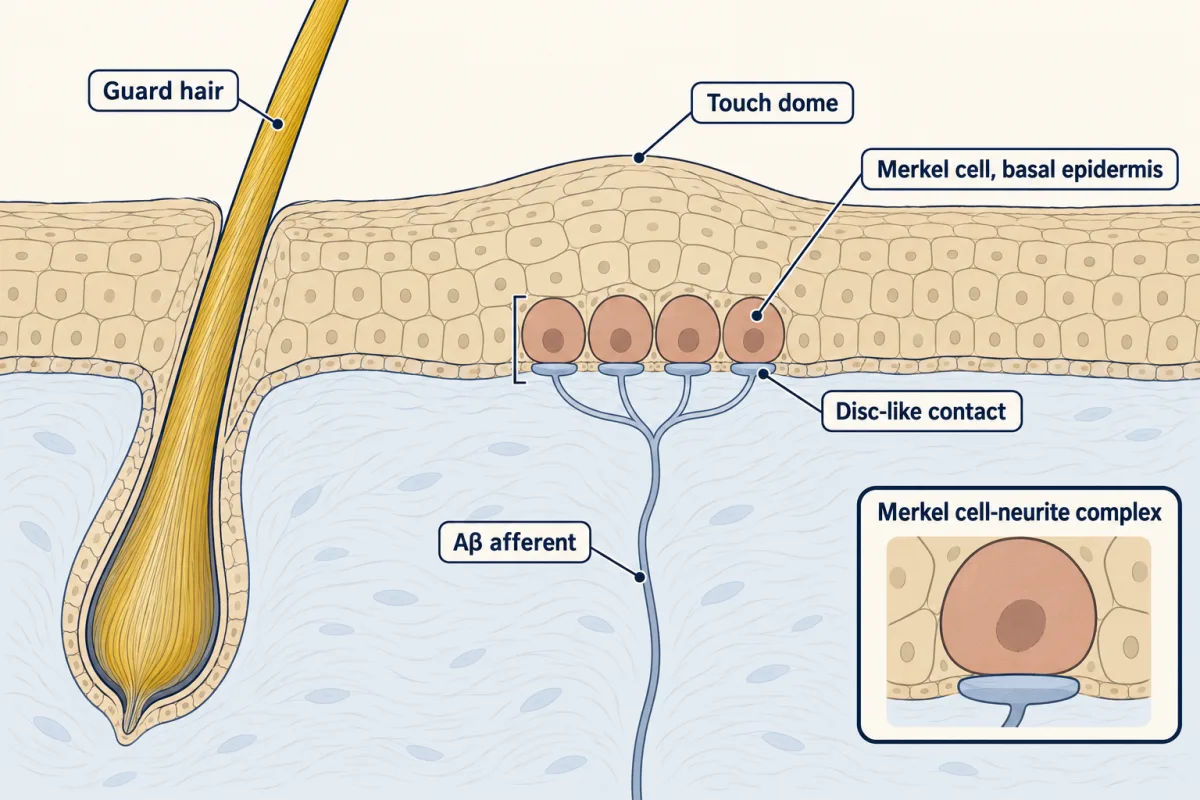
A touch dome in hairy mouse skin. Each Merkel cell lies in the basal epidermis, in contact with the basement membrane below. The drawing is schematic, and one afferent is shown as an example. AI-generated illustration -
The signature response: a burst, then a hold
-
Two receptors, one axon
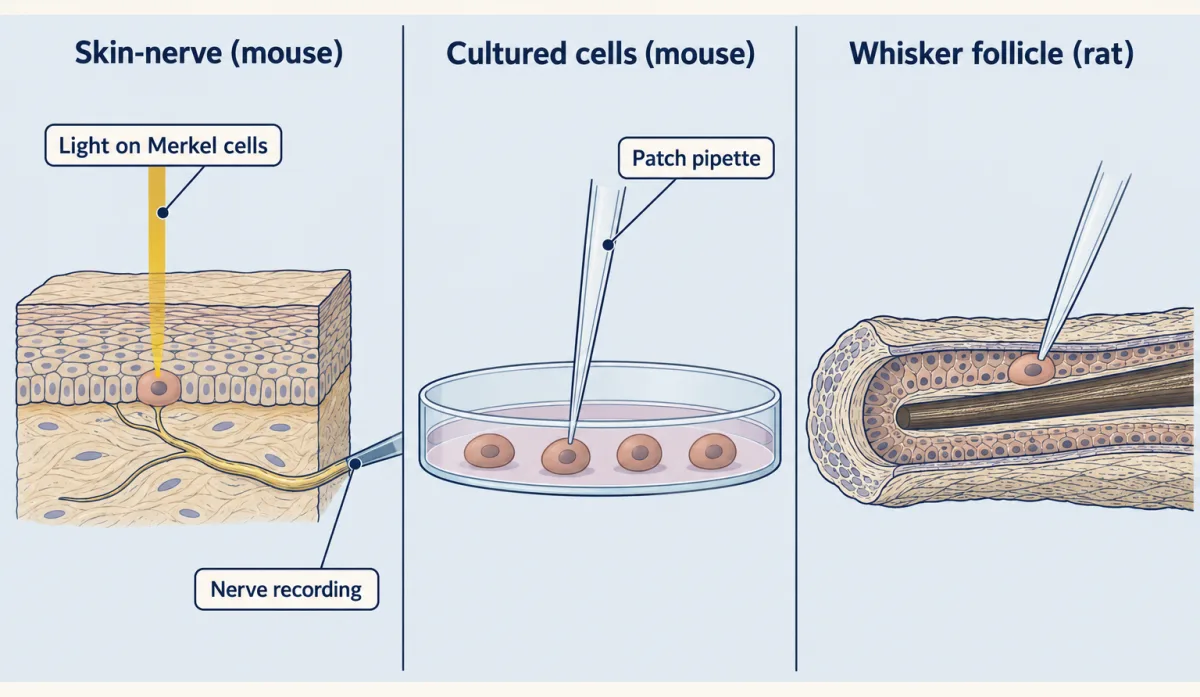
The three 2014 papers used different preparations: Maksimovic and colleagues recorded afferents in mouse skin-nerve, Woo and colleagues patched cultured mouse Merkel cells, and Ikeda and colleagues patched Merkel cells in excised rat whisker follicles. AI-generated illustration -
A brief current that holds a press
-
A different reading from rat whiskers
-
What SA1 input is for
-
The synapse nobody agrees on: noradrenaline, serotonin or protons
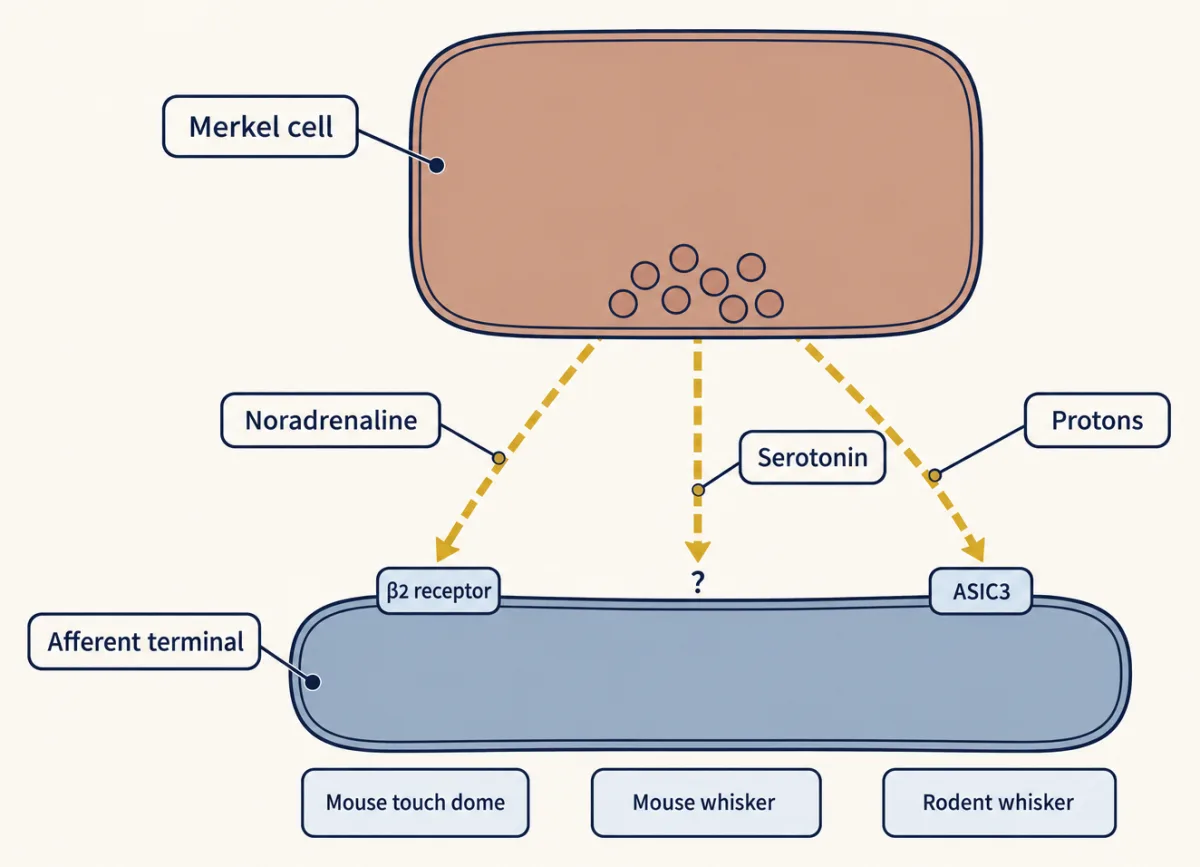
Competing accounts propose noradrenaline in mouse touch domes (through beta-2 adrenergic receptors; the downstream conductance is unknown), serotonin in mouse whiskers (reported 5-HT3 and 5-HT2 receptors), and protons acting on ASIC channels, with ASIC3 contributing, in rodent whiskers. Each rests on its own preparation and the question is not settled. The three arrows are drawn onto one terminal for convenience; they are not simultaneous pathways at one complex. AI-generated illustration -
Going deeper
Where this lesson fits
Before thisReview first
- Piezo Channels and the Physics of ForceThis course · Lesson 2
You need how Piezo2 turns force into current to follow the Merkel cell's own mechanically activated current.
- Five Ways to Turn a Stimulus into a CurrentThis course · Lesson 1
Its ways of turning a stimulus into a current frame how a non-neuron can act as the receptor.
- Sensory Neurons by Their Genes: the Atlas EraThis course · Lesson 3
It introduces the touch afferent classes and the Cre driver lines this lesson uses to separate cell from ending.
After thisStudy next
- Where Touch Is First Processed: Dorsal Horn and Dorsal Column NucleiThis course · Lesson 8
It shows how the sustained SA1 signal is first processed once it reaches the spinal cord.
- Touch Over-reactivity in Autism ModelsThis course · Lesson 9
It uses the Merkel cell-afferent touch route and its Piezo2 dependence in a disease model.
Elsewhere on the siteFilms, simulations and method films in other courses
- Quantal analysisMethod film
The lesson reads irregular spike timing as a clue for packets of transmitter, and quantal analysis is the method for testing packets.
- Pharmacological blockade and inhibitorsMethod film
The debate over noradrenaline, serotonin and ASIC protons rests on blocking each route with drugs.
Suggested by an AI model from the lessons themselves, then checked. How we use AI