Biology · Skim version
Meiosis and Variation
Read the full lesson → Skim the whole course →
The guiding idea
If two parents give every child half of their chromosomes, why do their children come out different from each other?
Meiosis separates homologous pairs first, then sister chromatids, while crossing over and assortment remix alleles.
From the film: Homologs First, Sister Chromatids Second
- Meiosis separates homologous chromosomes in its first division, then sister chromatids in its second.
- Copying DNA makes sister chromatids but does not double the chromosome count.
- In the simple animal model, one diploid cell usually makes four haploid cells.
- Halving keeps the chromosome number from doubling each generation.
From the film: How Meiosis Remixes Alleles
- Meiosis separates homologous pairs first, then sister chromatids, while crossing over and assortment remix alleles.
- Crossing over exchanges matching pieces between non-sister chromatids of paired homologs.
- Independent assortment gives two choices per pair, or 2 to the power n combinations.
- Genes close together on one chromosome tend to travel together.
-
Explore: shuffle chromosomes in a model cell
-
Explain: two divisions make half
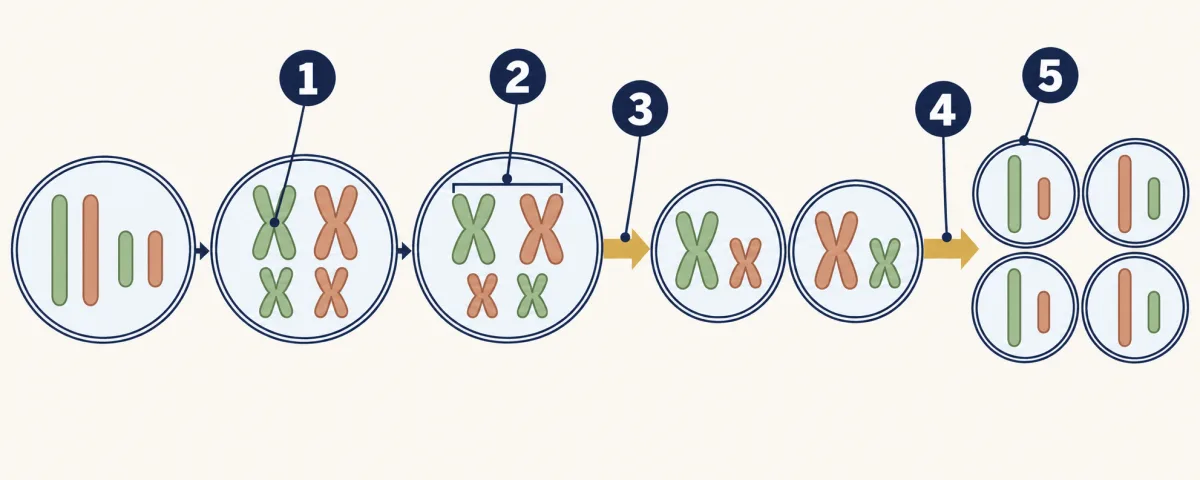
- sister chromatids
- homologous chromosomes
- Meiosis I
- Meiosis II
- haploid
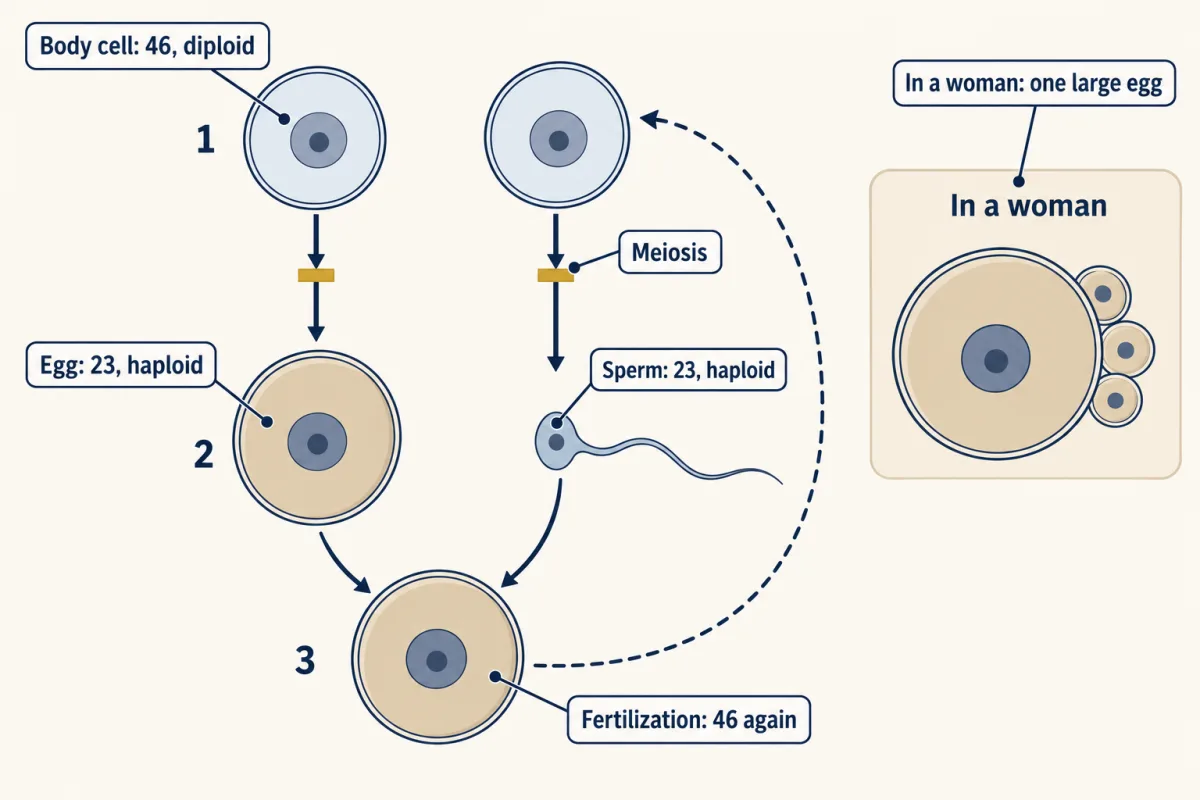
Halving and restoring: meiosis turns 46 chromosomes into 23 in each sex cell, and fertilization brings the number back to 46. In a woman the divisions are uneven and make one large egg. AI-generated illustration -
Explain: count the mixes
-
Explain: mitosis and meiosis side by side
-
Elaborate: count the combinations
-
Evaluate: check your thinking
Where this lesson fits
Before thisReview first
- The Cell Cycle and MitosisThis course · Lesson 10
You need to know how DNA is copied into sister chromatids and how mitosis divides them, to compare it with meiosis.
- DNA: Structure and CopyingThis course · Lesson 16
You need to know how DNA copying makes identical sister chromatids before meiosis separates them.
After thisStudy next
- Mendel and Punnett SquaresThis course · Lesson 20
Each sex cell gets one allele of a gene, which is what lets you fill in a Punnett square.
- Variation and SurvivalThis course · Lesson 27
Shuffled alleles give the variation among individuals that selection acts on when conditions change.
- Beyond Dominant and RecessiveThis course · Lesson 21
Alleles passed on through separate sex cells explain the offspring patterns you predict here.
Elsewhere on the siteFilms, simulations and method films in other courses
- Beetles and new coloursSimulation · Life Science
It shows how new alleles from mutation add to the variation that meiosis shuffles.
- Linkage mapping with test crossesMethod film
It uses how often crossing over separates genes on a chromosome to map their distances.
Suggested by an AI model from the lessons themselves, then checked. How we use AI