Sensory Systems · Skim version
Piezo Channels and the Physics of Force
Read the full lesson → Skim the whole course →
The guiding idea
Mouse PIEZO2 threads 114 transmembrane helices through the membrane to build one ion channel, and its pore sits at the centre. Why would a channel need so much protein around one pore?
Tension pays for area: a channel that takes up more membrane when open is pushed open by membrane tension, and in a two-state model the area gained sets the steepness of the switch.
From the film: Which Protein Carries the Poke?
- Silencing a gene in a cell line showed it was required for the poke-evoked current there, not that its protein is the channel.
- Expressing the Piezo genes in other cultured cells gave mechanically activated currents, which showed sufficiency in those cells.
- Necessity, sufficiency and pore identity are three separate claims, and later work on purified protein and structures earned the third.
From the film: A Channel Shaped Like a Dome
- Mouse PIEZO2 has 38 transmembrane helices per subunit and 114 per channel, and the two numbers are kept apart.
- In the leading model, still debated, the curved blades bow the membrane into a dome.
- For an idealized smooth cap, flattening gains about 310 square nanometres of projected area, which depends on how deep the dome is, not how wide.
From the film: Tension Pays for Area
- Tension pays for area: if a channel takes up more membrane when open, tension lowers the energy of the open state by tension times the area gained.
- In a two-state model, the half-activation tension is the resting preference for closed divided by the area gained, and the slope factor is thermal energy divided by the area gained.
- More area gained means a steeper switch.
From the film: Reading a Patch
- Read as a two-state switch, the slope factor of a current-tension fit implies an effective area.
- For mouse Piezo1 in a human cell line the fit implied about 5 square nanometres, an effective area that can underestimate the true one.
- A channel's sensitivity depends on the tension it was already under, since a prepulse lowered the half-activation tension.
From the film: The Sixty-Fold Gap
- Cryo-EM showed about 300 square nanometres of in-plane expansion, but a two-state reading of the current gives about 5, so the slopes differ about sixty-fold.
- The dome may not be a two-state switch, patch curves may pool uneven tensions, or the flattened class may not be the open channel.
- Which part of the structural expansion couples to opening is still open.
From the film: Lipid, Tether and People
- Purified mouse Piezo1 in droplet bilayers was activated by force, so protein plus lipid is sufficient there, which does not exclude a tether route in intact cells.
- Two PIEZO2 variants from distal arthrogryposis families both sped recovery from inactivation, but only one slowed inactivation during the pulse, so each variant must be read on its own.
- Mouse and human loss-of-function findings should be kept apart: two people without working PIEZO2 had selective deficits in touch and limb position.
-
Three questions and one idea
-
Which protein? A screen, and the claim it refused to make
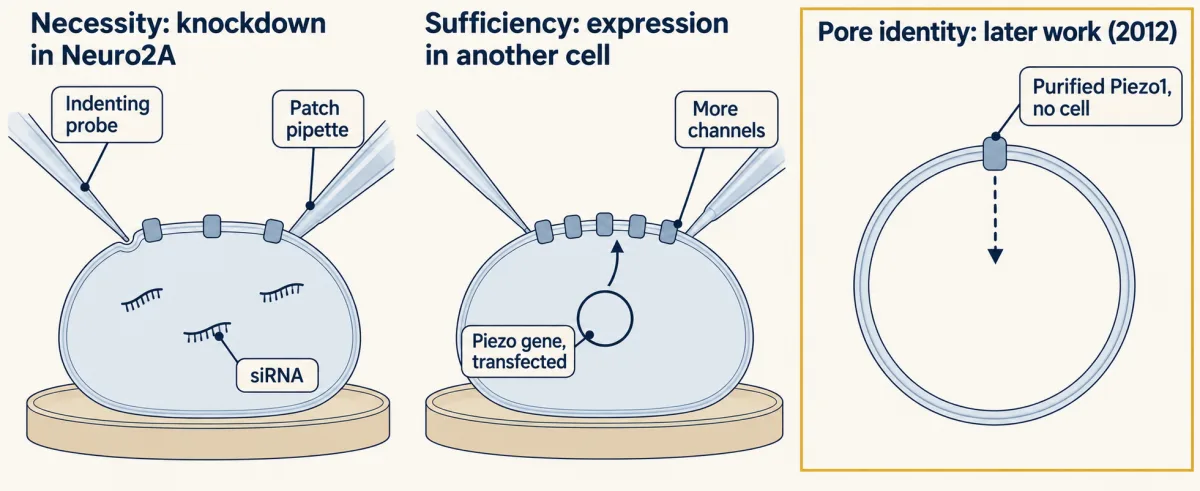
The 2010 experiments showed that Piezo1 knockdown sharply reduced mechanically evoked current in mouse Neuro2A cells, and that expressing the Piezo1 or Piezo2 gene conferred such currents in other cultured cells (the gene was expressed, not protein added). These establish necessity and sufficiency in those preparations, not pore identity, and the channel blocks are schematic. Purified mouse Piezo1 formed ion channels in artificial bilayers and liposomes in 2012; later structures located the central pore. AI-generated illustration -
Blades, beam and dome
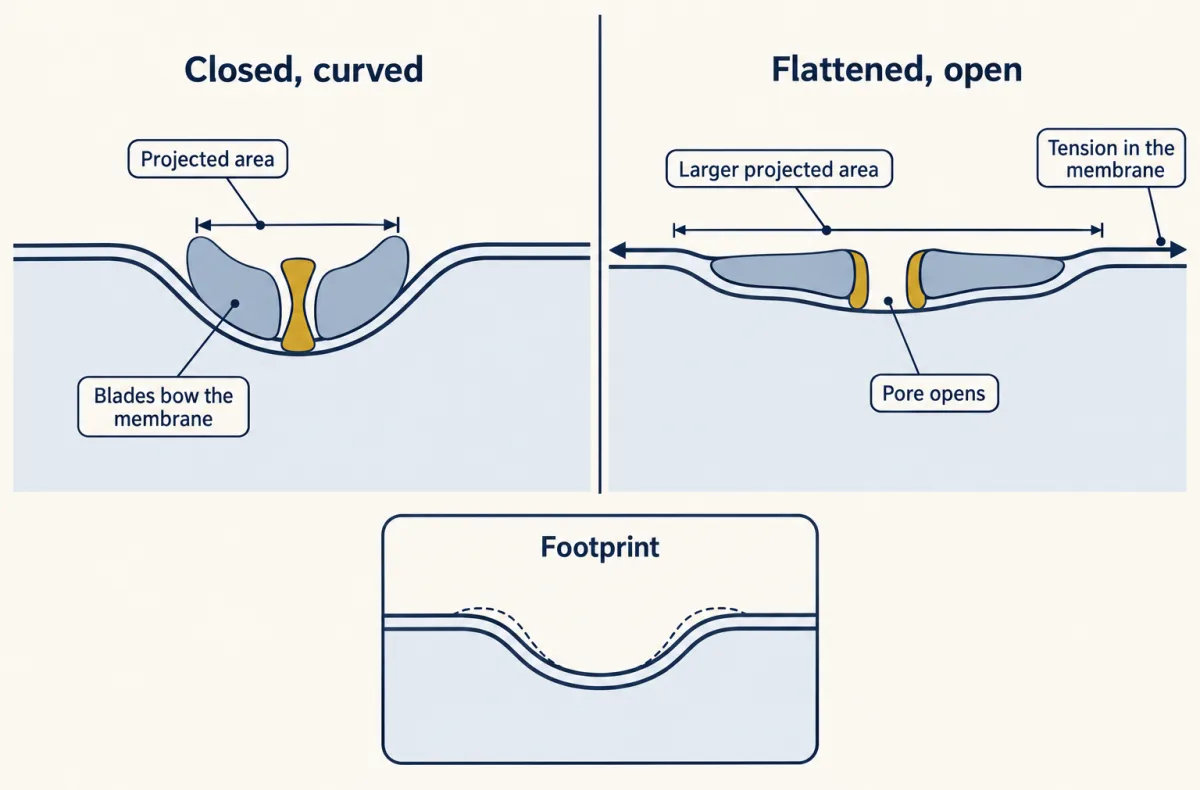
In the leading, still debated model, Piezo's curved blades bow the membrane into a dome; flattening increases the projected area, so membrane tension favours the flat state. Flattening is thought to help the pore open, but does not by itself establish an open pore, and the drawn open pore is a schematic of that proposal. In the elasticity model, the bilayer bending away from the dome forms a footprint, so tension does work on more than the protein itself. AI-generated illustration -
Tension pays for area: from an energy to a curve
-
Reading a patch: from pressure to current, and back to an area
-
The gap between structure and current
-
Lipid or tether?
-
Variants that change inactivation, and what people report
-
Going deeper
Where this lesson fits
Before thisReview first
- Five Ways to Turn a Stimulus into a CurrentThis course · Lesson 1
It sets out direct mechanical gating as one way a stimulus becomes a current, which this lesson then explains physically.
After thisStudy next
- Merkel Cells: Touch Receptors That Are Not NeuronsThis course · Lesson 5
It asks how a Piezo2-bearing skin cell helps a touch nerve keep firing during a held press.
- The Hair Cell's Transduction ChannelThis course · Lesson 22
It asks what must be shown before a protein counts as the pore of a mechanical channel, the problem begun here.
- Proprioception: Sensing the Body's Own PositionThis course · Lesson 15
It follows Piezo2's role in limb position sensing, including the human loss-of-function findings and tendon-vibration experiments.
Elsewhere on the siteFilms, simulations and method films in other courses
- One channel, two numbersSimulation · Cell Biology
Its channel simulation relates an open channel's current to voltage, which helps with reading the current in a patch.
- A Path Is Not a PumpFilm · Biochemistry
It shows what a lipid bilayer is and how a protein sits in that sheet, which is the membrane the tension acts on.
Suggested by an AI model from the lessons themselves, then checked. How we use AI