Biology · Unit 1: The chemistry of life
What Am I Made Of?
Rewritten on : new text, flashcards and film. Your notes and highlights stay, but the text around them may have moved.
How can a turkey sandwich on whole-wheat bread end up as part of your own body?
The main idea, the figure and what the films show. Under each heading, "Read this part" opens it.
Three real-life stories behind this lesson, about 4 minutes aloud, or read them below.
Both films, 6 minutes, then three short stories told aloud, 4 minutes more.
The whole lesson: about 40 minutes, the length of a class.
Pause when the reading reaches a film, and offer to play it. Saved on this device.
Watch the film now, or keep listening
That is the end of the reading
This idea at other levels
This lesson teaches the molecules of life at high school level. Simpler: DNA (grade 7), or read a short grade 7 version here. Deeper: Carbohydrates (upper-level college).
The grade 7 version · about 1 minute to read
In grade 7 you learned that cells are the building blocks of living things. You learned that proteins help build cells and carry out life processes. You also learned that carbon is a building block of living things, and that nitrogen is used to make proteins and DNA. Food gives your body matter and energy. Biology adds the words carbohydrate and lipid, and shows that all four kinds of large molecule are chains or groups of smaller pieces that cells join together and break apart.
See every levelHide the levels
The molecules of life (macromolecules)
Living things are built from four kinds of large molecule: carbohydrates, proteins, nucleic acids and lipids, each made of smaller building blocks.
Three levels here: grade 7, high school and upper-level college. The lesson at grade 7 was picked by hand for this lesson.
College, upper level · the level you chose
Introduction to Biochemistry and Cell Biology: Compartments Create Control
98% of atoms are H, O or C; four molecule classes do the work.
Biochemistry · about 32 min · 3 practice questions
Carbohydrates: One Bond Decides Fuel or Fiber · also at this level, picked for this lesson
Biochemistry · about 30 min · 3 practice questions
High school · the level you chose
What Am I Made Of? · this lesson
Four classes, their blocks and jobs: starch and cellulose differ by one link.
Biology · about 40 min · film 3:15 · Virginia BIO.2b
Grade 7 · the level you chose
DNA: The Code of Life · also at this level, picked for this lesson
Life Science · about 40 min · Virginia LS.10 a
Next door to the molecules of life
- DNA, the molecule of heredityDNA is the nucleic acid that stores a living thing's instructions.Nearest lesson: DNA: Structure and Copying (high school)
- EnzymesMost enzymes are proteins, so this is the kind of large molecule that makes reactions fast enough for life.Nearest lesson: Enzymes at Work (high school)
Also at college: Lipids: The Building Blocks That Refuse to Polymerize · Amino Acids: How One Side Chain Decides Everything
Short versions inside this lesson
Where Biology II takes it · about 1 minute to read
Virginia’s Biology II: Advanced Survey of Biology Topics course looks closely at how monomers join into polymers and at the energy changes when chemical bonds break and form. You draw the actual rings of sugars and the side chains of amino acids that this lesson left out. In the Biology II: Genetics course, you study four levels of protein structure. The primary structure is the order of amino acids in the chain. That chain coils and folds into local shapes, then into a full three-dimensional shape, and some proteins join several chains together. A change in the order can change the final shape and the job the protein can do.
Find an idea: every idea, searchable
Which lessons teach an idea, and the notes on each level, were written by AI models from the lessons and checked by a second model. A person has not yet read every one. How we use AI
About this lesson goals, help with the tasks, standards, parts
What you'll learn
- You will explain how cells build large molecules (polymers) by joining many small building blocks (monomers), and how carbon, hydrogen and oxygen from sugar can join with nitrogen to make amino acids and other carbon-based molecules.
- You will name the four classes of large molecule (carbohydrates, proteins, nucleic acids and lipids), the building blocks of each (simple sugars, amino acids, nucleotides, and, for fats, fatty acids and glycerol) and their main jobs (quick energy and short-term energy storage; building tissues and running cell processes; storing and passing on genetic information; long-term energy storage, insulation and cell membranes).
- You will use structure-to-function reasoning to explain one example from each class, and use nutrition data to evaluate the claim that fats and carbohydrates are bad for people.
Help with the tasks
Builds on:Water and Life (read)Why these?
Essential question: How can four kinds of large molecule, built from a small set of building blocks, make every part of a living thing?
Standards: Virginia SOL BIO.2b · Practices BIO.1c, BIO.1d, BIO.1e, BIO.1f
Grade 7 Life Science: LS.10 a · Biology II: Advanced Survey of Biology Topics, BIOII.3 a; Genetics, GEN.2 d
Rewritten on : new text, flashcards and film. Notes and highlights stay, but the text around them may have moved.
In this lesson. Your body takes food's large molecules apart by adding water, one water per link, and builds its own by removing water, one water per link counted from the free blocks.
The films
 ▶ Watch Take It Apart, Build It Again · 3:15
Read the transcript of “Take It Apart, Build It Again”
Film transcript: Take It Apart, Build It Again
You eat a turkey sandwich, and some of it goes on to become part of you. How can a wheat plant and a bird turn into part of a person? Zoom into the bread. Its starch is a long chain of small sugar blocks. Now zoom into the turkey. Its proteins are chains of a different kind of block, amino acids of many kinds. Each small block is called a monomer. A long chain of them is a polymer. Think of beads on a necklace, though real chains fold and coil.
In your gut, the chains come apart. A water molecule slips into one link, and the link breaks. Splitting with water is called hydrolysis. One water, one broken link. Here is a chain of six sugar blocks. How many water molecules will it take to break every link?
Five. Six blocks have only five links between them. Each water breaks one link. So it is one water per link, not one per block. The freed blocks leave the gut and reach your body's cells. There, the job turns around. Instead of taking chains apart, the cell builds new ones. Inside the cell, the blocks join into new chains.
Compare the free blocks with the finished chain. One water's worth of atoms is missing at each link. Building by removing water is called dehydration synthesis. Now count it the other way. Breaking a chain of six blocks took five waters. A chain of six built from free blocks is five waters short. One per link, either way. Joining blocks does not happen for free. Joining takes energy. In cells, each kind of molecule is built by its own energy-using route. So the real steps usually release other products, not water. The water count is bookkeeping for the atoms. Taking apart adds water. A built chain is one water short per link. Look at the new protein.
Its amino acids sit in a different order from the turkey's. A turkey protein does not become your protein. Its blocks are reused. Cells use four kinds of block: simple sugars, amino acids, nucleotides, and the fatty acids and glycerol of fats. They build four classes of large molecule. The text sorts out which block builds which. So the sandwich does become you, block by block. Digestion adds one water for each link it breaks. Counted from its free blocks, each new chain is one water short per link.
From the film: five take-homes
- Digestion breaks starch, protein and other large molecules in food into smaller pieces by adding water, one water for each link it breaks (hydrolysis).
- Counted from the free blocks to the finished chain, building removes one water for each link (dehydration synthesis).
- A chain has one fewer link than it has blocks, so a chain of 6 blocks has 5 links.
- Joining takes energy. In cells, each kind of molecule is built by its own energy-using route, so the real steps usually release other products, not water.
- A turkey protein does not become your protein; its amino acids are reused to build your own.
Within hours of eating a turkey sandwich, made from wheat plants and a bird, your body has begun taking its large molecules apart. So how can one living thing’s food become another living thing’s body? The first film gives the short answer: take apart, build again.
The one idea. Your body takes food’s large molecules apart by adding water, one water for each link it breaks, and builds its own by removing water, one water for each link counted from the free blocks. The blocks, the links between them and the shape they take decide the job.
Scope: the water count compares the free blocks with the finished molecule, like a balanced equation. In cells, the real building steps usually give off other products instead (see Going deeper). The link count works for a chain, straight or branched, with no rings and no extra cross-links. For a chain of n blocks there are n − 1 links. A common fat is not a chain, but its 4 pieces still have 3 links.
What do you think? Decide before you read.
-
Scientists disagree: Your body uses both. Carbohydrate-rich foods supply quick energy, and many plant foods also supply fiber. Fats store energy for a long time and insulate the body. Phospholipids, another kind of lipid, build every cell membrane. A few fatty acids must come from food because the body cannot make them. Nutrition scientists judge whole foods and diets, not one class of molecule as good or bad.
What scientists think
Scientists disagree: Your body uses both. Carbohydrate-rich foods supply quick energy, and many plant foods also supply fiber. Fats store energy for a long time and insulate the body. Phospholipids, another kind of lipid, build every cell membrane. A few fatty acids must come from food because the body cannot make them. Nutrition scientists judge whole foods and diets, not one class of molecule as good or bad.
-
Scientists disagree: USDA food data list protein in bread, peanut butter and milk as well as turkey, because plant and animal cells all build proteins. Proteins also do far more than build muscle. They form skin and hair, carry oxygen in blood, and speed up most of the chemical reactions in cells.
What scientists think
Scientists disagree: USDA food data list protein in bread, peanut butter and milk as well as turkey, because plant and animal cells all build proteins. Proteins also do far more than build muscle. They form skin and hair, carry oxygen in blood, and speed up most of the chemical reactions in cells.
-
Scientists disagree: Chemical analysis shows that carbohydrates, lipids, proteins and nucleic acids are all built mostly from the same three elements: carbon, hydrogen and oxygen. Proteins add nitrogen, and nucleic acids add nitrogen and phosphorus. The classes differ mainly in how those atoms are arranged.
What scientists think
Scientists disagree: Chemical analysis shows that carbohydrates, lipids, proteins and nucleic acids are all built mostly from the same three elements: carbon, hydrogen and oxygen. Proteins add nitrogen, and nucleic acids add nitrogen and phosphorus. The classes differ mainly in how those atoms are arranged.
Explore: build big molecules from small blocks
Pick one kind of building block (simple sugar, amino acid, nucleotide, or fatty acids with glycerol) and snap the blocks together; the simulation names the molecule, gives its job and counts the waters.
- Blocks
- Links
- Water released
- Large molecule
- Main job
- Elements
In this sketch each block is one monomer drawn as a labelled box, not a molecule. A chain stops at 12 blocks to fit the screen; a real polymer has many monomers.
Rule to keep: joining two monomers releases one water molecule, so a chain of n blocks has n − 1 links and releases n − 1 waters. A common fat is one glycerol joined to three fatty acids, so it is not a true polymer.
Try this.
- Use the first film’s rule to predict the waters for a chain of 10 sugars. Build it and check.
- Switch to amino acids. Predict whether the molecule’s name changes and whether the rule still works, then test.
- Try fatty acids and glycerol. Predict whether you can keep adding blocks to make a very long chain, then try it.
Check step 3
You cannot. A common fat stops at one glycerol and three fatty acids, so it is not a chain. The simulation does not count a fat’s waters; the second film does: three links, three waters.
Explain: small blocks, big chains
- monomer
- polymer
- macromolecule
- dehydration synthesis
- hydrolysis
- carbohydrate
- protein
- amino acid
- nucleic acid
- nucleotide
- lipid
A monomer is a small molecule that can join to others like it. A polymer is a large molecule of many monomers linked in a chain; each link is a chemical bond between two blocks. A macromolecule is a very large molecule in a living thing, such as a polymer. Starch, proteins and nucleic acids are polymers; lipids are not, as step 3 showed.
The first film counted the waters; here are the atoms. In the figure below, one block has a hydrogen (H) on its end and the next an oxygen and a hydrogen (OH). When the link forms, those three atoms leave the chain: one water molecule, H2O. Joining this way is dehydration synthesis, “making something by removing water.” It takes energy, which the cell supplies. Run backward, hydrolysis (“splitting with water”) puts a water molecule back: the H goes to one block and the OH to the other, and the link breaks.
C6H12O6 + C6H12O6 → C12H22O11 + H2O (dehydration synthesis: two glucose molecules form maltose, a double sugar, and water; the small numbers count atoms)
maltose + water → glucose + glucose (hydrolysis)
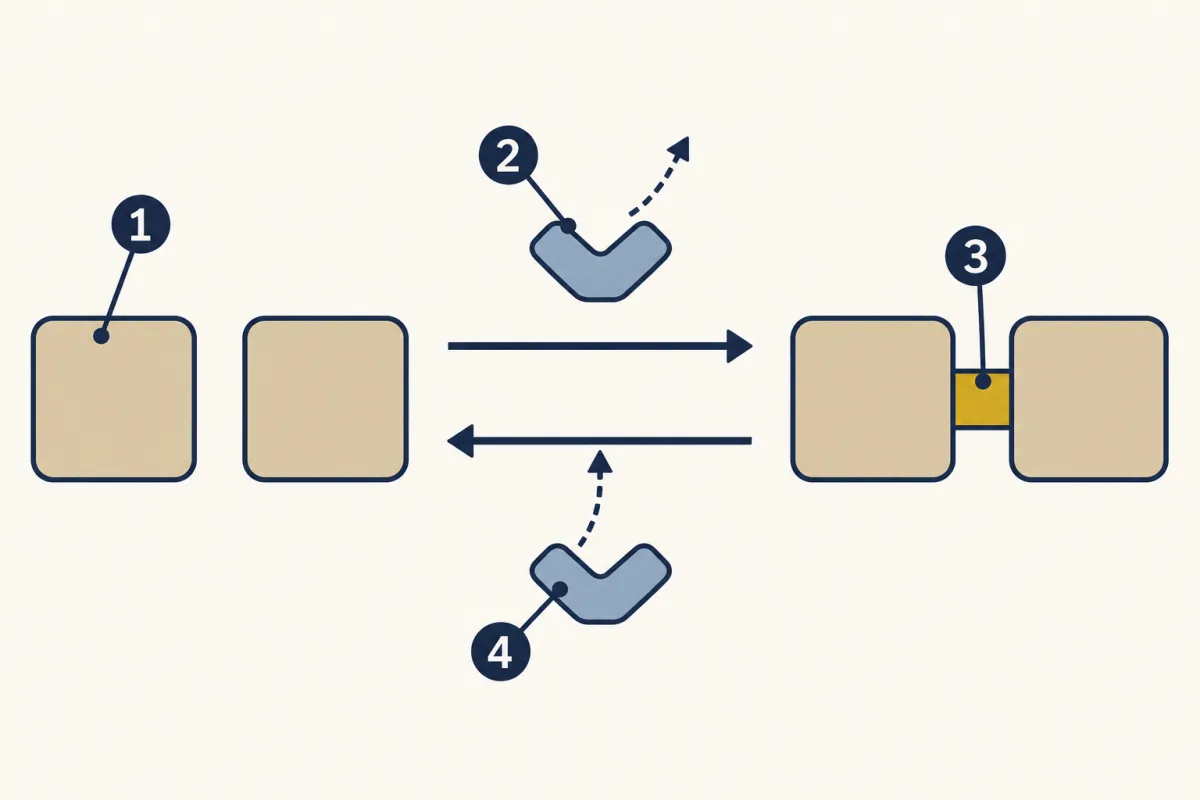
- monomers
- water molecule
- link
- water added
- monomers
- blank
- link
- blank
Word bank: water added, water molecule
- blank
- blank
- blank
- blank
Check your labels
- monomers
- water molecule
- link
- water added
Predict. On the mass scale chemists use for molecules, glucose weighs about 180, so two weigh 360. Maltose weighs about 342. Where did the missing 18 go?
Check your prediction
Into the one water molecule, which weighs about 18. The atoms are not lost; they leave as water.
Beyond the starch and protein in the first film, the sandwich’s fats are split, freeing fatty acids, and because the bread and turkey came from cells, their nucleic acids are split into the parts of nucleotides.
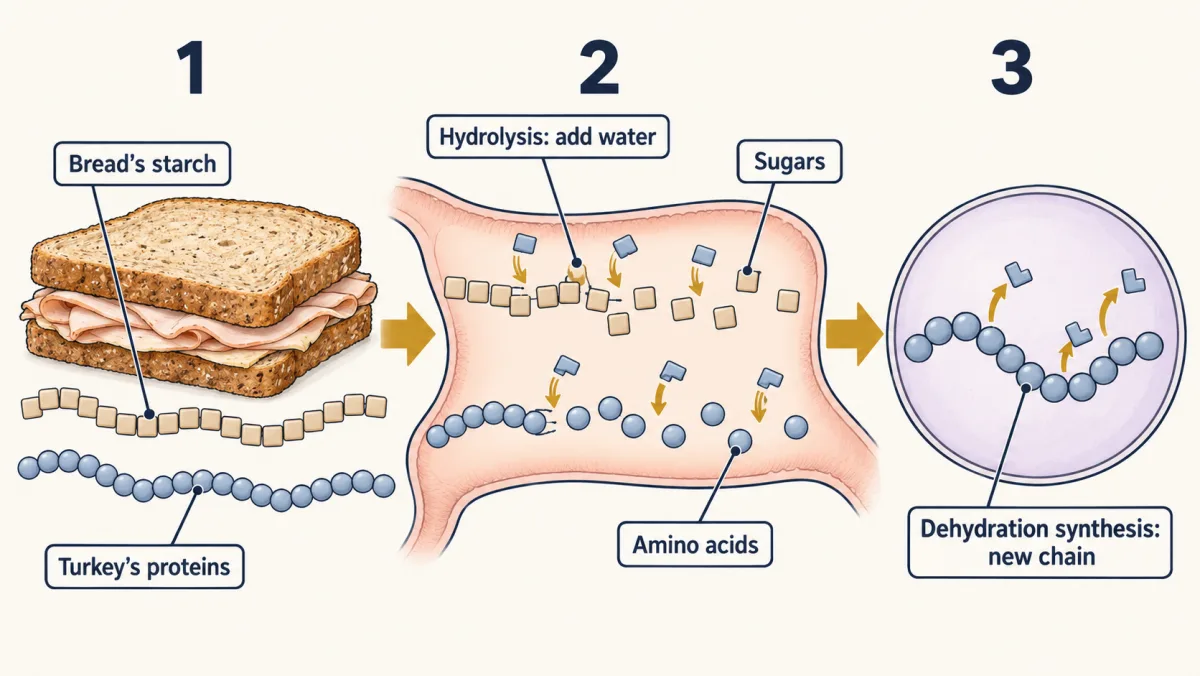
Your cells can make some amino acids from the carbon, hydrogen and oxygen of sugar, adding nitrogen moved from other amino acids. About nine, the essential amino acids, must come from food. Plants get their nitrogen another way (see Going deeper).
Explain: four classes, four kinds of job
| Class | Building blocks | Main jobs | Elements |
|---|---|---|---|
| Carbohydrates | simple sugars | quick energy; short-term energy storage (starch, glycogen); plant cell walls | C, H, O |
| Proteins | amino acids | building tissues; running cell processes | C, H, O, N (most also S) |
| Nucleic acids | nucleotides | storing and passing on genetic information | C, H, O, N, P |
| Lipids | fats: fatty acids and glycerol; other lipids differ | fats: long-term energy storage and insulation; phospholipids and cholesterol: cell membranes | mostly C, H, O |
- A carbohydrate is a molecule made of simple sugars, such as glucose, starch or cellulose.
- A protein is a chain of amino acids folded into a shape. An amino acid is a small molecule containing nitrogen that is the building block of proteins; most proteins also contain some sulfur.
- A nucleic acid is a chain of nucleotides, such as DNA or RNA. A nucleotide is a building block made of a sugar, a phosphate group and a base containing nitrogen.
- A lipid is a molecule that mostly does not mix with water, such as a fat or oil. A phospholipid is a lipid with one end that does attract water.
Not every lipid is a fat: phospholipids and steroids such as cholesterol are lipids too.
The table gives carbohydrates two jobs that pull opposite ways, quick energy and stiff plant walls, yet starch and cellulose are both chains of glucose. The second film shows how.
Read the transcript of “Shape Decides the Job”
Film transcript: Shape Decides the Job
Starch and cellulose are both chains of the same sugar, glucose. So why can your own enzymes take starch apart, but not cellulose? The first film showed food taken apart by adding water, one water per link. Here are the same gold sugar blocks. But their links are not all alike. In starch, the glucose links let the chain coil, and some starch branches. It is the plant's store of sugar, and your enzymes can take it apart for energy. A digestive enzyme is a protein folded into a pocket. Starch's links fit that pocket. The enzyme adds water at a link, and the chain breaks into smaller sugars. Other enzymes finish the job, down to glucose.
In cellulose, the glucose blocks are linked the other way. The chains lie straight and stack side by side. Together they form strong fibers that stiffen plant cell walls. Now the same enzyme tries cellulose. Its pocket does not fit these links. Your own enzymes cannot break them. So for you, cellulose is fiber. Same sugar, different links, two shapes, two jobs. One stores energy; the other stiffens plant walls. The blocks, the links between them and the shape they take decide the job. The enzyme follows the same rule. It is a protein, a chain of amino acids folded into a shape. That folded shape makes the pocket, and the pocket fits one kind of molecule.
Lipids follow the rule too. A phospholipid has a head that is attracted to water and two tails that avoid it. Picture many phospholipids dropped into water, all tumbling at once. Each head likes water, and each pair of tails avoids it. Which way will the heads point?
Out, toward the water, on both sides. The tails tuck into the middle. That double layer is the basic structure of a cell membrane. Fats are lipids too, but a fat is not a chain. One glycerol holds three fatty acids by three links. Count from the free pieces, and three waters are missing. The water count still works. The chain picture does not. Counting water only tells you how many links there are. It does not tell you the job. The blocks, the links between them and the shape they take decide what each molecule can do.
From the film
- Starch and cellulose are both chains of glucose, but their links differ: starch coils and some of it branches, while cellulose chains lie straight, side by side.
- Digestive enzymes are proteins whose folded pockets fit starch's links; they cut starch into smaller sugars, then glucose. Your own enzymes cannot break cellulose's links.
- Cellulose chains pack into strong fibers that stiffen plant cell walls.
- In water, phospholipids form a double layer, heads out and tails in: the basic structure of a cell membrane.
- A common fat is one glycerol joined to three fatty acids by three links, so it is not a chain.
Explain: shape decides the job
Beyond the second film’s starch, cellulose, enzyme and membrane:
- Nucleic acid: DNA. DNA has two strands whose bases pair in a fixed way, A with T and G with C, so each strand can guide the copying of the other, passing the information to new cells. DNA: Structure and Copying shows how.
- Carbohydrate: cellulose. Much of the fiber in whole-wheat bread is cellulose and other cell-wall material; bacteria in your gut can break down some of it.
- Protein: an enzyme. An enzyme is usually a protein that speeds up a reaction. Its pocket works somewhat like a lock that opens only for a key of the right shape, although the analogy breaks because molecules bend and move.
Predict. If heat or acid changes the shape of an enzyme’s pocket, what happens to the enzyme’s work?
Check your prediction
The molecule may no longer fit, so the enzyme may stop speeding up its reaction. You will test this in Enzymes at Work.
Together these molecules run life processes: proteins and lipids build new cells for growth and repair, DNA passes information on in reproduction, a protein in red blood cells carries oxygen for gas exchange, enzymes run metabolism (the chemical reactions in cells), and membrane proteins detect signals so cells can respond.
Elaborate: what is in the sandwich and its neighbors
Each row gives grams of nutrient per 100 grams of a reference food, a fair basis for comparing. Carbohydrate already includes the fiber, the part your own enzymes cannot digest.
| Food (100 g) | Carbohydrate (g) | Protein (g) | Fat (g) | Fiber (g) |
|---|---|---|---|---|
| Whole-wheat bread | 42.71 | 12.45 | 3.5 | 6 |
| Turkey breast, roasted | 0 | 30.13 | 2.08 | 0 |
| Peanut butter, smooth | 22.31 | 22.21 | 51.36 | 5 |
| Apple, raw, with skin | 13.81 | 0.26 | 0.17 | 2.4 |
| Whole milk | 4.8 | 3.15 | 3.25 | 0 |
| Olive oil | 0 | 0 | 100 | 0 |
Source: USDA FoodData Central, SR Legacy reference foods (FDC IDs 172688, 171496, 174266, 171688, 171265, 171413), published April 2019. These are averaged reference values, not one sample from one store or lab. This table does not include nucleic acids.
Food scientists estimate energy in kilocalories (kcal) with factors of about 4 kcal per gram for carbohydrate and protein and about 9 kcal per gram for fat. These are rounded averages, and fiber gives less energy than other carbohydrate, so real values and food labels can be lower.
- Which two foods have the most protein per 100 grams? Is one of them a plant food?
- Bread lists 42.71 grams of carbohydrate, including 6 grams of fiber. How many grams are not fiber? Compare with the apple.
- Using the energy factors, about how much energy is in the fat of 100 grams of peanut butter? How does that compare with the energy estimated for its carbohydrate?
Claim, evidence, reasoning
Make a claim that answers this question, using the table: are fats and carbohydrates simply bad for people?
Start with: The data show that fats and carbohydrates are blank.
Start with: For example, blank contains blank g of carbohydrate including blank g of fiber, and blank contains blank g of fat along with blank g of protein.
Start with: This matters because the body uses carbohydrates for blank and fats for blank, so blank.
Compare with a model answer
Fats and carbohydrates are not simply bad; they are parts of many foods and do different jobs. Whole-wheat bread has 42.71 g of carbohydrate per 100 g, including 6 g of fiber, and 12.45 g of protein. Peanut butter is about half fat, 51.36 g, yet also has 22.21 g of protein. The body uses carbohydrates for quick energy and fats for long-term energy storage and insulation, with other lipids in membranes. A limit: these are averaged reference foods, and the table cannot show whether a whole diet is healthy.
Saved in this browser only.
Design problem
Many school labs use three tests. Iodine solution turns blue-black with starch. Biuret solution turns violet with protein. A drop of fat leaves a see-through spot on brown paper that stays after the paper dries. Plan an investigation to find which of these molecules are in bread, turkey and apple.
Saved in this browser only.
One way to do it
The independent variable is the food. The dependent variable is the color change or spot. Keep the amount of food, the amount of test solution and the waiting time the same. For each test, use water as a negative control (it should not react) and a known sample as a positive control (it should): starch for iodine, a known protein for biuret, oil for the spot test. Run each test three times. Based on the table, you might expect starch in the bread and protein in the turkey and bread. The apple has very little protein or fat, and a ripe apple may show little starch. Treat these as predictions to test. Wear goggles, never taste lab samples, and handle iodine and biuret solution with care.
Evaluate: check your thinking
Trace one bite: digestion splits its large molecules into small pieces, such as sugars, amino acids, fatty acids and the parts of nucleotides, and your cells build their own molecules from those pieces and from blocks they make themselves.
Science practices you used: predicting and testing with a model, naming where an analogy breaks, reading data on a fair 100-gram basis, calculating with energy factors, and planning a test with controls and repeated trials.
Going deeper
The real steps in a cell
Joining takes energy. In cells, each kind of molecule is built by its own energy-using route, so the real steps usually release other products, not water. The one-water-per-link count describes atoms, not the cell’s steps. Digestion is different: hydrolysis does add one water for each link it breaks.
Where plants get their nitrogen
Plants also build amino acids from sugar-derived carbon, but they take their nitrogen from inorganic nitrate or ammonium in the soil. In legumes such as peas, bacteria in root nodules also supply nitrogen.
The three stories, told aloud Side Hops: three stories that go with this lesson Side Hops
A panda, a camel and a box of used bandages
3:55 · Narration: an AI narrator voice (ElevenLabs, Jessica).
Read the transcript
Let's visit a panda, a camel and a castle cellar, because each one shows a big molecule doing its job, or refusing to.
Start with the giant panda. A panda can spend ten to sixteen hours a day eating, sitting upright on the ground like a person on the floor, holding each stalk with a kind of extra thumb that is really an enlarged wrist bone. It can get through about twelve and a half kilograms of bamboo in a day. And yet, in feeding trials with two captive pandas, researchers estimated that the animals digested less than a fifth of the bamboo's dry matter, and only about eight percent of its cellulose. Most of it simply passes through. Here is why. Cellulose is a chain of glucose, the same sugar that makes up the starch in a potato. But cellulose's glucose blocks are joined by a different kind of link, and the panda's own enzymes cannot cut it. Its gut is built more like a meat eater's, and its gut bacteria look more like a meat eater's too, with few of the kinds that break down cellulose. So the panda sits on a pile of glucose it mostly cannot unlock, and makes up for it by eating a great deal of bamboo and moving it through quickly.
Next, the camel. You have probably heard that a camel's hump is a water tank. It is not. A hump is mostly fat, and the Cleveland Zoo says a single hump can hold up to eighty pounds of it. That is fat doing exactly the job in your lesson table: long-term energy storage. When food runs short, the camel breaks down hump fat for energy, and the hump shrinks. After long hunger it can nearly disappear. On adult domestic Bactrian camels, the two-humped kind, a hump can go soft and flop over to one side, which looks a little undignified. Keeping the fat in one place has a desert bonus, too: the rest of the body is not wrapped in a warm coat of fat. And the water? Camels are simply excellent drinkers. A thirsty one can drink about thirty gallons in ten minutes.
Last, a castle in Tübingen, Germany, in eighteen sixty-nine. A twenty-four-year-old Swiss scientist named Friedrich Miescher had a lab in the castle's old vaults, and he wanted to know what white blood cells are made of. Where do you find a lot of white blood cells? In pus. So the local hospital sent him its used bandages. He had to invent his own ways to get the cells off the bandages and pull them apart. Out came a substance that was not protein and not fat. It was acidic, and it was much richer in phosphorus than proteins are. That phosphorus is the P in your lesson's table, in the row for nucleic acids. Because it came from the cell's nucleus, he called it nuclein. His sample was not pure, but its main ingredient is what we now call D N A. Miescher later wondered whether nuclein played a part in fertilization and heredity. About seventy-five years after he found it, experiments in nineteen forty-four showed that D N A could pass a trait from one bacterium to another.
One sugar locked behind the wrong link, one fat tucked into a hump, and one acid hiding in a bandage. Each time, the blocks and the way they are put together decided what the molecule could do.
The idea underneath them. Your body takes food's large molecules apart by adding water, one water per link, and builds its own by removing water, one water per link counted from the free blocks.
Your notes
Select any text in the lesson to highlight it or add a note to it. Your highlights and notes are saved in this browser and collected in your notebook.
This browser is not letting the site save anything (a private window or strict privacy settings), so highlights and notes will be lost when you leave the page.
Try the Predict questions again
Two Predict questions from this lesson, on their own. Answer each one first, then open its check.
On the mass scale chemists use for molecules, glucose weighs about 180, so two weigh 360. Maltose weighs about 342. Where did the missing 18 go?
From: Explain: small blocks, big chains
Check your prediction
Into the one water molecule, which weighs about 18. The atoms are not lost; they leave as water.
If heat or acid changes the shape of an enzyme’s pocket, what happens to the enzyme’s work?
From: Explain: shape decides the job
Check your prediction
The molecule may no longer fit, so the enzyme may stop speeding up its reaction. You will test this in Enzymes at Work.
How we measure it
Food-composition database lookup
A food-composition database such as USDA FoodData Central lists how many grams of carbohydrate, protein, fat and fiber are in 100 grams of a reference food. You can scale those values to any portion with one multiplication: grams of nutrient = value per 100 g × grams of food ÷ 100.
Nutrition-label reading
A Nutrition Facts label gives the grams of carbohydrate, protein, fat and fiber in one serving. Comparing foods only makes sense on the same basis, such as the same serving size or 100 grams, and a single total like grams of fat does not decide whether a food is healthy.
Where this lesson fits
Before thisReview first
- Water and LifeThis course · Lesson 1
You need water's structure and its role in reactions from there to see why adding or removing water breaks or builds links.
After thisStudy next
- Enzymes at WorkThis course · Lesson 3
It takes the idea of proteins with folded pockets and shows how enzymes speed up the breaking and building of links.
- DNA: Structure and CopyingThis course · Lesson 16
It takes nucleotides and the base pairing of DNA from this lesson and shows how one strand guides copying.
- Respiration and ATPThis course · Lesson 5
It uses the energy stored in sugars and fats, and shows how cells release it as ATP.
Elsewhere on the siteFilms, simulations and method films in other courses
- What a Root Has to ReachFilm · Organismal Biology
Shows how plants get the nitrogen they need to turn sugar into amino acids.
Suggested by an AI model from the lessons themselves, then checked. How we use AI
That is the skim: you have the shape of it.
Those are the stories. The idea under them is the one the lesson builds.
That is both films: the lesson in pictures.
The rest of the lesson is here when you want it.
Finish line
Test yourself
8 questions
Practice and MCAT-style, with explained answers.
Next · Lesson 3
Enzymes at Work
Why does fresh pineapple keep gelatin from setting, while canned pineapple lets it set?
Continue →Rewritten on : new text, flashcards and film. Notes and highlights stay, but the text around them may have moved.