Biology · Skim version
What Am I Made Of?
Read the full lesson → Skim the whole course →
The guiding idea
How can a turkey sandwich on whole-wheat bread end up as part of your own body?
Your body takes food's large molecules apart by adding water, one water per link, and builds its own by removing water, one water per link counted from the free blocks.
From the film: Take It Apart, Build It Again
- Digestion breaks starch, protein and other large molecules in food into smaller pieces by adding water, one water for each link it breaks (hydrolysis).
- Counted from the free blocks to the finished chain, building removes one water for each link (dehydration synthesis).
- A chain has one fewer link than it has blocks, so a chain of 6 blocks has 5 links.
- Joining takes energy. In cells, each kind of molecule is built by its own energy-using route, so the real steps usually release other products, not water.
- A turkey protein does not become your protein; its amino acids are reused to build your own.
From the film: Shape Decides the Job
- Starch and cellulose are both chains of glucose, but their links differ: starch coils and some of it branches, while cellulose chains lie straight, side by side.
- Digestive enzymes are proteins whose folded pockets fit starch's links; they cut starch into smaller sugars, then glucose. Your own enzymes cannot break cellulose's links.
- Cellulose chains pack into strong fibers that stiffen plant cell walls.
- In water, phospholipids form a double layer, heads out and tails in: the basic structure of a cell membrane.
- A common fat is one glycerol joined to three fatty acids by three links, so it is not a chain.
-
Explore: build big molecules from small blocks
-
Explain: small blocks, big chains
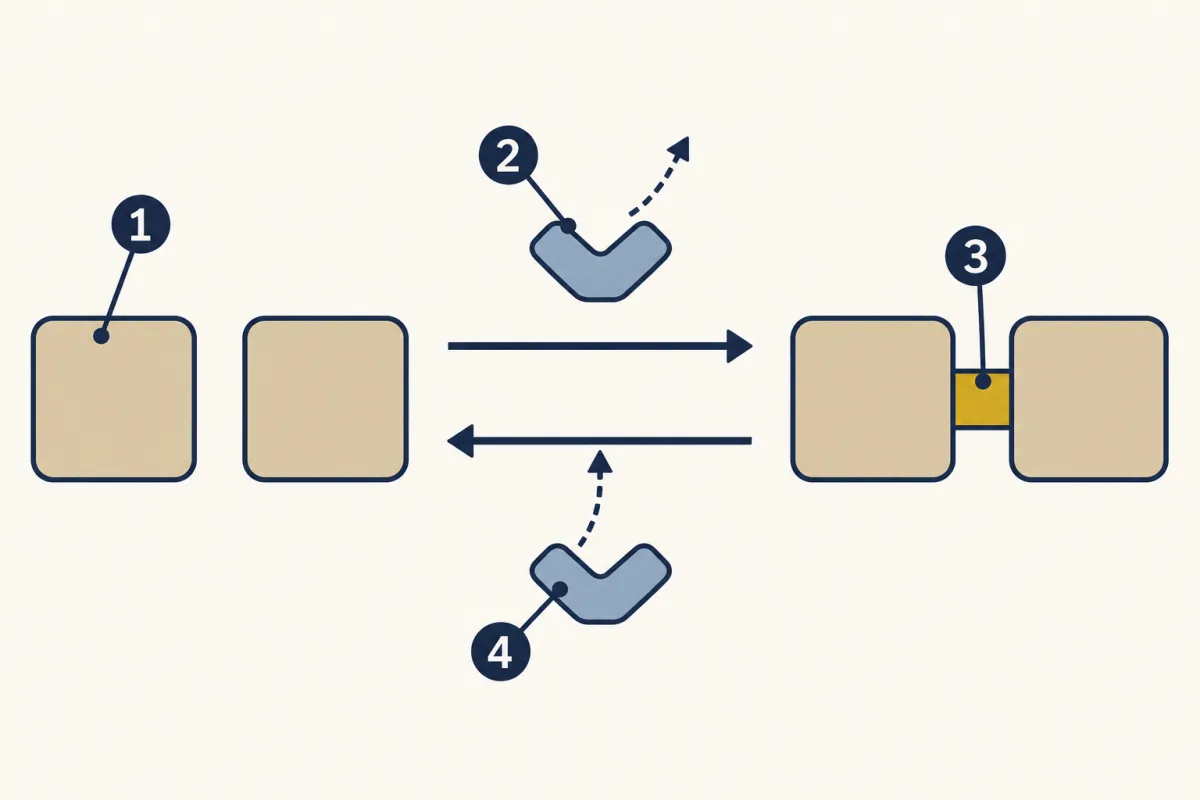
- monomers
- water molecule
- link
- water added
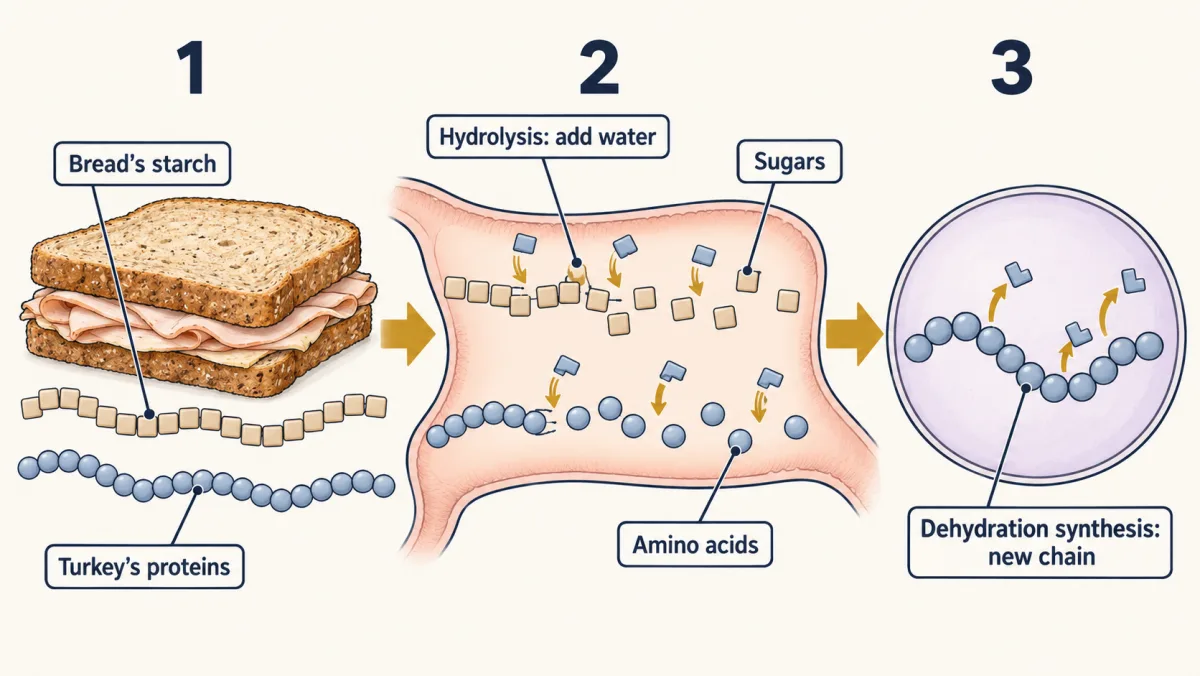
Digestion splits the bread's starch and the turkey's proteins into pieces by adding water; your cells then join those pieces into their own polymers. AI-generated illustration -
Explain: four classes, four kinds of job
-
Explain: shape decides the job
-
Elaborate: what is in the sandwich and its neighbors
-
Evaluate: check your thinking
-
Going deeper
Where this lesson fits
Before thisReview first
- Water and LifeThis course · Lesson 1
You need water's structure and its role in reactions from there to see why adding or removing water breaks or builds links.
After thisStudy next
- Enzymes at WorkThis course · Lesson 3
It takes the idea of proteins with folded pockets and shows how enzymes speed up the breaking and building of links.
- DNA: Structure and CopyingThis course · Lesson 16
It takes nucleotides and the base pairing of DNA from this lesson and shows how one strand guides copying.
- Respiration and ATPThis course · Lesson 5
It uses the energy stored in sugars and fats, and shows how cells release it as ATP.
Elsewhere on the siteFilms, simulations and method films in other courses
- What a Root Has to ReachFilm · Organismal Biology
Shows how plants get the nitrogen they need to turn sugar into amino acids.
Suggested by an AI model from the lessons themselves, then checked. How we use AI