Cell Signaling · Skim version
Long-Distance Signaling in Neurons
Read the full lesson → Skim the whole course →
The guiding idea
How does a neuron that takes in its survival signal at the tip of its axon get that message to a nucleus centimeters away?
A neuron receives its survival signal, NGF, at the tip of an axon that can be centimeters from the nucleus that must respond.
-
A Problem: the signal and the genes are far apart
-
The evidence: NGF at the far end is enough
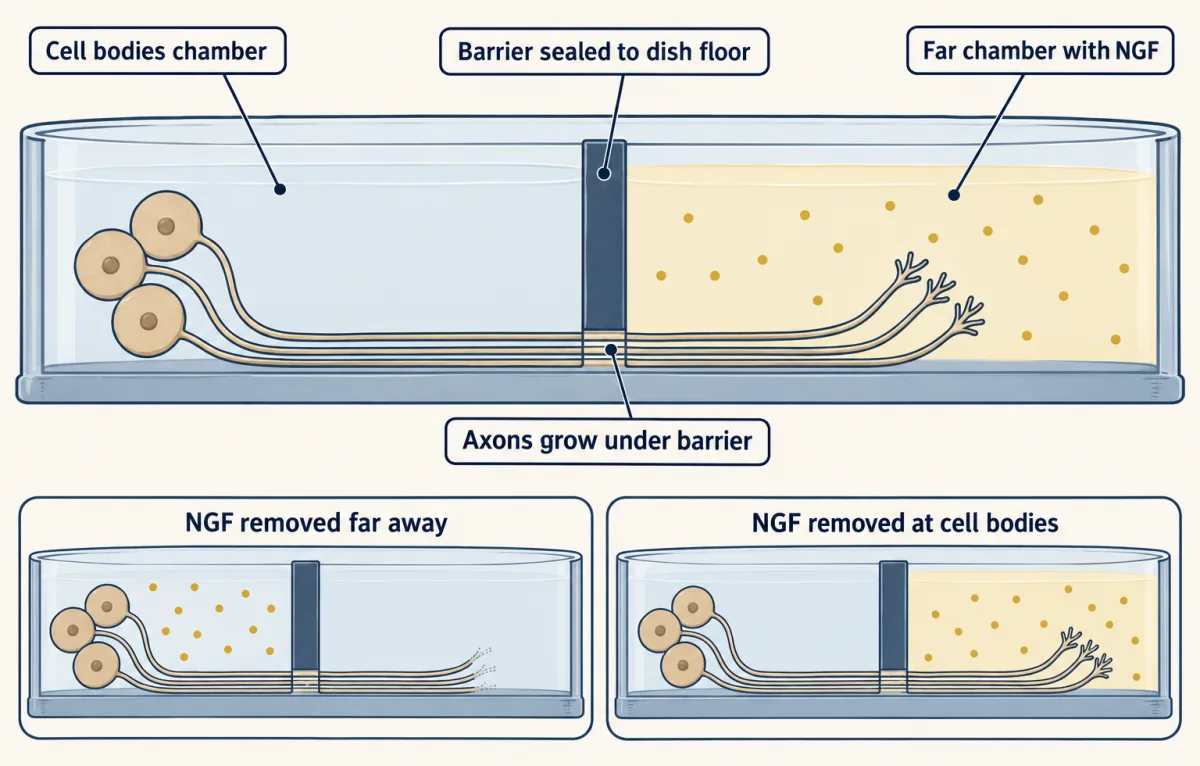
Campenot's divided dish lets the fluid around the cell bodies and the fluid around the axon tips be changed separately. Without NGF at the far end the axons stopped growing and later appeared to degenerate; without NGF at the cell bodies, many neurons survived as long as their axons reached NGF. AI-generated illustration -
The model: the endosome as a parcel
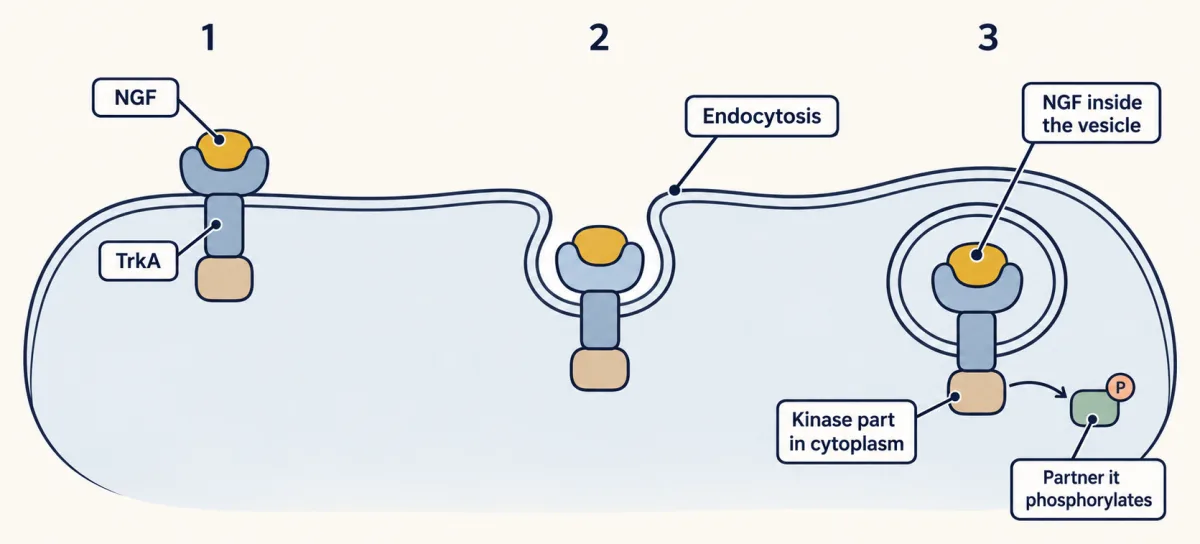
At the axon tip NGF binds TrkA and the pair is taken in by endocytosis. In the vesicle NGF is inside and the kinase part of TrkA faces the cytoplasm, where it can go on phosphorylating its partners, so the vesicle is a patch of active membrane that can be shipped. AI-generated illustration -
Carried, or relayed? Why blocking the motor does not settle it
-
Two more answers to distance, and a road that fails
-
Going deeper
Where this lesson fits
Before thisReview first
- Finding a Signal: NGF, EGF and the BioassayThis course · Lesson 2
This is where NGF and its discovery through bioassay are introduced, and this lesson assumes you know the signal.
- Receptor Tyrosine KinasesThis course · Lesson 18
You need TrkA as a receptor tyrosine kinase that stays active after binding NGF to follow the endosome model.
After thisStudy next
- Hacking the Cell: Reporters, Actuators and Genetic ToolsThis course · Lesson 44
The tagged receptors and microfluidic tools used here are extended into reporters and actuators for watching signals in living cells.
Elsewhere on the siteFilms, simulations and method films in other courses
- Still On When It Gets ThereFilm · Developmental Neuroscience
This shows the survival signal from the target traveling home to the cell body.
- Grip, Swing, Let GoFilm · Cell Biology
Dynein walking toward the microtubule minus end, back to the cell body, is the motor that carries the endosome.
- Too Small, or Lost?Film · Developmental Neuroscience
This gives the target-supplied NGF survival evidence that sets up the distance problem.
Suggested by an AI model from the lessons themselves, then checked. How we use AI