Neuroscience · Skim version
Recording Many Neurons: Imaging, Arrays and Atlases
Read the full lesson → Skim the whole course →
The guiding idea
A probe with 960 recording sites does not record one neuron per site. What does it record?
Each big number in large-scale neuroscience is a proxy, one or more steps from your claim, to be trusted only as far as each step has been measured in conditions like yours.
From the film: One Question for Every Number
- Each big number in large-scale neuroscience is a proxy, one or more steps from your claim.
- Trust each step only as far as someone has measured it in conditions like yours.
- More cells sharpen the estimate for each animal, but they never count as more animals.
- The rule says how far to trust a measurement, not whether a pathway is needed for anything; that takes a manipulation.
From the film: The Answer Key: How Many Spikes Is a Flash?
- Fluorescence is measured in light, not spikes, so turning it into spikes needs a calibration against an electrical recording of the same cells.
- A calibration belongs to its conditions, not to the sensor, so ask whether it was done at your field of view, expression level and cell type.
- In population imaging a flat trace does not prove a silent cell, because one or a few spikes can hide in it.
From the film: How Many Mice?
- Units recorded from one mouse share that mouse, so counting them as independent samples is pseudoreplication.
- For a claim about mice, the sample is the number of mice, not the number of units.
- More units sharpen each mouse's estimate, but only more mice lower the floor on the error.
-
Four big numbers, four questions
-
Probes: sites, channels and units
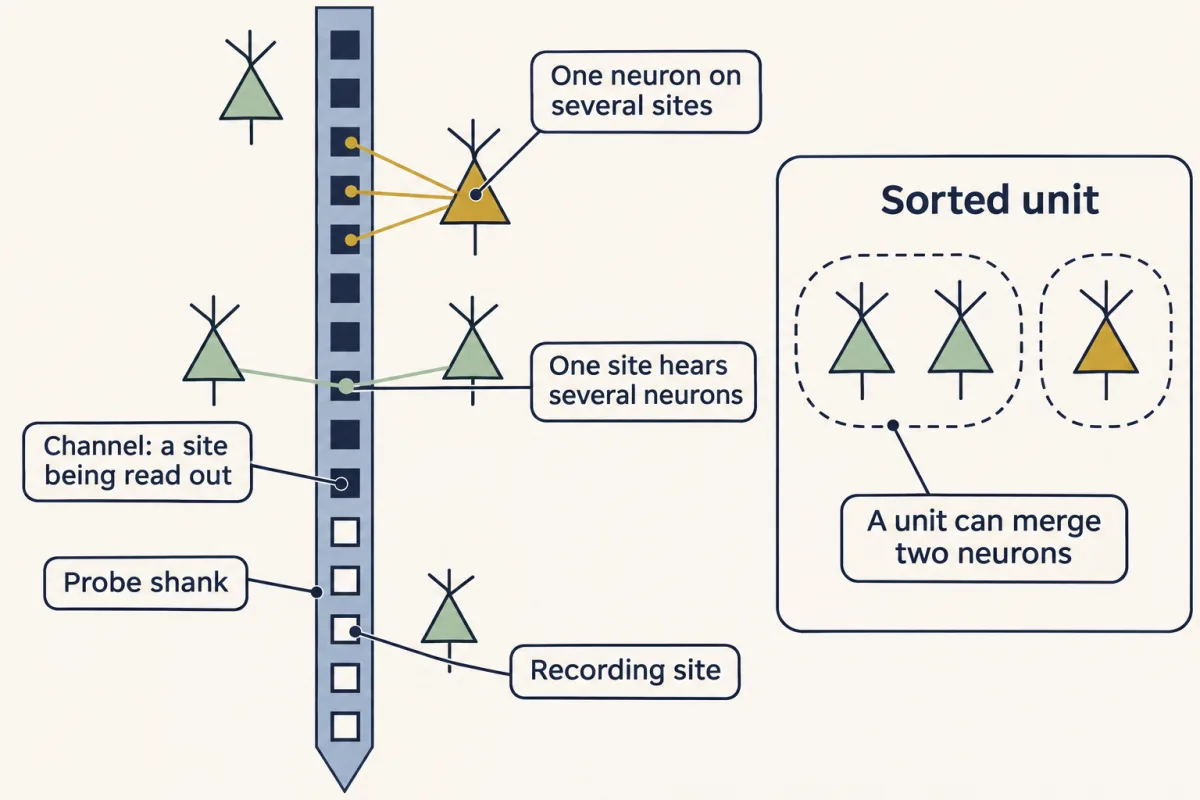
Sites and channels are hardware, but units are an inference: one neuron can show up on several sites, one site can hear several neurons, and spike sorting can merge two neurons into one unit. AI-generated illustration -
Imaging: light, two steps from a spike
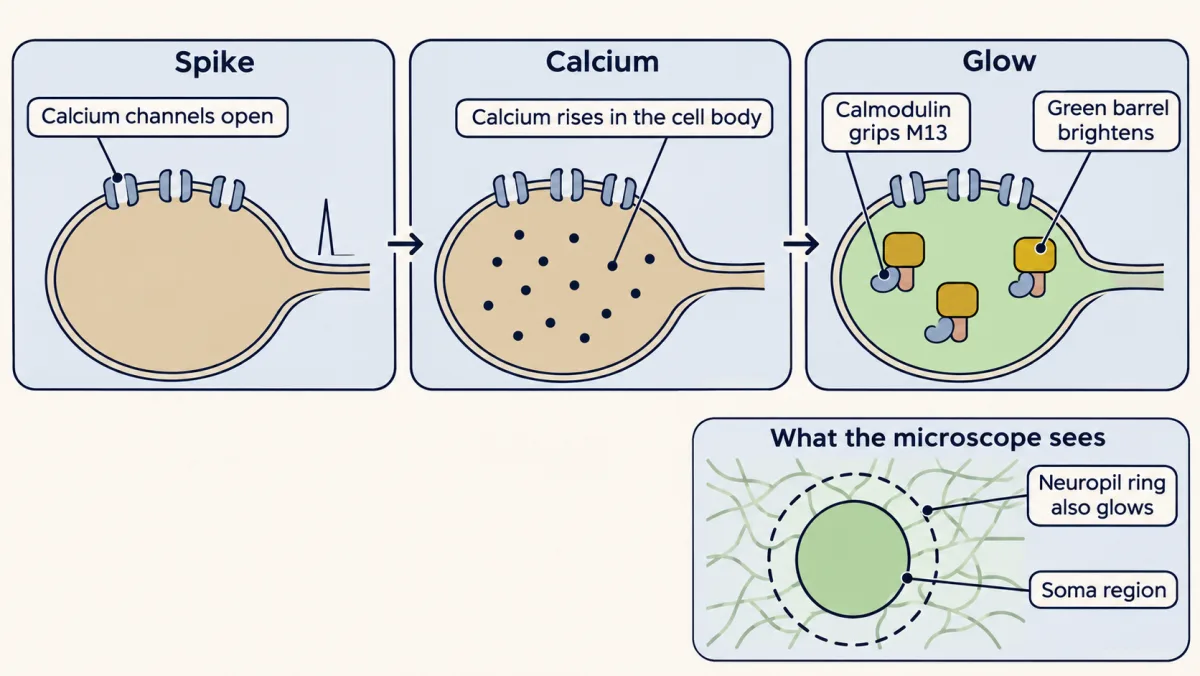
Imaging light is two steps from a spike: the spike lets calcium in, calcium makes the sensor brighten, and glowing neuropil around the cell leaks into any soma region drawn on the image. AI-generated illustration -
How many spikes is a flash? Calibrate it
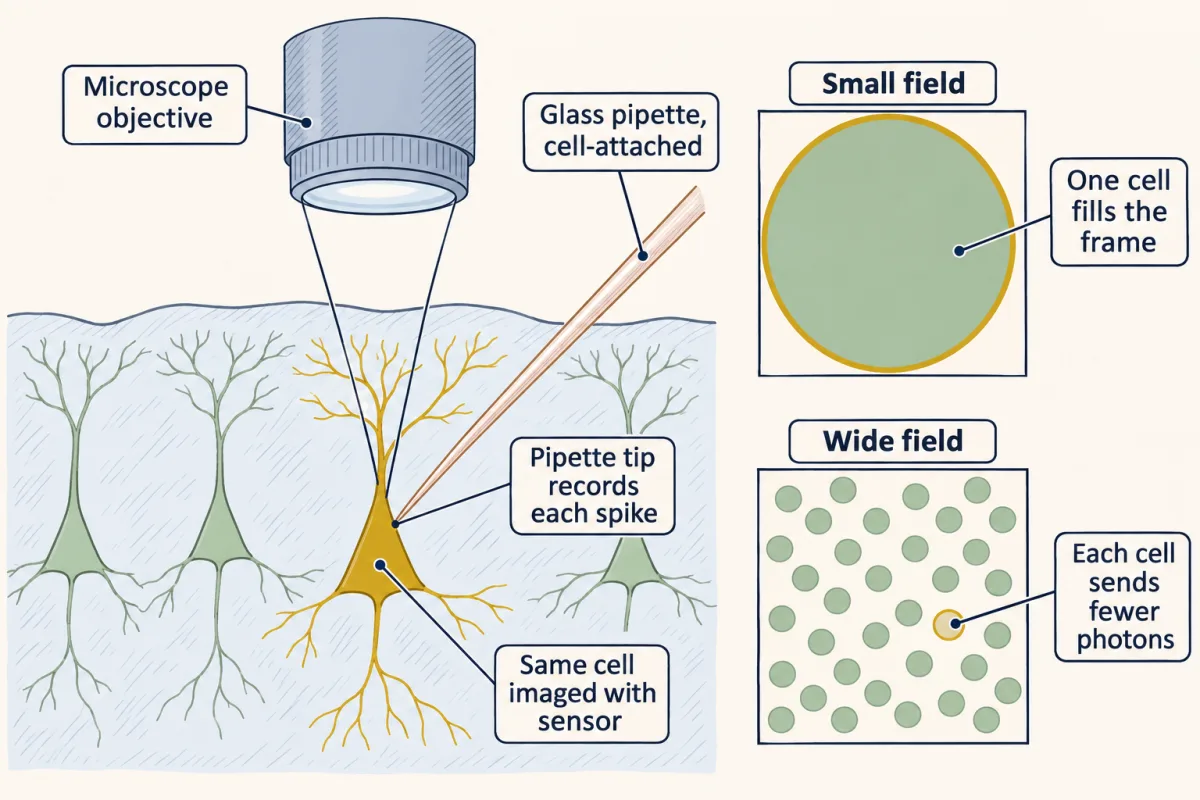
Calibration records each spike with a cell-attached pipette while imaging the same cell; in a wide field each cell sends back fewer photons, which Huang and colleagues proposed as the reason fewer single spikes are detected. AI-generated illustration -
How many samples do you really have?
-
Atlases and connectomes: steps the data do not fully check
-
MICrONS: one cell, seen twice
-
What none shows alone
-
Going deeper
Where this lesson fits
Before thisReview first
- The Action Potential and ConductionThis course · Lesson 4
You need to know what a spike is and how it lets calcium in before asking what probes and light record.
- Principles of Sensory CodingThis course · Lesson 9
Population recordings and sorted units are used there to read codes, so you need what a spike train carries.
After thisStudy next
- Designing a Causal Circuit ExperimentThis course · Lesson 28
Observational datasets cannot show a pathway is needed, so you take this idea further with a manipulation and its controls.
Elsewhere on the siteFilms, simulations and method films in other courses
- Extracellular single-unit and nerve recordingMethod film
It shows how spikes are picked out from outside the cell, the basis of sorted units on a probe.
- Before the Data ArriveFilm · Cell Biology
It shows why the independent unit must be fixed before data arrive, the same issue as units versus animals.
- What Zoom Cannot RecoverFilm · Cell Biology
It shows what image resolution can and cannot recover, relevant to reading fluorescence signals.
Suggested by an AI model from the lessons themselves, then checked. How we use AI