Sensory Systems · Skim version
Melanopsin Cells: Light for the Clock and the Pupil
Read the full lesson → Skim the whole course →
The guiding idea
A mouse with no working rods or cones still sets its body clock to the day and still narrows its pupils in bright light. Which cells are measuring the light?
A mouse with no working rods or cones still sets its body clock and narrows its pupils.
From the film: A Blind Mouse That Knows It Is Day
- A small set of retinal ganglion cells, the ipRGCs, make their own light response with melanopsin and also relay rod and cone signals.
- In mice, these cells are the main route by which light reaches the clock and the pupil.
- Each ipRGC pools two light signals into one output.
From the film: The Light Response That Survived the Block
- A ganglion cell that still responds to light once rod and cone synapses are blocked is most likely making its own response.
- The cell's own response is usually slow to start, needs brighter light and is long-lasting.
- Slow and sustained suits a cell that reports how bright the world is, not what is in it.
From the film: Two Inputs, One Exit
- An ipRGC pools the rod and cone relay and its own melanopsin response into one output.
- In M1 cells, melanopsin signals through a G protein and phospholipase C beta 4 to open TRPC6 and TRPC7 channels, which depolarizes the cell.
- Light hyperpolarizes a rod but depolarizes an M1 cell.
From the film: Remove the Pigment, or Remove the Cell
- In mice, either input alone is enough to entrain the clock and to constrict the pupil, and losing both leaves nothing.
- Removing the ipRGCs gave larger deficits than removing melanopsin alone, close to the triple mutants.
- A single knockout shows what the other input can do alone, and it does not show each input's share.
From the film: Separate Cells for the Clock and the Pupil
- The clock and the pupil depend on partly different ipRGCs.
- Removing only the Brn3b-positive cells severely impaired the pupil reflex but spared photoentrainment.
- The names M1 to M6 are for mouse cells, and they are not six matching human types.
From the film: Beyond the Clock: Mood, Learning, Seeing and People
- In mice, ipRGCs contribute to mood-like and learning effects of abnormal light cycles, through separate outputs.
- Whether a matching circuit exists in humans was not tested.
- Two blind adults show that human light responses can run without rods and cones, but that is an existence proof and not a population result.
-
A light response that survives the block
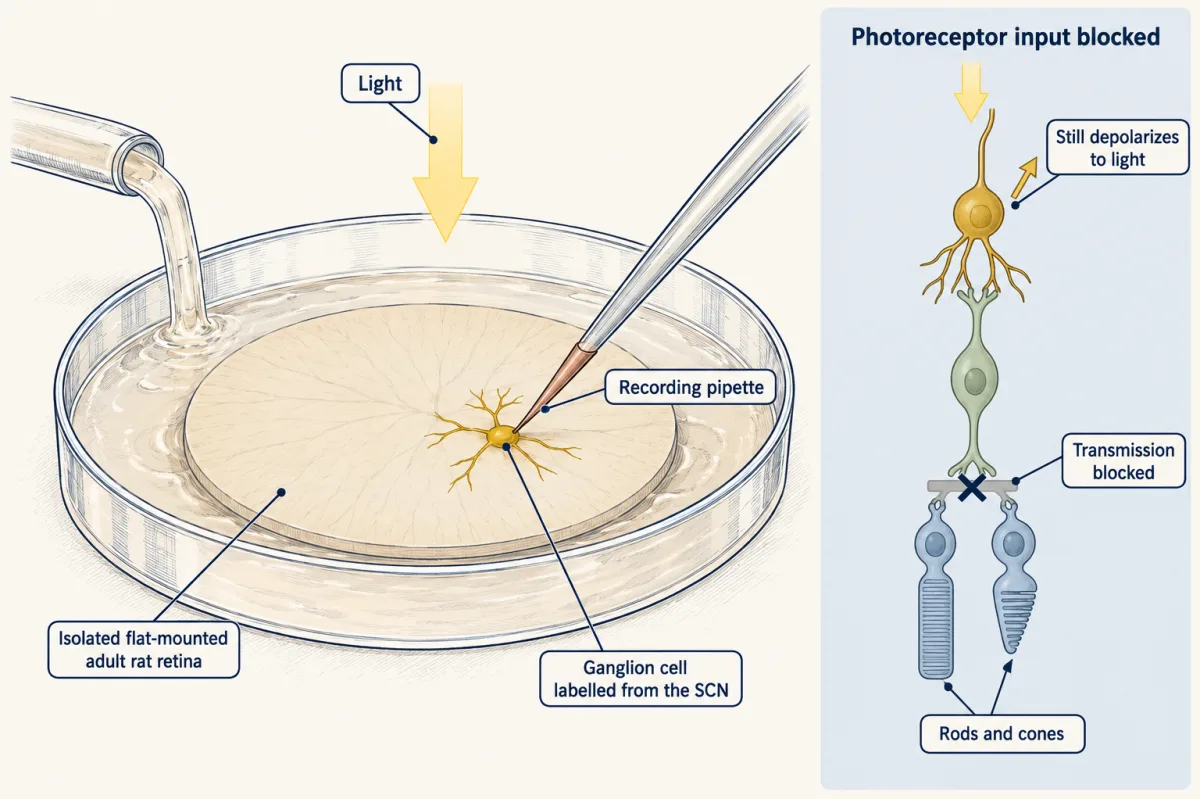
In 2002 Berson, Dunn and Takao recorded from SCN-labelled ganglion cells in flat-mounted adult rat retina while blocking synaptic transmission from rods and cones. The cells still depolarized to light, supporting an intrinsic response within the ganglion cell. AI-generated illustration -
Two inputs, one exit: how light becomes a voltage
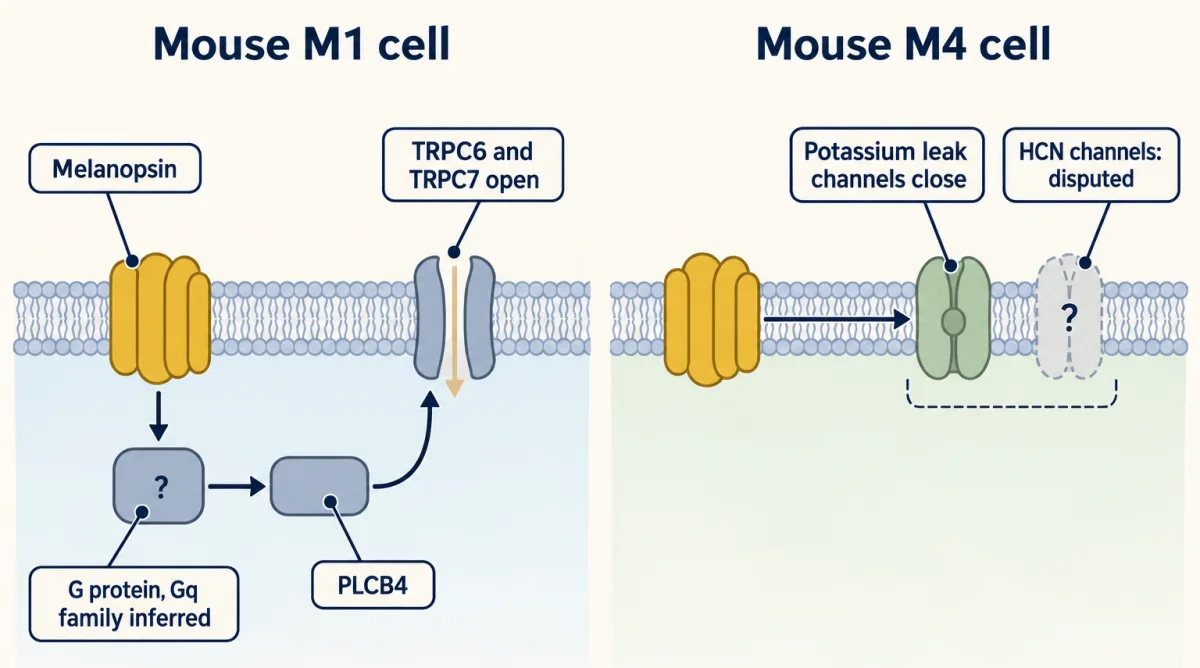
In mouse M1 cells, melanopsin signals through a G protein inferred to belong to the Gq family, PLCB4 and opening of TRPC6 and TRPC7 channels. In M4 cells, studies support potassium leak-channel closure together with TRPC channel opening; the drawing shows only the potassium-channel route and omits intermediate steps and TRPC. Whether HCN channels contribute is disputed between two 2023 papers. AI-generated illustration -
Remove the pigment, or remove the cell
-
Separate cells for the clock and the pupil
-
Beyond the clock: light, mood and learning in mice
-
What people show: two blind participants and an evening screen
-
A smaller extension: coarse patterns and contrast
-
Going deeper
Where this lesson fits
Before thisReview first
- Parallel Channels Out of the EyeThis course · Lesson 18
You need the ganglion cell types and the mouse ON alpha cell from there to place M4 and the other ipRGC subtypes.
- Five Ways to Turn a Stimulus into a CurrentThis course · Lesson 1
It sets out the ways a stimulus becomes a current, which this lesson applies to melanopsin's depolarizing pathway.
After thisStudy next
- Calcium Feedback Sets Photoreceptor Gain, and When Photoreceptors DieThis course · Lesson 21
It takes the question of how photoreceptors set their gain and survive further, with rods and cones that this lesson showed can be lost.
- Combining Senses and Predicting ThemThis course · Lesson 29
It builds on the idea of pooling several signals into one output, here across senses weighted by reliability.
Elsewhere on the siteFilms, simulations and method films in other courses
- Pressure and the ClockFilm · Neuroscience
It shows how light resets a circadian clock, which is the job ipRGCs do for the suprachiasmatic nucleus.
- Turn the year dialSimulation · Life Science
Environmental cues timing a daily rhythm is the entrainment that ipRGC light signals drive.
- One Cell CountsFilm · Neuroscience
It shows rods and cones turned down by light, contrasting with the ipRGC depolarizing response.
Suggested by an AI model from the lessons themselves, then checked. How we use AI