Developmental Neuroscience · Skim version
Injury and Regeneration: Why the Brain Does Not Regrow
Read the full lesson → Skim the whole course →
The guiding idea
A cut nerve in your arm can grow back. A cut tract in your spinal cord mostly cannot. Is the fault in the neurons or in what surrounds them?
A peripheral nerve can regrow after injury, but axons in the adult brain and spinal cord mostly cannot.
From the film: One Cut, Two Fates
- A cut splits an axon into two pieces with different fates.
- The piece cut off from its cell body destroys itself by a program it carries.
- The attached piece tends to regrow where the neuron's drive to grow outweighs the resistance of the surrounding tissue.
From the film: The Stump That Kills Itself
- The cut-off stump is not simply starving, because deleting one gene, Sarm1, keeps cut axons intact for a long time.
- NMNAT2 is a short-lived enzyme that must keep arriving from the cell body, and after a cut its loss lets SARM1 destroy NAD+.
- Energy then fails, calcium rises and calpains cut the cytoskeleton, and this is not apoptosis.
From the film: Drive Against Resistance
- Central axons grew about 30 millimetres along peripheral nerve grafts but stopped in central tissue, so the tissue resists regrowth.
- Deleting PTEN in mouse retinal ganglion cells let some axons cross a crushed optic nerve, so the neuron's own drive matters too.
- Regrowth is a balance, no single fix is enough, and regrowth is not the same as recovery.
-
One cut, two pieces
-
The cut-off piece destroys itself
-
Clearing the way
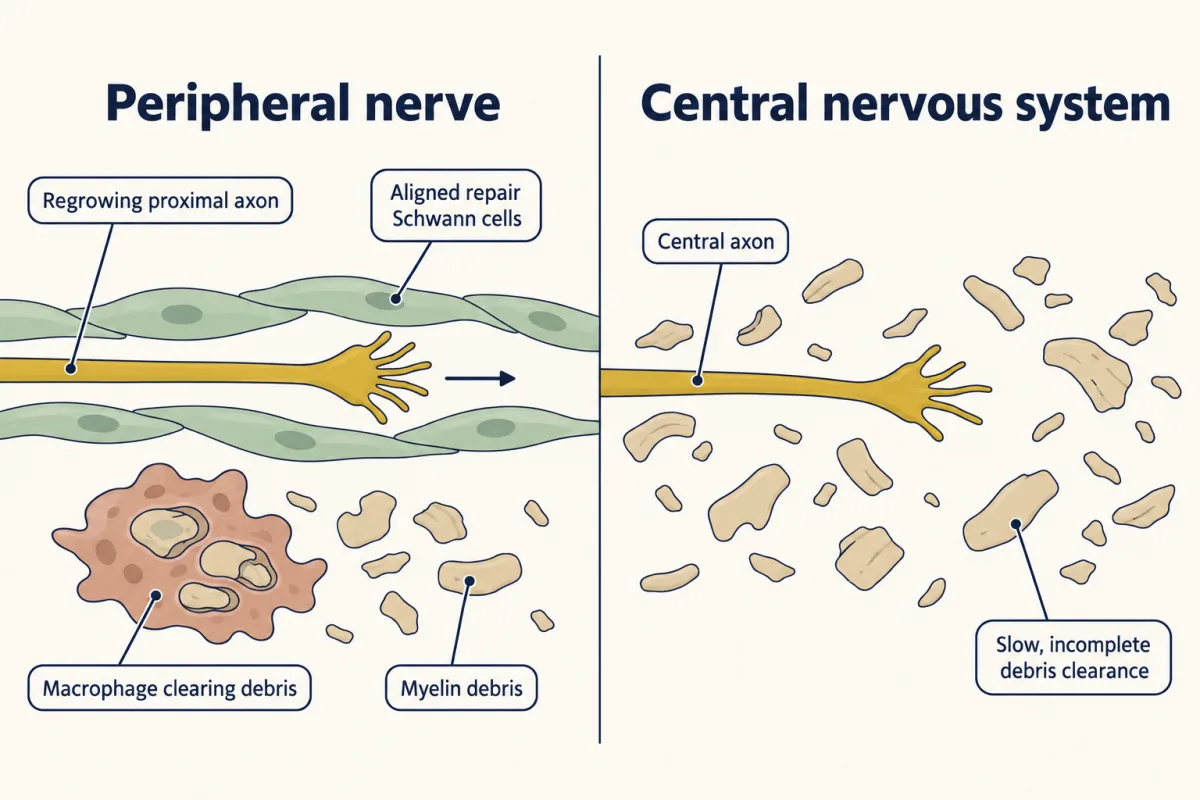
In peripheral nerve, repair Schwann cells and macrophages clear myelin, and the Schwann cells line up into tubes that guide the regrowing axon. In the central nervous system, debris is cleared slowly, the lesion fills with growth-blocking molecules, and adult central neurons turn their growth program down. AI-generated illustration -
The attached piece: drive against resistance
-
Regrowth is not recovery
-
Two problems, two fixes
-
Putting it together
-
Going deeper
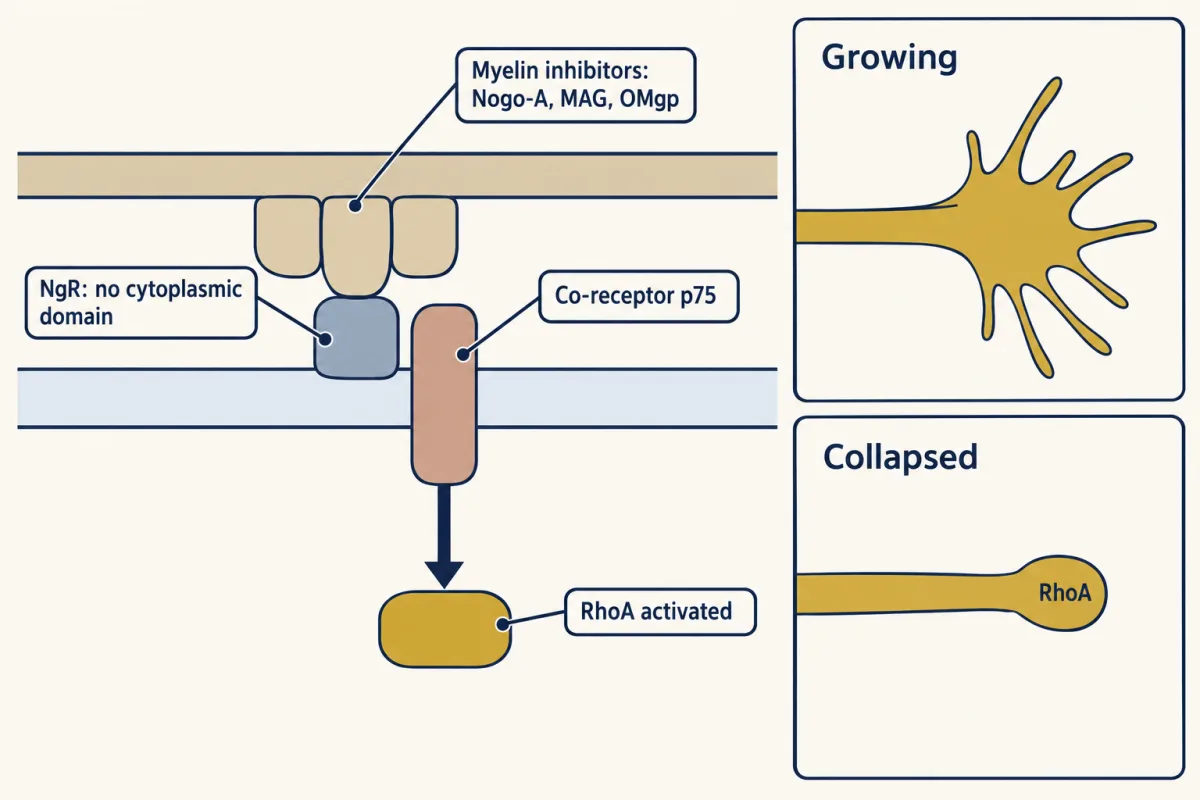
Nogo-A’s Nogo-66 domain, MAG and OMgp are alternative ligands for NgR, which has no cytoplasmic domain. In the illustrated pathway, NgR signals with LINGO-1 and p75, or TROY in neurons lacking p75, to activate RhoA and promote growth-cone collapse. AI-generated illustration
Where this lesson fits
Before thisReview first
- The Growth Cone: The Tip That Steers the AxonThis course · Lesson 3
You need the growth cone's steering and actin dynamics from there to follow how the attached stump regrows.
- Pruning Without Dying: Axons That Cut Themselves BackThis course · Lesson 34
It shows caspase-dependent axon cutting without cell death, the contrast this lesson draws with injury-induced degeneration.
- Myelination: Wrapping the Axon So the Signal JumpsThis course · Lesson 44
You need the glial wrapping of axons from there to understand myelin debris and myelin inhibitors after a cut.
After thisStudy next
- Two Places the Adult Brain Still Makes NeuronsThis course · Lesson 47
It asks whether the adult brain can replace lost neurons, the other half of repair after the axon repair problem here.
Elsewhere on the siteFilms, simulations and method films in other courses
- Reading annexin V and PISimulation · Cell Biology
It shows how apoptosis is read with annexin V and PI, the programmed death this lesson distinguishes from stump degeneration.
- A Current That Light Can Use UpFilm · Sensory Systems
It shows how a neuron's own signalling loss leads to cell death and degeneration.
Suggested by an AI model from the lessons themselves, then checked. How we use AI