A Current That Light Can Use Up
Read the transcript of “A Current That Light Can Use Up”
Film transcript: A Current That Light Can Use Up
Your eyes work in starlight and in bright sun. How can one kind of cell cope with both? Between starlight and sunlight, the light changes a hundred-million-fold or more. Yet a dark-adapted rod goes from barely responding to saturated over about a hundredfold range of flashes. In darkness, cGMP holds channels open in the outer segment. A steady dark current flows in. Light activates PDE, which breaks down cGMP, and channels close. Each response switches off part of that current. So light spends the current. What is still flowing limits how big the next response can be. Two terms. Gain is how much current one absorbed photon switches off, and for how long.
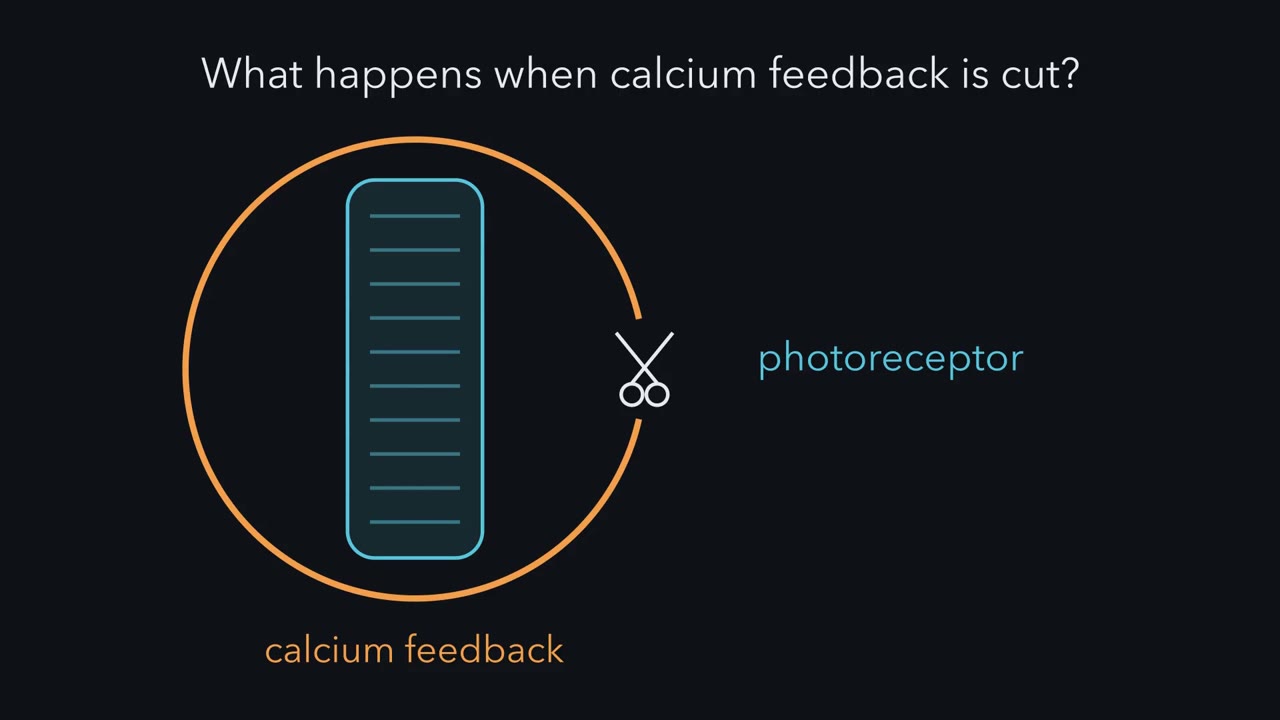
Sensitivity is the response to a dim flash, divided by the strength of that flash. Predict. Suppose a rod's gain never changed. What would a modest steady background do to it? It would close nearly every channel. The rod would be saturated, unable to signal any further brightening. Only dimming the light would let current return. So a photoreceptor turns its own gain down as the background brightens. Calcium feedback helps. While the light stays on, it reopens some channels, keeping current in reserve. It also cuts and shortens each new response. Each photon does less. The result is called Weber behaviour. On brighter backgrounds, sensitivity falls roughly as one over the background.
Contrast is a change in light, as a fraction of the background. The payoff. On bright backgrounds, take small, brief flashes of the same contrast and the same duration. Their photon count grows with the background, while sensitivity falls just as fast. So their peak responses stay about the same. Now remove the GCAPs. In darkness, a rod's response to one photon gets larger. But on a background it keeps less current in reserve. Its sensitivity falls more steeply. This picture comes mainly from mouse rods and cones. A bright enough light can still saturate them. Pigment bleaching, light using up visual pigment, and other mechanisms extend the range in bright light.
One feedback loop does most of this work. The test is to cut it. The takeaway. Light spends a limited current, and calcium feedback keeps some in reserve.
Delete the GCAPs, proteins that turn a rod's gain down, and its response to a single photon becomes about five times larger. Yet cones lacking the GCAPs and recoverin lose sensitivity more steeply than normal cones as a steady background brightens. How can removing gain control make a cell adapt worse in the light?
Continue in the lesson: Calcium Feedback Sets Photoreceptor Gain, and When Photoreceptors Die →
2:52 · Free, with captions and a transcript. The lesson has the full text, the questions and the sources.
More films from this lesson
How this film was made. Narration: an AI narrator voice (Kokoro, af_heart) reading narration written from this lesson's text. Animation: AI-generated in code (Manim) by Claude, a schematic with no drawn molecular structures. Captions come from the narration script. See something wrong? Report it.