Neuroscience · Skim version
Autonomic Control and the Hypothalamus
Read the full lesson → Skim the whole course →
The guiding idea
A thirsty mouse quiets its thirst neurons within a minute of drinking, while its blood osmolality is still raised five minutes later.
The osmotic vasopressin response needs two numbers, a threshold and a gain, and water-balance circuits act on an estimate of fluid balance: the blood, corrected for what is on its way.
From the film: Correction, Threshold and Gain
- The osmotic vasopressin response needs two numbers: a threshold, where release starts, and a gain, how much release grows above it.
- Below threshold there is no osmotically driven release, so the response is flat and then rises in a straight line.
- Water-balance circuits act on an estimate: feedback reads the blood, and feedforward adds what was just swallowed or a learned cue.
- Nerves often act within seconds, while hormone effects usually build over minutes to hours.
From the film: Two Ways Out: Blood and Wires
- The posterior pituitary is reached by axons and the anterior pituitary by blood, through portal veins that carry releasing hormones.
- In the stress axis, CRH drives ACTH, ACTH drives cortisol, and cortisol feeds back to turn the axis down.
- The usual autonomic chain has two neurons: acetylcholine on nicotinic receptors at the ganglion, then at the target usually acetylcholine on muscarinic receptors for parasympathetic and noradrenaline for most sympathetic.
- Sweat glands and the adrenal medulla are the exceptions to the usual sympathetic pattern.
From the film: Acting Before the Blood Changes
- In awake mice, subfornical organ neuron activity fell within a minute of drinking, while plasma osmolality was still raised five minutes after water access.
- Seeing unreachable water or licking an empty bottle did not lower the activity, so the signal comes with fluid going in.
- Water put directly into the stomach of dehydrated mice lowered the activity in about two minutes, before any detectable change in blood osmolarity.
- Feedback reads the blood and feedforward reads what is coming; this is population calcium in mice, not the feeling of thirst.
-
The loop, built on water
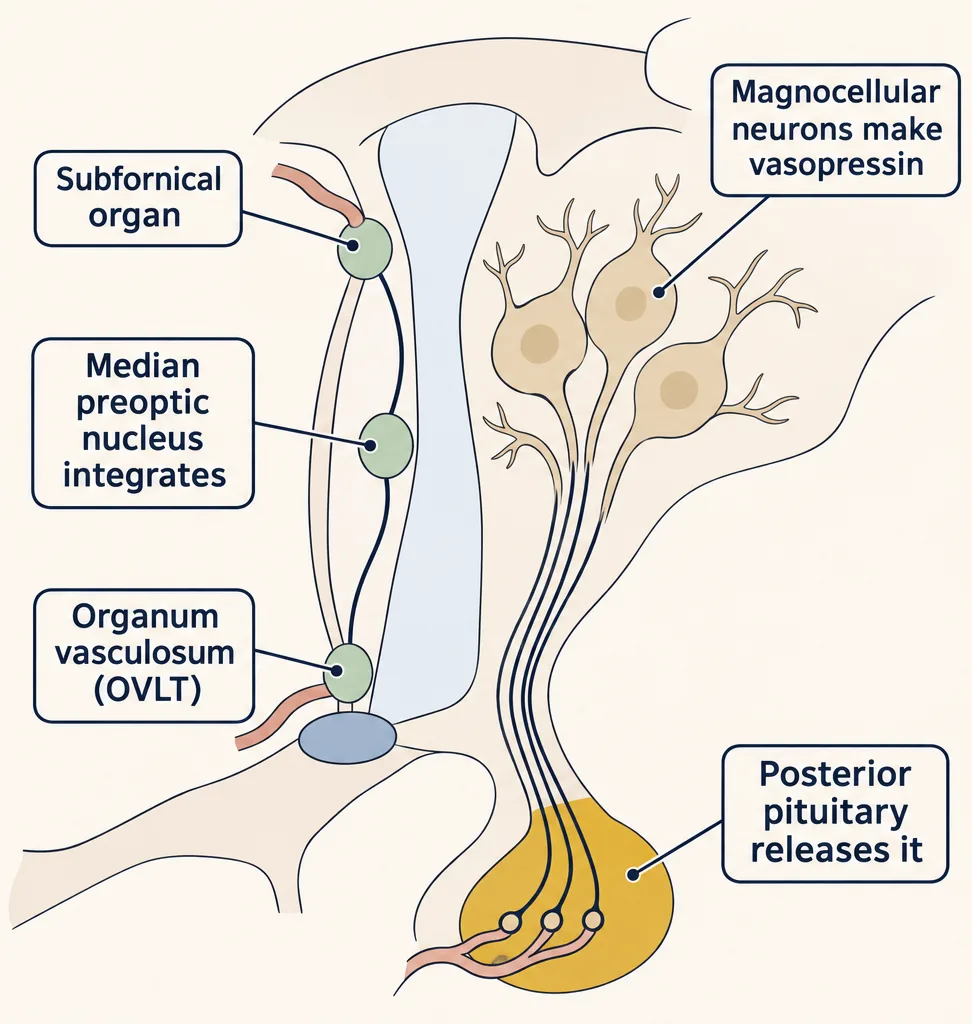
Sensors on the front wall of the third ventricle read plasma osmolality, and magnocellular neurons make vasopressin and send it down their axons to the posterior pituitary, which releases it. AI-generated illustration -
Threshold and gain
-
Two ways out: blood and wires
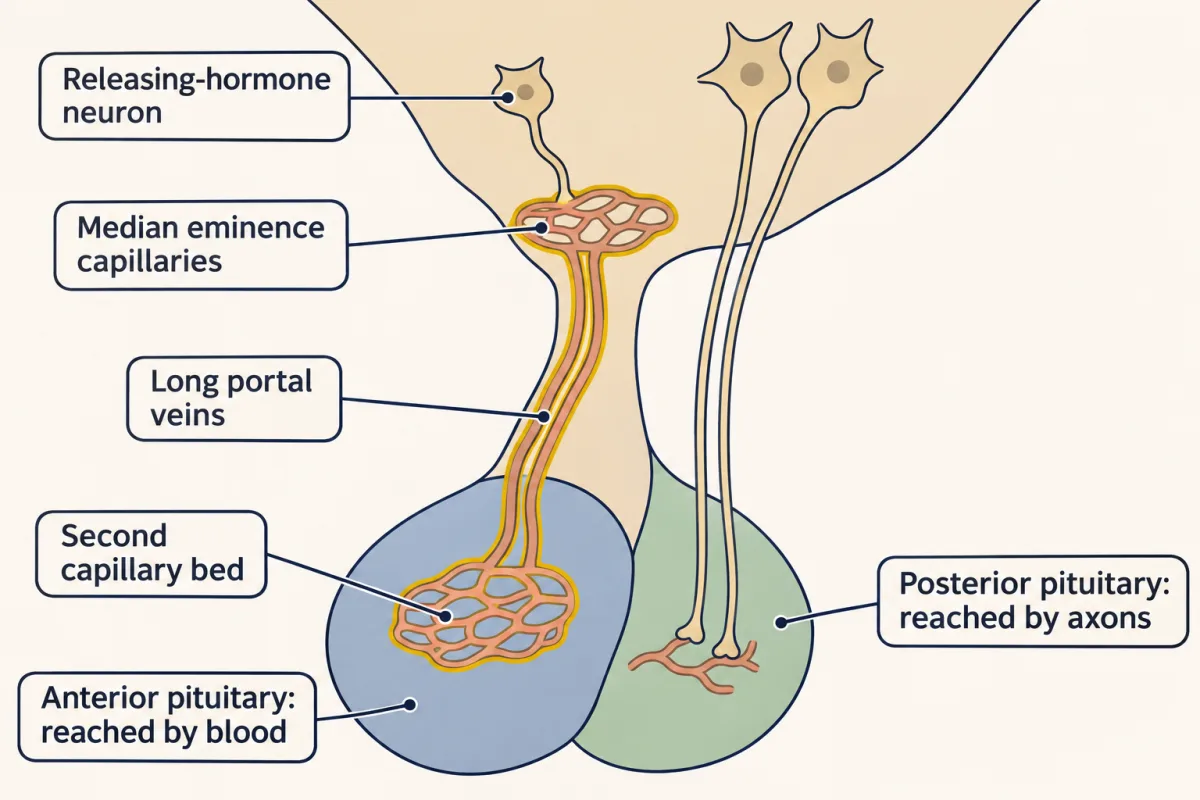
The posterior pituitary is reached by axons, the anterior by blood: releasing hormones enter capillaries at the median eminence and travel down portal veins to a second capillary bed in the gland. AI-generated illustration 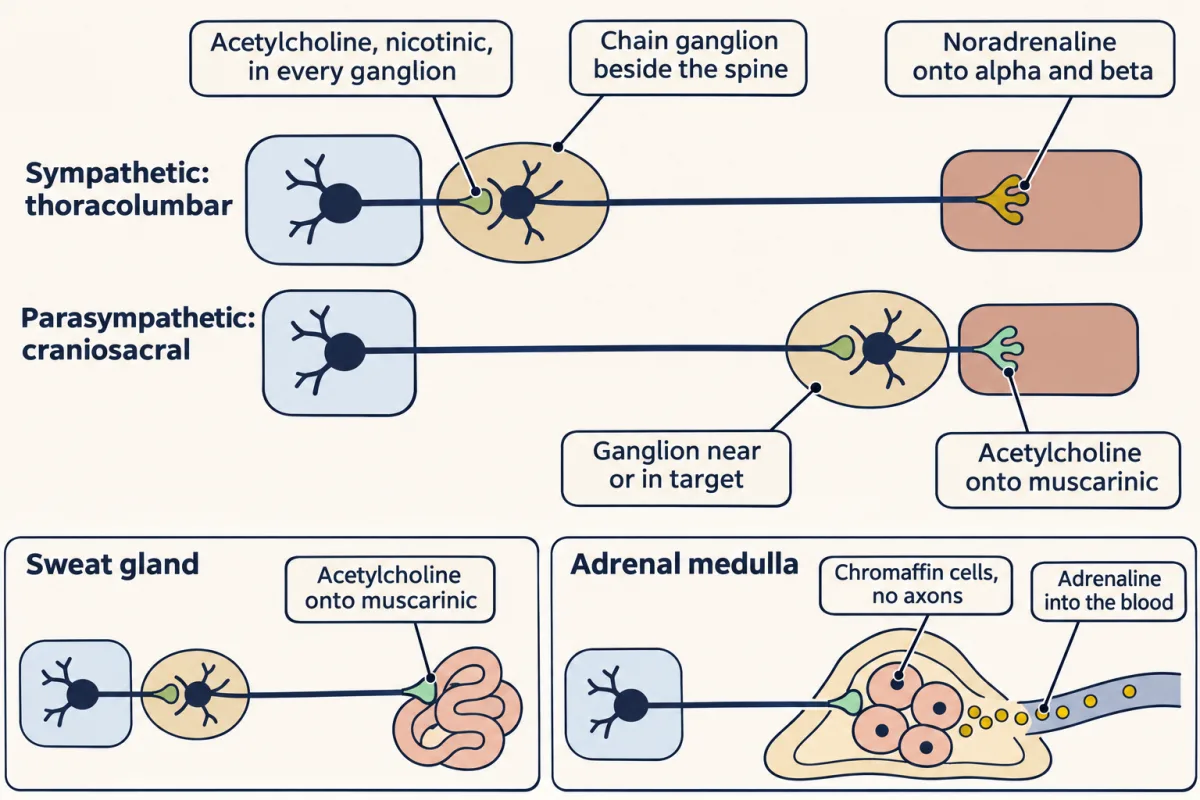
Every autonomic ganglion uses acetylcholine on nicotinic receptors, and the target synapse usually names the division, noradrenaline for sympathetic and acetylcholine on muscarinic receptors for parasympathetic; sweat glands and the adrenal medulla are the exceptions. AI-generated illustration -
Thirst: acting before the blood changes
-
Going deeper
Where this lesson fits
Before thisReview first
- Synaptic Transmission and Quantal ReleaseThis course · Lesson 5
You need how a synapse releases transmitter onto receptors to follow the two-synapse autonomic chain.
- Transmitter Systems and DrugsThis course · Lesson 6
Naming acetylcholine and noradrenaline at each autonomic synapse uses their nicotinic, muscarinic and adrenergic receptors from there.
After thisStudy next
- Circadian Rhythms and SleepThis course · Lesson 21
Daily timing is another prediction made before the body changes, building on acting ahead of the error.
- Emotion and StressThis course · Lesson 20
It uses the PVN's CRH output and the HPA axis with cortisol feedback introduced here.
Elsewhere on the siteFilms, simulations and method films in other courses
- Step through a feedback loopSimulation · Biology
It steps through a feedback loop with a regulated variable, sensor and effector, as used for water balance here.
- Read the Pair, Not One NumberFilm · Physiology
It shows how to read hypothalamic-pituitary-adrenal axis hormones in pairs, extending the CRH, ACTH and cortisol feedback chain.
- Sweat Cools Only When It EvaporatesFilm · Physiology
Cholinergic sympathetic sweat-gland fibres drive the cooling response discussed as an autonomic exception.
Suggested by an AI model from the lessons themselves, then checked. How we use AI