Ecology and Evolution · Skim version
Human Evolutionary History: An African Origin and Archaic Ancestry
Read the full lesson → Skim the whole course →
The guiding idea
If our species began in Africa, why do living people whose ancestors lived outside Africa carry a little Neanderthal DNA, and how can a genome tell when it got there?
To read the human past, ask what each piece of evidence dates: fossil layers place Homo sapiens in Africa among connected populations, not at one birthplace on one date, and the length of archaic DNA segments dates when some descendants interbred with Neanderthals and Denisovans.
From the film: What Was Dated?
- Homo sapiens arose in Africa from connected populations that split and sometimes merged, not at one birthplace on one date.
- A fossil's date usually belongs to something beside or above it, so ask what was dated and where it lay.
- An ash layer above a fossil gives a minimum age: Omo I is at least about 233,000 years old.
- People with partly modern anatomy lived in north Africa around 300,000 years ago.
- A fossil outside Africa, like Misliya's, shows presence there, not that living people descend from that group.
From the film: A Clock Made of Cuts
- Sampled Eurasian genomes share more Neanderthal variants than sampled sub-Saharan African genomes do: a clue to mixing, not proof.
- The surplus gives no date, and old population structure could produce some of it.
- Recombination breaks inherited Neanderthal DNA into shorter pieces, so long pieces mean recent mixing: segment length is the clock.
- Ust'-Ishim, who lived about 45,000 years ago, carried longer Neanderthal segments than people today: the mixing came 7,000-13,000 years before he lived.
- At Bacho Kiro, three early Homo sapiens each had a separate, recent Neanderthal ancestor only a few generations back.
-
An African origin, without one birthplace or birthday
-
What the first film’s dates leave out
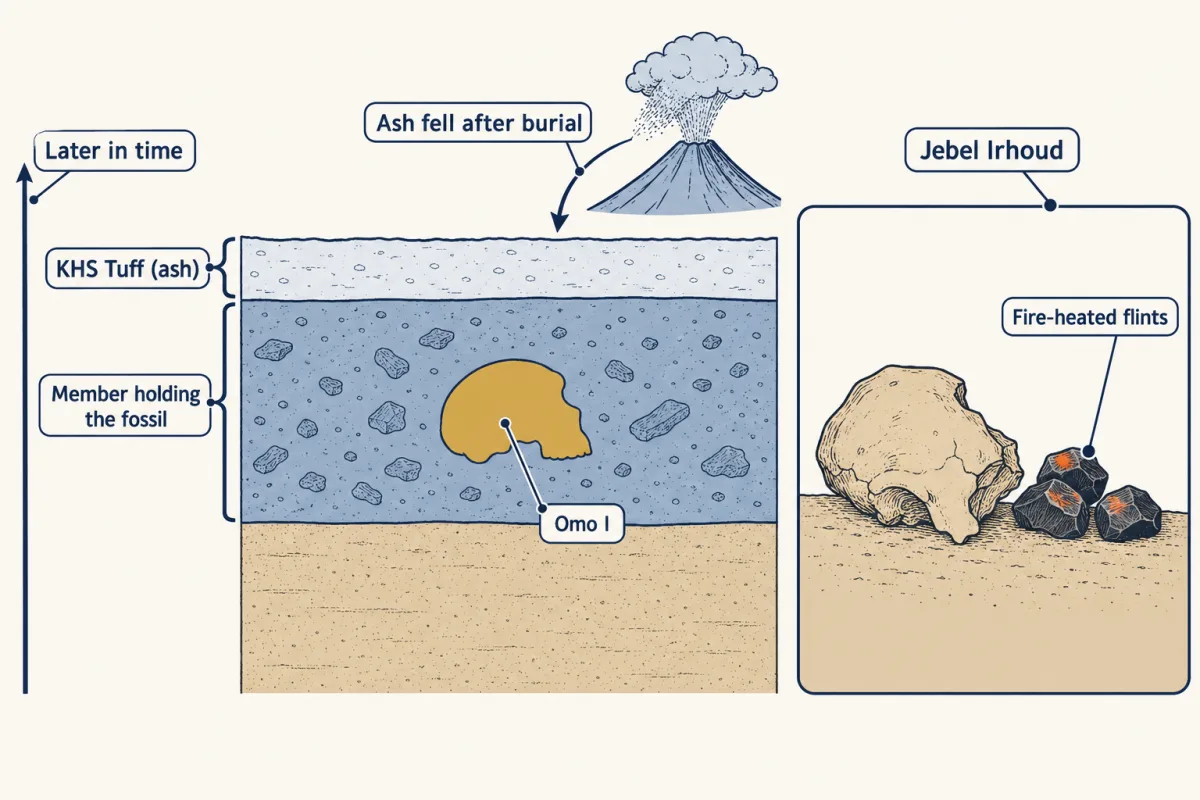
An ash above a fossil fell after burial, so its date is a minimum for the bone; at Jebel Irhoud the dated flints lay beside the remains. AI-generated illustration -
Counting the clue: the D statistic
-
Segment length as a clock
-
Denisovans, and a child of two groups
-
What the inherited DNA did: adaptive introgression
-
One species: why genetic clustering does not make races
-
What remains open
-
Going deeper
Where this lesson fits
Before thisReview first
- Reading Phylogenetic TreesThis course · Lesson 2
You need to read a tree with an outgroup to follow the four-genome ABBA and BABA comparison here.
- Drift, Gene Flow and Competing ExplanationsThis course · Lesson 4
You need to weigh gene flow against other explanations to see why a positive D is only a clue.
- Molecular EvolutionThis course · Lesson 5
You need shared derived variants and lineage sorting from there to understand ABBA and BABA sites.
After thisStudy next
- Demography and SurvivorshipThis course · Lesson 13
Reading ancestry from data on who lived and had offspring leads into tracking cohort survival and reproduction by age.
Elsewhere on the siteFilms, simulations and method films in other courses
- Meiosis shufflerSimulation · Biology
Seeing how recombination shuffles chromosomes shows why inherited segments get shorter each generation, making length a clock.
- Rock layers and DNASimulation · Biology
Rock layers and dating show how a fossil's age depends on what was dated and where it lay.
Suggested by an AI model from the lessons themselves, then checked. How we use AI