Cell Signaling · Skim version
How Signaling Evolved
Read the full lesson → Skim the whole course →
The guiding idea
A human has 58 receptor tyrosine kinases and baker's yeast has none. Where did they come from?
Animals share a short list of signalling pathways, and the tyrosine-kinase machinery that one of them uses is older than animals.
-
The idea: a few old pathways, copied many times
-
The simplest relay: two proteins and one phosphate
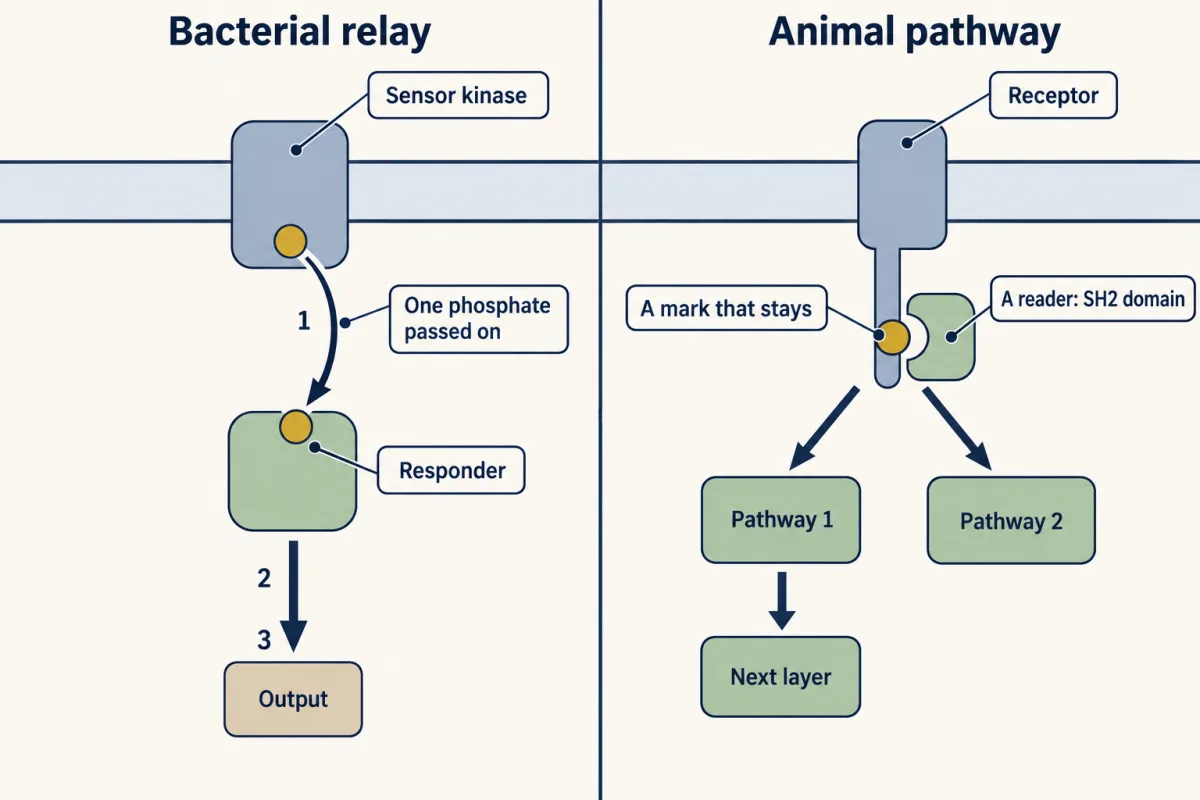
A bacterial relay passes one short-lived phosphate from sensor to responder. An animal pathway adds a mark that stays, a reader for it, and branches. AI-generated illustration -
Copy, then change: three fates for a spare gene
-
”The virtue of modularity”: new wiring from old parts
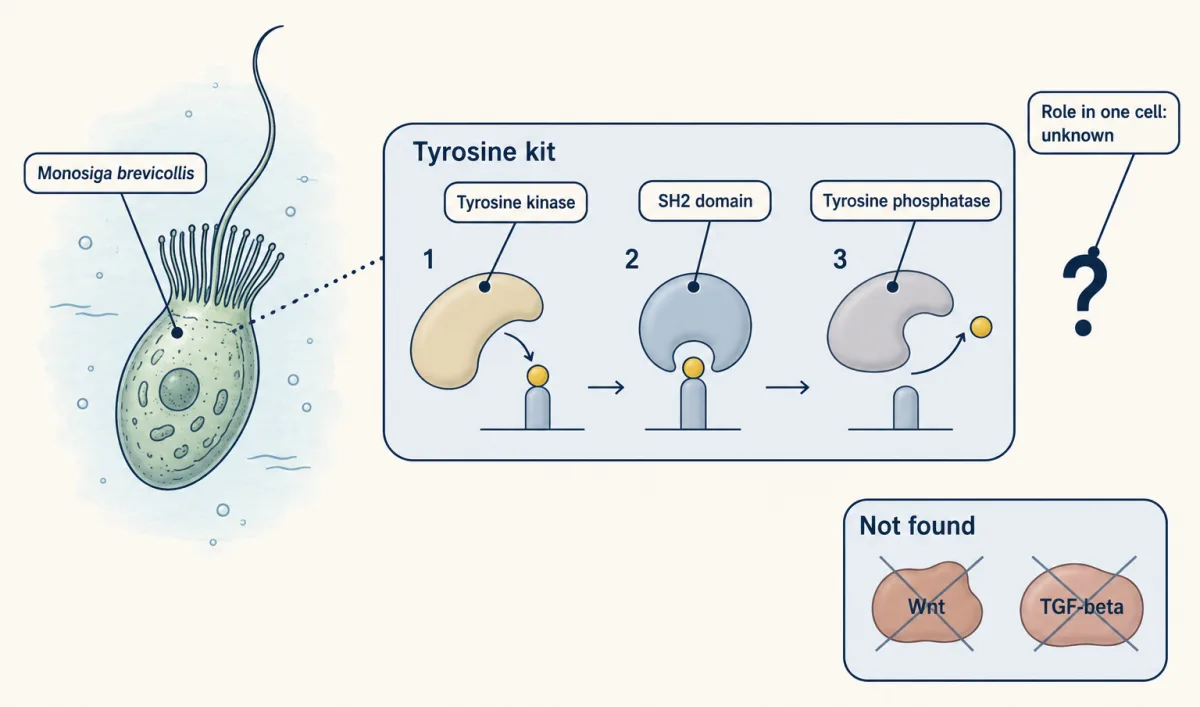
Monosiga brevicollis, a single-celled relative of animals, carries a kinase to write the tyrosine mark, an SH2 domain to read it and a phosphatase to erase it. What the kit does in one cell is still largely unknown. AI-generated illustration -
Why a network and not a set of wires
-
Going deeper
Where this lesson fits
Before thisReview first
- Phosphorylation: Kinases and PhosphatasesThis course · Lesson 6
Phosphate marks on serine, threonine and tyrosine, and the phosphatases that remove them, are compared with the bacterial histidine-aspartate relay here.
- Protein Modules: SH2, SH3, PTB, PDZ and PHThis course · Lesson 9
Moving SH2 domains and docking sites to make new wiring only makes sense once you know how these modules read phosphotyrosine.
- Receptor Tyrosine KinasesThis course · Lesson 18
The expansion from one receptor tyrosine kinase to 58 assumes you already know how these receptors work.
After thisStudy next
- Drugs Against a PartThis course · Lesson 42
Related kinases keep a similar ATP pocket, so a drug shaped for one often hits its relatives.
- Oncogenes: When the Switch SticksThis course · Lesson 41
Shared hubs like Ras and bypass through a second receptor explain how a stuck switch or an escape route drives cancer.
Elsewhere on the siteFilms, simulations and method films in other courses
- Calibrating a molecular clockSimulation · Ecology and Evolution
Gene copies diverge as substitutions build up over time, the same process that changed duplicated receptors.
- Same Protein, Different SwitchFilm · Ecology and Evolution
New wiring comes from changing where and when a gene is switched on, shown here with enhancer changes.
Suggested by an AI model from the lessons themselves, then checked. How we use AI