Organismal Biology · Skim version
Gas Exchange and Breathing
Read the full lesson → Skim the whole course →
The guiding idea
Water holds far less oxygen than air, yet a trout's gill can send its blood out at a higher oxygen partial pressure than the water leaving it. Your lung cannot do that with air. Why not?
Oxygen and carbon dioxide cross every exchange surface by diffusion alone, so blood that takes up oxygen all along the surface can leave with no higher oxygen partial pressure than the water or air it last touched.
From the film: The Last Gas the Blood Touches
- Oxygen and carbon dioxide cross every exchange surface by diffusion, a net flow from higher partial pressure to lower.
- Partial pressure is not amount: water at the same PO2 as air holds far less oxygen per litre.
- Fick's law: more area, a thinner barrier and a steeper partial-pressure difference all speed transfer.
- While the water or air stays richer, blood can at best reach the PO2 it last touched; the surface and the flows set how close it gets.
- In a teleost gill the leaving blood last touches incoming water; in a mammal lung it can at best match the alveolar gas.
From the film: Keeping the Gas Fresh
- Breathing renews the air or water at the exchange surface and blood flow renews the blood; together they keep the partial-pressure difference up.
- In a mammal, the first air of each breath into the alveoli is stale air from the dead space, the airways where no exchange happens.
- At steady state, breathing ordinary air with carbon dioxide production unchanged, alveolar ventilation, not total air moved, sets alveolar PCO2.
- In resting mammals, carbon dioxide, sensed largely through brain pH, sets most of the drive to breathe.
-
Fick’s law: how fast gas crosses
-
Water or air: skin, gills and tracheae
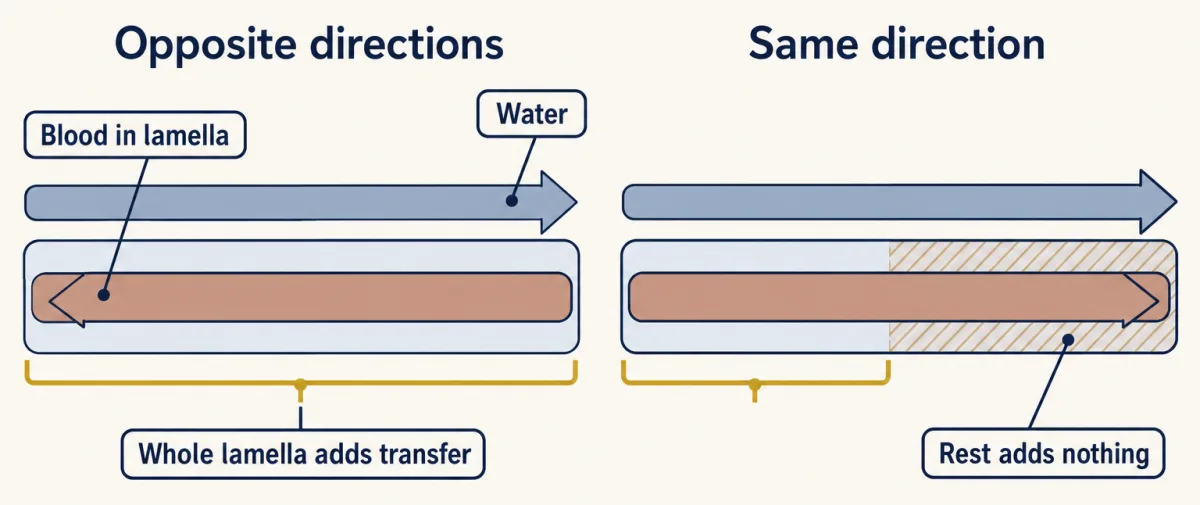
In a teleost lamella blood runs opposite to the water, so a PO2 difference holds along the whole lamella. If the streams ran the same way, their PO2 values would come close to equal partway along, and the rest of the lamella would add little. AI-generated illustration -
Three lungs: mammal, bird, alligator
-
Moving the gas: aspiration and the frog’s pump
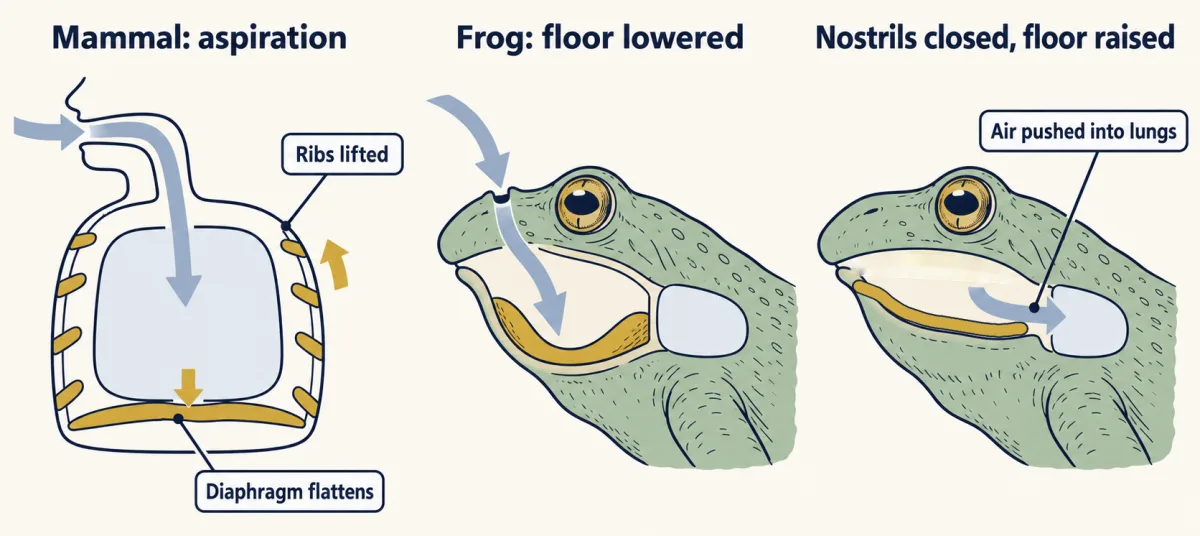
A mammal enlarges its chest and air flows in as pressure falls; a frog lowers its mouth floor with the nostrils open, then closes them and raises the floor to push air into its lungs. AI-generated illustration -
Carbon dioxide runs the controller
-
Going deeper
Where this lesson fits
Before thisReview first
- Size, Scale and SurfaceThis course · Lesson 2
Fick's law and surface area against volume from there are used here without being re-taught.
- What an Organism Has to DoThis course · Lesson 1
It sets up the trade-off of taking in gas across a surface while losing water, which this lesson builds on.
- Tissues, Organs and HomeostasisThis course · Lesson 6
Breathing here is a controlled loop with sensors and set points, as built up there.
After thisStudy next
- Carrying Oxygen and Carbon DioxideThis course · Lesson 13
It takes the blood leaving the exchange surface and shows how haemoglobin carries oxygen and carbon dioxide.
- Osmoregulation and Nitrogenous WasteThis course · Lesson 15
Gills are also the fish's salt and water surface, so the same large thin surface now faces a water-balance problem.
- Moving Water and Sugar in PlantsThis course · Lesson 23
It treats plant gas exchange through stomata and the water lost alongside it.
Elsewhere on the siteFilms, simulations and method films in other courses
- A cell’s energy budgetSimulation · Biology
It shows why cells need a steady oxygen supply and produce carbon dioxide.
Suggested by an AI model from the lessons themselves, then checked. How we use AI